
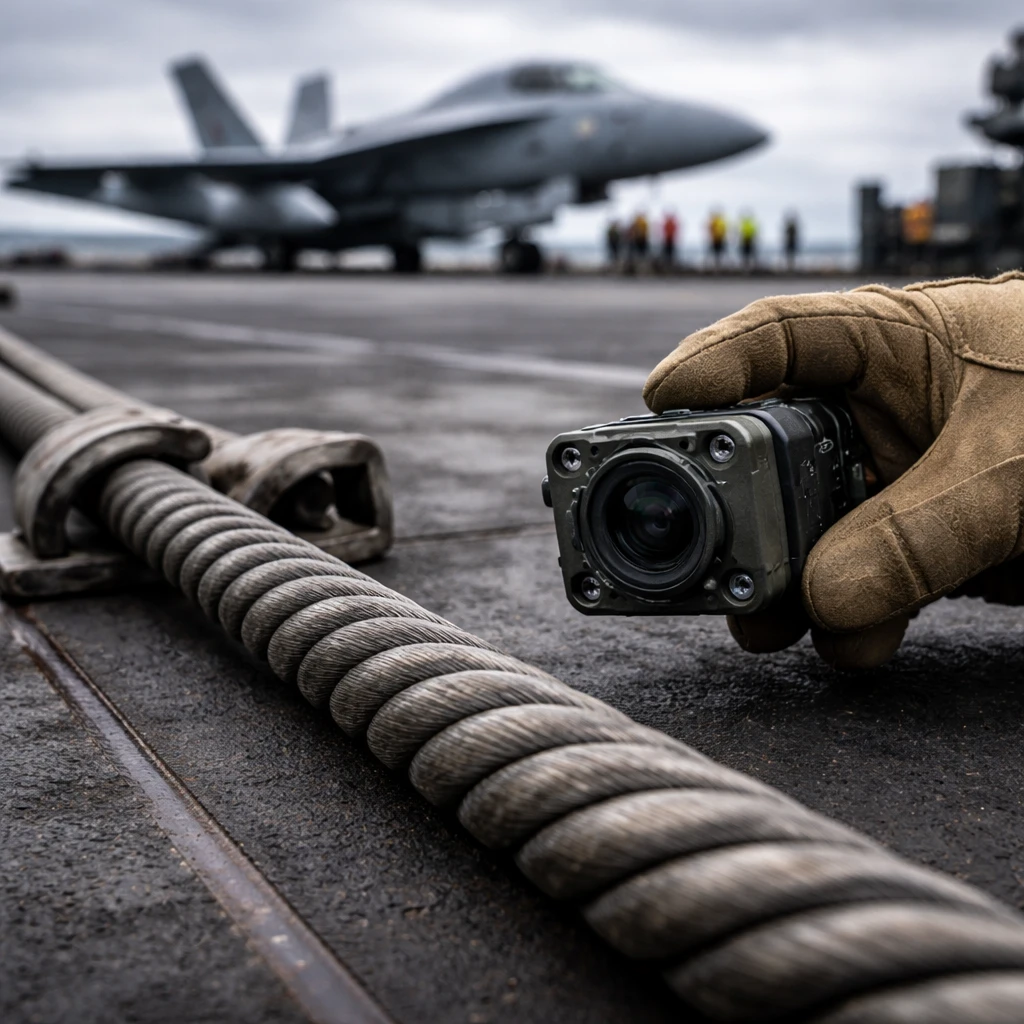
Odysight.ai (NASDAQ:ODYS) shares jumped 100% on Monday following the company's announcement of a Cooperative Research and Development Agreement (CRADA) with the Naval Air Warfare Center Aircraft Division Lakehurst, a component of the U.S. Navy. The deal establishes a formal collaboration to advance visual sensing and AI/ML technologies aimed at predictive and conditions-based maintenance across the Navy's fleet.
The CRADA pairs Odysight.ai's computer vision and machine learning capabilities with NAWCAD's operational expertise and test infrastructure. The agreement sets an initial mission focus on carrier arresting cables - a high-stakes component of carrier operations - with the stated intent of supporting the operational availability of naval platforms.
Officials said the collaboration is designed to increase fleet availability, lower the incidence of unscheduled maintenance events, and improve maintenance planning for mission-critical systems. Odysight.ai's platform is built around miniature ruggedized visual sensors that can be installed in hard-to-access locations, enabling continuous internal visual monitoring. Onboard edge-based AI/ML analytics then process imagery in real time to detect anomalies and identify early-stage degradation before failure occurs.
"This agreement marks an important step in advancing AI-driven visual sensing in mission-critical defense environments," said Yehu Ofer, Odysight.ai CEO. "Our collaboration with NAWCAD validates our platform and supports a transition toward condition-based monitoring across U.S. Navy systems. This is the first step, laying the foundation for expansion into fixed and rotary wing aircraft, ground vehicles, and more."
The company described the partnership as a pathway to refine its capabilities within mission-relevant conditions while demonstrating scalability across broader defense sectors. The technology is expected to enable more effective allocation of human capital across the U.S. Navy's fleet by shifting some maintenance functions toward condition-based approaches supported by continuous sensor data and automated analytics.
Context for operators and markets
For naval maintenance managers and systems engineers, the initiative targets early detection of component degradation in locations that are difficult to inspect visually. For markets and defense contractors, the collaboration provides a testbed to evaluate the scalability and operational fit of edge AI-enabled visual sensing in a mission-critical environment.