
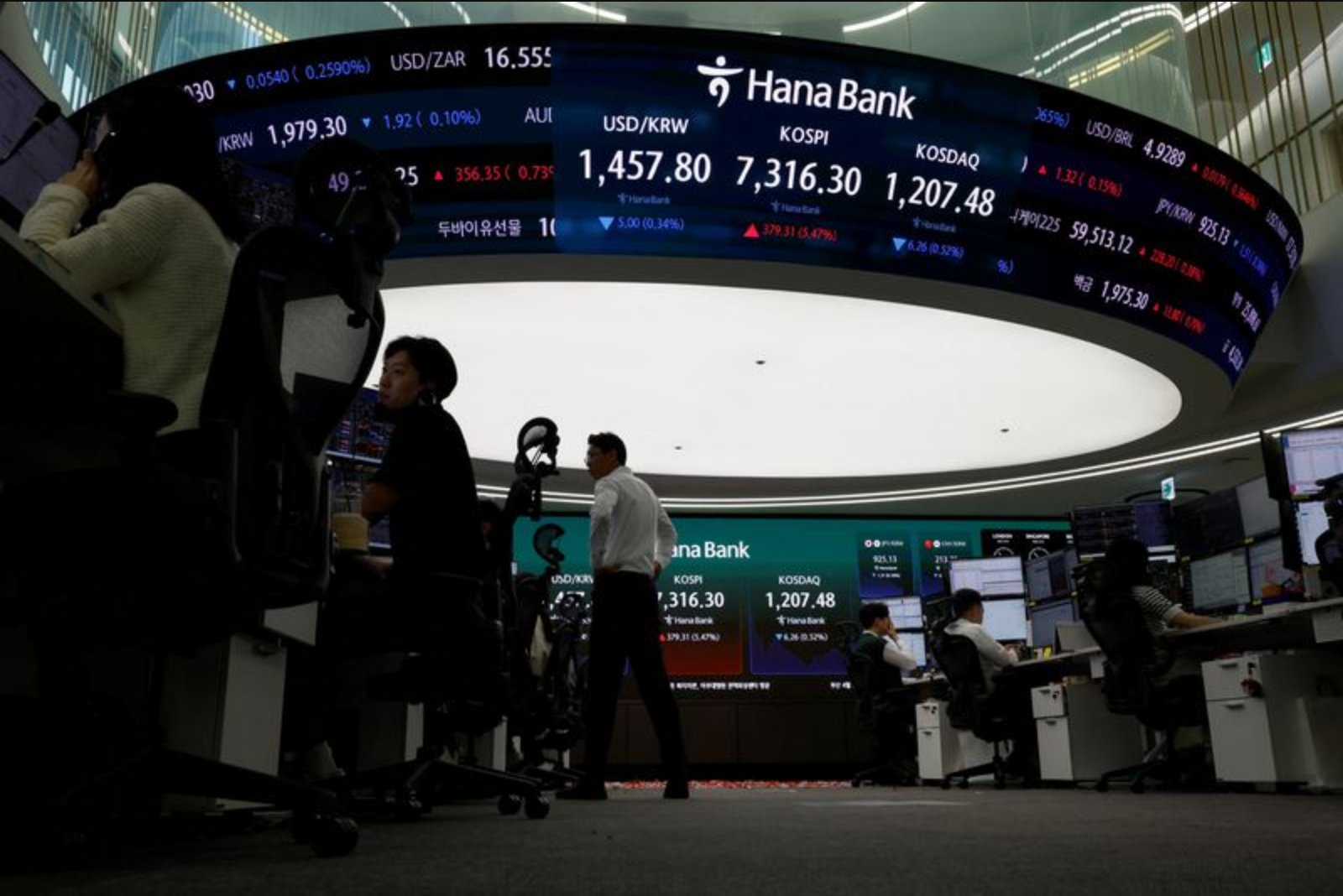
Global hedge funds markedly increased their equity purchases in Asia last week, pushing weekly buying of South Korean, Japanese and Taiwanese stocks to the strongest level seen in the past decade, according to a Morgan Stanley prime brokerage team note distributed to clients on Friday.
The bank said most of this buying activity occurred outside the United States, with the Asia-Pacific region accounting for the majority of trading. The surge in demand was broad-based - Morgan Stanley said flows into the three markets came from clients across all regions and across all strategies - and it described the week that ended on May 7 as the heaviest week of buying in more than 10 years in notional terms. The note did not provide specific figures; the bank defined notional buying as gross buying volumes.
Investment interest was clustered in semiconductors and hardware, the note added. Market participants have been reallocating to Asian technology firms that are positioned to benefit from artificial intelligence-related demand, and the three markets highlighted by Morgan Stanley have emerged as focal points for semiconductor and hardware investment.
Asia’s three most valuable companies are chipmakers - Taiwan Semiconductor Manufacturing Co, Samsung Electronics and SK Hynix - and their recent record earnings have underscored their roles in the global AI supply chain, the note said. Hussein Sacoor, a partner at Tekne Capital in New York, is quoted in the note as saying the international tech cycle is still nascent and that Asia remains underowned, undervalued and increasingly central. He added that, in terms of cost and bill of materials, roughly 90% of the tech supply chain sits in Asia, while most capital remains concentrated in U.S. markets.
Major benchmarks in South Korea, Taiwan and Japan hit fresh highs last week as hedge funds increased exposure, the Morgan Stanley note reported. The firm also said that hedge funds' net exposure to Japan, South Korea and Taiwan rose to the highest level since its prime brokerage team began tracking the metric in 2010, reaching roughly 19% of global positioning.
Separately, the note referenced a different industry observation: Goldman Sachs reported that April registered the largest monthly hedge fund buying inflows into Asian equities in a decade, following a sharp selloff in March. That pattern - a pronounced pullback followed by strong inflows - was noted as part of the recent trading backdrop.
This episode highlights concentrated demand for technology-related names in APAC and a notable shift in hedge fund allocations toward markets with heavy semiconductor and hardware exposure. The information provided in the Morgan Stanley note was specific about the direction and scope of flows but limited on granular numeric detail.
Context and market focus
The buying described by Morgan Stanley was concentrated outside U.S. equity markets and predominantly in Asia-Pacific. Sectors most directly affected are semiconductors and hardware, given the stated focus of recent orders and the prominence of major chipmaking firms in the region.