
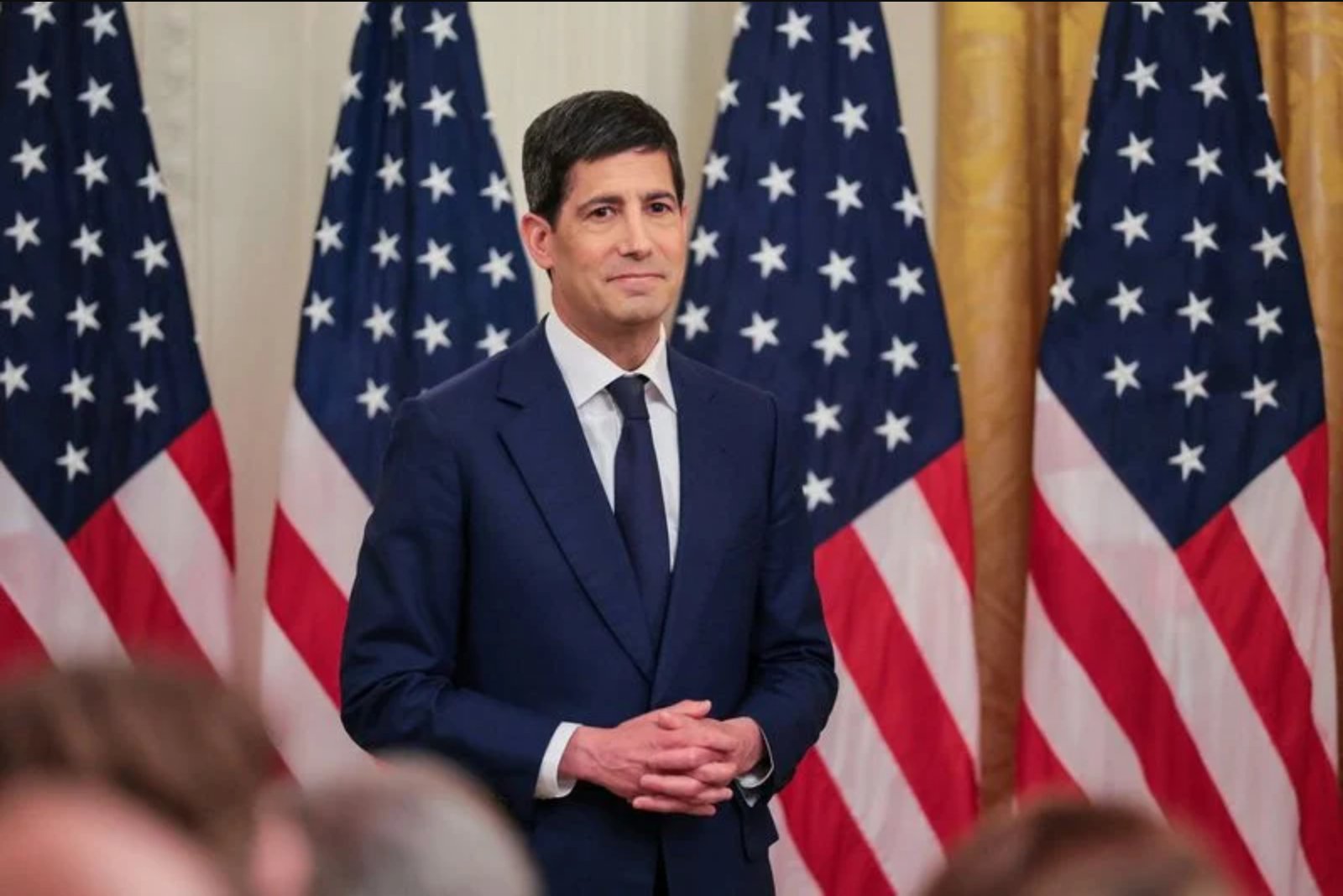
Kevin Warsh will preside over his first Federal Reserve meeting on June 16-17 and hold a press conference the next day, marking the start of an agenda he has said will introduce broad changes to how the U.S. central bank operates. With the market broadly expecting no change to the policy rate at this gathering, attention will focus on the committee's policy statement, the updated projections from policymakers, and Warsh's comments at the Wednesday 2:30 p.m. EDT (1830 GMT) media session.
Many of the contours of Warsh's approach are evident from speeches and writings he produced prior to rejoining the Fed roughly 15 years after his earlier stint on the Board of Governors. While he will not be able to enact every change immediately, several areas are likely to reveal his preferences early in his tenure.
Policy statement - a streamlined approach
Warsh favors a restrained, less-prescriptive policy statement at the end of each meeting. He has argued that excessive "forward guidance" can constrain the central bank's flexibility if economic conditions shift. While he acknowledges a role for explicit guidance in extraordinary circumstances - for example, to reassure markets in a crisis or to amplify policy actions - he believes that in normal times the Fed should avoid detailed hints about future rate moves.
Under his predecessor, Jerome Powell, the statements had already been pared back compared with earlier practice. Nevertheless, the last released language still included a reference to "additional adjustments" to interest rates - industry shorthand for the possibility of future cuts. Removing language like that could achieve two aims: it would trim the level of guidance in line with Warsh's preference and would also leave room for the committee to tighten policy further this year if data warrant.
Public communications - less may be more
Communications are another area where Warsh has been openly critical. He feels the Fed currently speaks too frequently and sometimes strays into topics that complicate public understanding. The institution's present practice includes a post-meeting press conference for the chair after every FOMC meeting, a quarterly Summary of Economic Projections (SEP), and frequent speeches and media appearances by other governors and reserve bank presidents. Warsh sees this as contributing to confusion rather than clarity.
Substantive reform of how the Fed communicates could be difficult to achieve. The committee considered changes to the SEP last year, including options to make it more detailed, but did not reach agreement. Curtailing how often colleagues appear in public or speak to the media would require a cultural shift at an institution that has trended toward greater transparency and that many view as operating more effectively with frequent public engagement.
Nonetheless, Warsh can alter his own conduct as chair. The upcoming Wednesday press conference - occupying the same 2:30 p.m. EDT slot used by Powell and former chair Janet Yellen - will be an early indication of his stance. He is not obligated to continue the current cadence of media sessions; before Powell these briefings were only quarterly, and earlier chairs managed without them entirely. Warsh's sessions could be shorter or more narrowly focused if he chooses.
Short-term data and longer-term narratives
An immediate policy dilemma confronts Warsh: President Donald Trump's expectation for eventual rate cuts exists in a macro environment in which recent data have pushed some policymakers toward a hawkish stance. Stronger-than-feared job growth has reduced immediate concerns about labor market weakness, and inflation remains materially above the Fed's 2% objective.
Warsh has previously raised several longer-term themes that could, in his view, support lower interest rates over time. Those themes include the prospect that artificial intelligence may reduce production costs and his stated preference for a financially smaller central bank that would, he suggests, ease financial conditions for a given level of inflation. However, basing near-term policy on such forward-looking considerations would approach the kind of guidance Warsh has said he prefers to avoid, and such an approach carries risks if the anticipated structural shifts fail to materialize.
The data available today are not unambiguously supportive of a looser posture. Indeed, some elements of the AI buildout are already pushing prices higher in at least certain sectors and for now. How Warsh navigates these tensions in his initial press conference - reconciling near-term signals that may point toward rate hikes with a broader narrative about structural change - will be watched closely for clues about his likely path.
He has also flagged issues of measurement around inflation, suggesting a review of the statistics the Fed relies on could be warranted. That line of inquiry could influence how the committee interprets incoming data in the future.
Inflation framework and the 2% target
At his Senate confirmation hearing Warsh did not explicitly reaffirm the Fed's 2% inflation target. Instead he criticized what he described as an excessive fixation on narrow numeric precision, implying some tolerance for inflation around the 2% level even if it does not fall exactly on that figure. His comments have prompted concern among some colleagues who warn that any loosening in rhetoric around the target could weaken public confidence in the Fed's commitment and alter inflation expectations in ways that would push prices higher.
Observers will therefore be attentive to what Warsh says about the role of expectations, the priority the committee assigns to price stability versus maximum employment, and whether he signals an ideological distance from his colleagues, whom he has suggested may have been subject to groupthink.
Balance sheet reduction and regulatory levers
Warsh has been an outspoken critic of large-scale asset purchases by the central bank except in circumstances of broad market dysfunction. Reducing the Fed's "footprint" has been a signature theme of his commentary. In practice, some of the groundwork for shrinking the balance sheet could come from regulatory adjustments pursued by Fed Vice Chair for Supervision Michelle Bowman, including measures that would lower banks' needs for overnight reserves - a factor that has helped drive the Fed's $6.73 trillion balance sheet.
Even with regulatory shifts, reducing the balance sheet is unlikely to be quick or straightforward unless the Fed alters the way it implements its policy rate in a fundamental way. There is some willingness within the system to consider change, and general agreement that the central bank might not need to hold mortgage-backed securities and that its Treasury holdings should better reflect the maturity composition of the market. But there is no consensus on the question of overall size, and several policymakers argue the absolute scale of assets is not particularly consequential.
What to watch this week
With the policy rate expected to remain unchanged at the close of the June 16-17 meeting, investors and market participants will be parsing three main items for insight into Warsh's priorities: the exact wording of the policy statement, the updated projections for the economy and interest rates, and the chair's remarks during the Wednesday press conference. Together these elements will provide the first public signals of whether Warsh will move quickly to implement his preferences or whether his agenda will unfold more gradually amid differing views inside the Fed.
How the new chair balances a desire for less-guiding language and reduced public comment against the immediacy of economic readings that many see as justifying tighter policy will shape expectations across fixed income markets, bank funding costs, and broader financial conditions. The answers are likely to emerge incrementally rather than in a single, definitive action.