
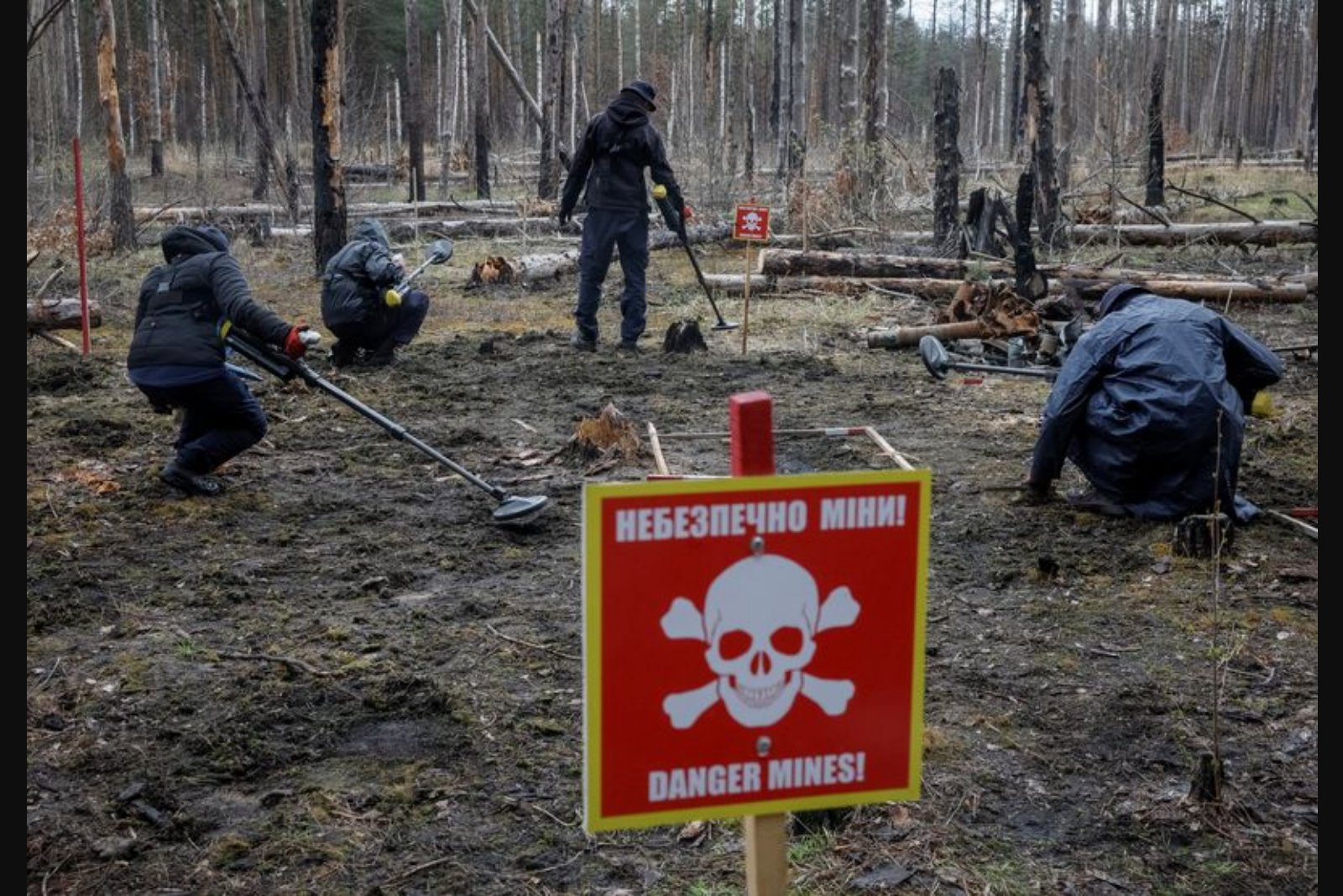
Near Myrotske, a village roughly 40 km northwest of Kyiv, a dozen personnel in protective gear advanced in disciplined rows, sweeping the ground with metal detectors in coordinated passes. Their work focuses on clearing unexploded ordnance scattered through woods and fields after Russian forces occupied the area early in the invasion, a presence that left the landscape littered with dangerous remnants.
Huge tracts of Ukraine remain contaminated by explosive devices following years of fighting. "Unfortunately, Ukraine is the most heavily mined country in the world," said Olena Shustova, media manager for the demining charity HALO Trust. "Ukraine will not be demined in less than 10 years." HALO, the world’s largest international mine action organisation, began operations at this site in December last year after a Ukrainian strike in March 2022 on a Russian military logistics base left the woods scattered with unexploded munitions, underscoring the persistent hazards once front lines move.
State-run Demine Ukraine reports that more than 132,000 square kilometres (50,965 square miles) remain contaminated by mines and other explosive remnants, an area comparable in size to Greece or the U.S. state of Mississippi. To date, nearly 42,000 sq km have been declared safe, the organisation said.
Given the scale of contamination, demining groups are integrating technology to improve speed and safety. HALO has been using high-resolution drone imagery that is analysed with artificial intelligence to spot likely hazards. That process, according to the organisation, has reached approximately 70% accuracy in identifying mines and explosive remnants, a level that the group says helps target human-led and mechanical clearance efforts more effectively.
Unmanned machines and remote operation
At a different site near Ivankiv, northwest of Kyiv, teams are experimenting with remote-operated heavy equipment to reduce risk to personnel. A worker, Oleksandr Liatsevych, sits inside a small portable steel cage with reinforced windows and operates a customised excavator from a distance. He looks into virtual reality glasses and manipulates a joystick to guide the machine a few metres away. The excavator digs and feeds soil into a specialised grinder that breaks up material containing potential ordnance.
The deployment of the remote digger followed a field incident: a Ukrainian serviceman from a nearby unit stepped on an anti-personnel mine while collecting firewood two years ago. That accident prompted intensified clearance work at the site and use of mechanised, remotely controlled equipment to lower human exposure to danger.
Liatsevych, 39, a former civil servant and farmer from Huliaipole who previously lived on the front line between Ukrainian and Russian forces, described the transition to remote operation. "The difference between driving from a cabin and driving a remote joystick is big," he said. "As I didn’t play many computer games as a child, it was difficult for me at first." His role illustrates the combination of manual skills, mechanical systems and new interfaces that are being adopted in the field.
Manual clearance and human risk
Even as robotics and AI play a growing role, manual demining persists in many places. In nearby woods, deminer Olha Kava wears a protective vest and visor while crouching to probe the soil by hand for a possible anti-personnel mine. Kava, a former travel agent and mother-of-three, took up demining after friends joined the armed forces following the full-scale invasion.
She acknowledged the emotional and physical strain of the work. "Of course, there is fear," she said. "It ... motivates you to do your job correctly and responsibly." Her presence underscores that despite technological advances, human operators remain central to identifying and neutralising explosive remnants.
Technology as an accelerant, not a solution
Organisations operating in Ukraine stress that technology is helping to prioritise and scale demining but is unlikely to replace the need for extensive manual and mechanised clearance over time. HALO employs 1,350 nationals in Ukraine and reports that its AI-assisted analysis of drone imagery is already guiding operations, even as the broader effort to make the country safe will extend over many years.
The combination of remote-controlled machinery, drone reconnaissance and AI analysis is presenting a new model for demining in an active post-conflict environment: machines reduce direct exposure to danger, AI helps focus scarce human and mechanical resources, and manual deminers continue to perform intricate, ground-level work in hazardous terrain.
While advances in automation and imaging accelerate the pace of clearance, the scale of contamination and the current limits of detection technologies mean the process will remain prolonged and resource-intensive.