
Chinese emperors once performed sacred rites beneath the blue-tiled roof of the Hall of Prayer for Good Harvests at Beijing’s Temple of Heaven to petition for plentiful crops and to reaffirm their right to govern. This week, Presidents Donald Trump and Xi Jinping will traverse the same grounds in a summit aimed at securing a modern harvest of trade and diplomatic outcomes.
The visit is scheduled as part of a two-day engagement: Trump is set to arrive in Beijing on Wednesday, ahead of talks on Thursday and Friday, and the two leaders are due to tour the Temple of Heaven on Thursday, according to the White House.
For Xi, hosting Trump at a site steeped in imperial symbolism offers a carefully curated stage to communicate China’s longevity and civilisational depth. For Trump, agriculture is expected to dominate his priorities. U.S. farmers are awaiting larger purchases of soybeans, other crops and meat from China, a market that has been crucial to U.S. agricultural exports.
"As a Chinese leader, this is the perfect backdrop to show the depth of Chinese history and how long it is, how sophisticated it is," said Lars Ulrik Thom, a Beijing-based historian and founder of the historical walking tour company Beijing Postcards.
The Temple of Heaven sits roughly 7 km south of the Forbidden City and was constructed in 1420 under the same Ming emperor who commissioned the imperial palace. Today the complex is ringed by ancient pines and cypress and serves both as a tourist attraction and an urban park where residents practice tai chi, play chess or dance.
During China’s dynastic era, emperors made an annual procession from the Forbidden City to the Temple of Heaven. Those processions could involve thousands of attendants and elephant-drawn carriages, culminating in rituals that were meant to secure good harvests and thereby justify imperial rule. The emperor’s legitimacy was partially judged by the success of the crops - poor harvests, famine or disorder could undercut his standing.
The Hall of Prayer for Good Harvests, the temple’s most recognized structure, was rebuilt in the late 1800s with tall redwood that, Thom said, was imported from the United States.
On the policy front, Trump is arriving with constrained objectives. Analysts note that recent court rulings on tariffs have limited the scope of his ambitions, narrowing the practical aims of the visit to a small set of transactions: larger purchases of soybeans, other agricultural goods, meat and a potential order for Boeing jets. Analysts also say Trump seeks China’s assistance on resolving his unpopular Iran war.
Before Trump’s current term, China was the leading market for U.S. farmers, taking about $24 billion of agricultural goods in 2024, according to the figures cited. Beijing has curtailed much of that trade and reduced its reliance on U.S. supplies, employing those adjustments as leverage in response to U.S. tariffs.
Farmers in the United States will be closely tracking whether China follows through on a pledge made last year to buy 25 million metric tons of soybeans each year through 2028. Larger Chinese purchases could provide relief to U.S. farmers who have been under economic strain and are an important constituency for Trump heading into upcoming elections.
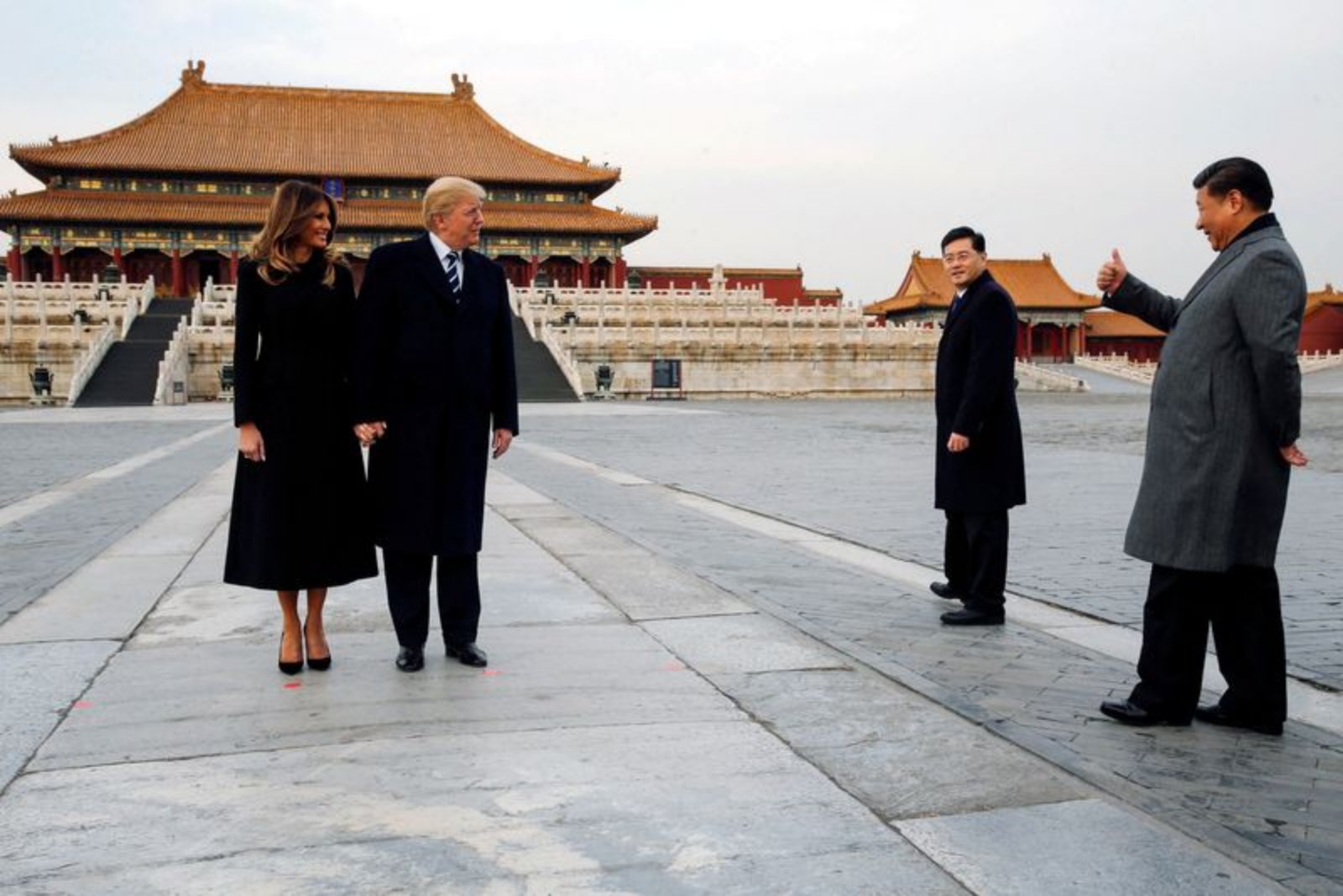
Observers are also watching whether Xi, who enters the meetings projecting greater confidence than his counterpart, will stage a formal, ceremonious reception for a leader known for his affinity for pageantry. Xi has in the past offered elaborate courtesies - in 2017 he and his wife provided Trump and the first lady a rare private tour of the Forbidden City - and analysts will be monitoring whether similarly lavish elements will appear this week.
Whatever the optics, the Temple of Heaven setting provides Xi with a powerful visual narrative about China’s continuity and presence on the world stage, while the economic dimension of the visit zeroes in on a handful of high-priority trade areas - most immediately agriculture, and to a lesser degree aerospace.
Key domestic constituencies - notably U.S. farmers - stand to be directly affected by the outcomes of the talks. The extent to which China increases purchases of soybeans, grains and meat, and whether it advances any aerospace orders, will shape short-term market responses in agricultural commodity markets and in sectors tied to aircraft sales.