
Overview
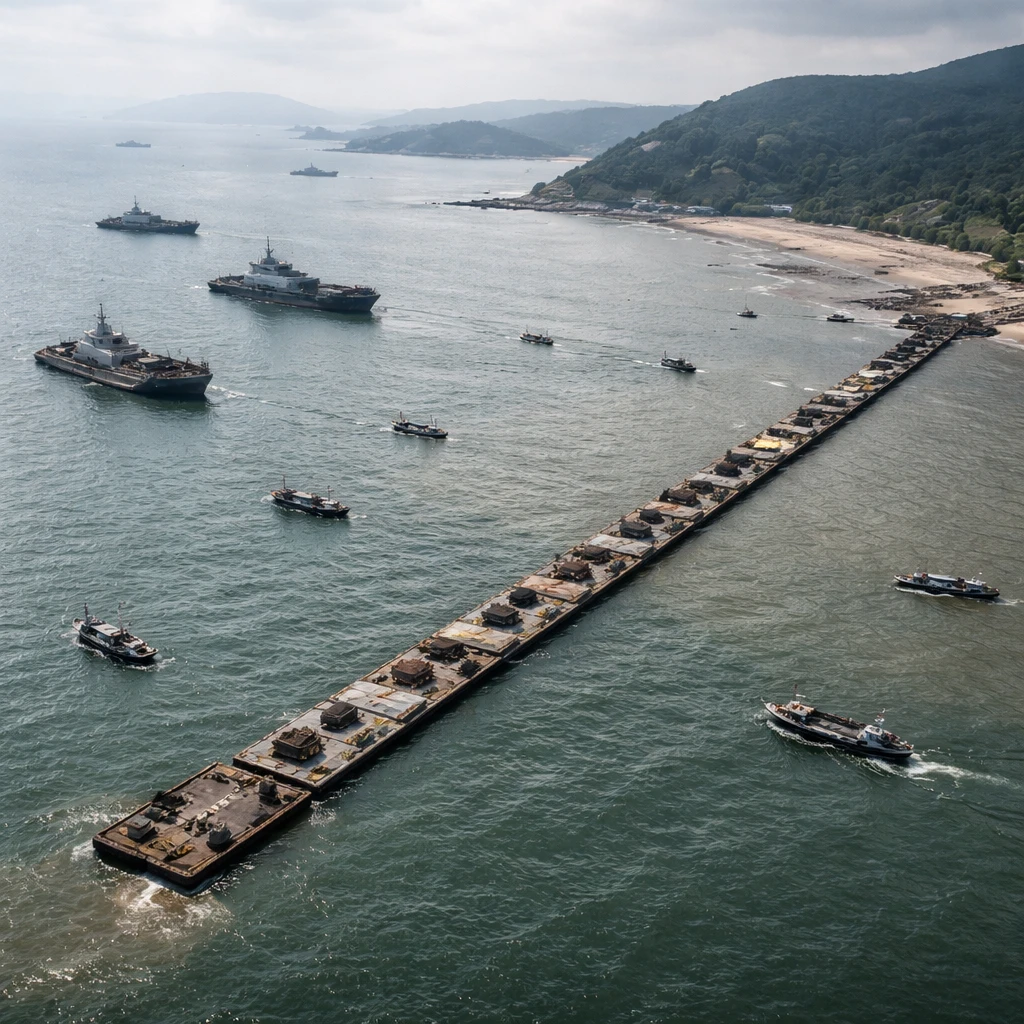
China has been conducting a multi-week amphibious landing exercise in the southeastern coastal waters opposite Taiwan that, according to satellite imagery and geospatial analysis, tested a method of linking civilian vessels into an ad hoc floating bridge to move equipment and materiel ashore. The activity was detected in Dacheng Bay, in Fujian province, and was visible in imagery captured between November 1 and November 16.
What was observed
Analysis of the imagery showed vessels manoeuvring around Dacheng Bay to form and then dismantle a floating bridge roughly 800 m (2,600 ft) long. Commercial and geospatial tracking data recorded movement patterns consistent with repeated assembly and disassembly of such a structure over the period under review.
Eight civilian ships were involved in the activity identified by the geospatial researcher - four barges, two semi-submersible vessels and two powered ships - accompanied by four landing craft and a number of smaller support vessels. Chinese navy vessels were present nearby during portions of the exercise. No purpose-built bridging equipment was visible in the imagery, suggesting an emphasis on using available civilian maritime assets to improvise logistics infrastructure in a contested setting.
Geospatial analyst assessment
Jason Wang, chief operating officer of the geospatial company that reviewed the imagery, said investigators interpreted the activity as rehearsal of logistics methods that carry a low signature while supporting forces possibly involved in a first island chain invasion scenario. He noted: "The People’s Liberation Army appeared to be rehearsing low-signature methods to provide logistical support to forces that could be involved in a first island chain invasion scenario." Wang added: "Using civilian ships to enable bridging of heavy equipment and materiel from deeper waters creates additional locations they can use along the Taiwan coastline."
Confirmation and purpose
A senior security official briefed on the drill confirmed the exercise was still in progress and described it as designed to "practise the swift seizure of small islands." The official characterised the activity as "very targeted" at contingencies along the first island chain - the arc of islands extending from Japan through Taiwan and the Philippines - and said it appeared to form part of this year’s "All-Military Strategic Exercise." The official also noted that this year's drills occurred later than in previous years. The official spoke on condition of anonymity because the matter is sensitive.
The location of the exercises - Dacheng Bay - lies about 280 km (175 miles) from Taiwan’s main island. Officials monitoring the activity said the exercise focused on island-group operations while cautioning against overstating the immediate battlefield value of the methods being tested.
The senior official warned that despite the innovation on display, practical limitations remain: "There is still some distance between innovation and fantasy," the official said, adding that barges would be "live targets" in wartime.
Responses from defence authorities
China’s defence ministry did not respond to a request for comment on the specific drills. When asked about recent People's Liberation Army drills in the region, the ministry said that such training was "entirely legitimate and reasonable" and offered that description on a Thursday in response to broader questions about PLA activity.
Taiwan’s defence ministry acknowledged awareness of Chinese military activity in Dacheng Bay, including the observed use of civilian vessels in exercises. Taiwan’s ministry said it was weighing the implications of the drills for security in the Taiwan Strait and for peace in the region.
Electronic interference and wider pattern
Geospatial analysts also reported jamming activity in the area where the drills were conducted. The jamming was noted in a synthetic aperture radar image that analysts described as blurry, indicating electronic interference coincident with the manoeuvres.
Similar uses of civilian shipping to support simulated landings have been observed previously. Authorities disclosed amphibious landing drills in Dacheng Bay in both 2023 and 2024 that involved roll-on/roll-off freighters; each of those took place in September. Separate observations and imagery gathered last year documented comparable drills off the southern coast of Guangdong in August, which also showed rehearsals employing civilian vessels to augment landing operations.
Operational and regional context
Military attaches stationed across Asia who monitor such exercises say China appears to be continually refining coastal drill techniques. Rival militaries, including Taiwan’s, routinely scrutinise these rehearsals to assess tactics and logistics approaches. Observers note the complexity of mounting amphibious operations across waters as wide as the Taiwan Strait, where maritime, electronic and logistical challenges converge.
While the drills occurred close to Dongshan Island - a location visited by China’s leader in 2024 and associated in historical records with past combat - Taiwanese officials report that China-Taiwan ties were not the central focus of domestic campaigning for Taiwan’s local elections held over the same period. Beijing, however, has repeatedly criticised certain local candidates in Taipei whom it labels "separatist."
Summary assessment
The Dacheng Bay activity demonstrates a focus by China’s military on experimenting with methods to leverage civilian maritime resources to support amphibious operations. Analysts and officials emphasise the targeted nature of the drill along the first island chain, while also underlining limits to the operational effectiveness of improvised bridging in a contested environment - particularly given the vulnerability of such assets to attack and the presence of electronic jamming in the exercise area.
Note: This report draws on satellite imagery, geospatial analysis and briefings from defence sources to describe the observed exercises and related reactions. Details reflect the observations and assessments available during the period stated above.