
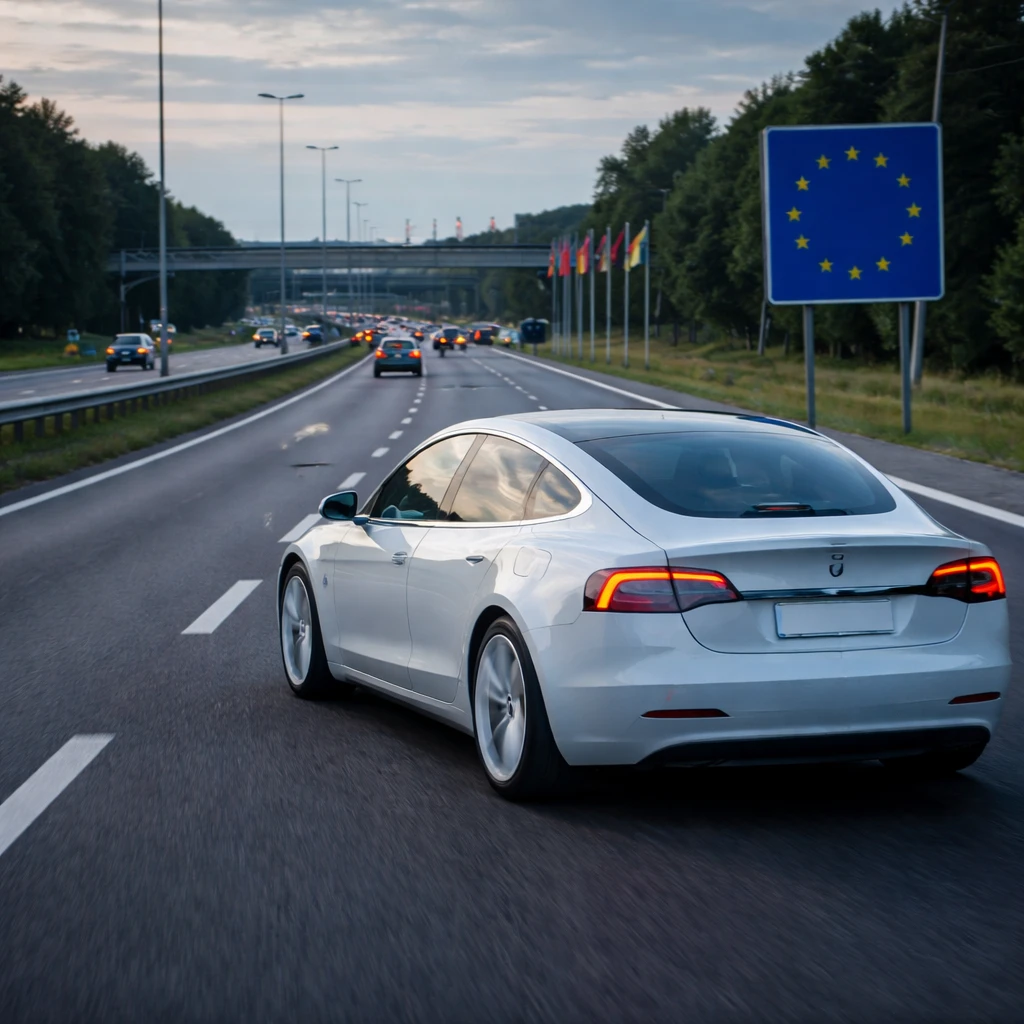
STOCKHOLM, Sept 1 - Tesla said on Tuesday that in the five European countries where its supervised Full Self-Driving (FSD) system has provisional approval, FSD-equipped vehicles were involved in significantly fewer collisions than manually driven Teslas during a four-month sample period.
The company reported that, across the Netherlands, Belgium, Denmark, Estonia and Lithuania, its supervised FSD technology recorded 4.1 times fewer collisions than manually driven Tesla cars. Tesla said the comparison was based on more than 100 million km (62 million miles) of driving data collected between April and August in those five countries.
According to the figures Tesla published, FSD-equipped vehicles were involved in three collisions on highways and nine collisions on non-highway roads, while manually driven Teslas in the same countries accounted for 137 highway collisions and 490 non-highway collisions over the same measured distance.
In conjunction with the statistics, Tesla uploaded an open-source safety dashboard to its website on Tuesday. The company said the dashboard had been shared with regulators in EU member states in April and described the public posting as a means of making one of the key pieces of evidence used to support the Netherlands' provisional approval available to a wider audience ahead of possible bloc-wide consideration.
Provisional approvals for Tesla's supervised FSD system began when the Netherlands granted conditional authorization in April. Following that decision, Belgium, Denmark, Estonia and Lithuania provided similar provisional approvals for the system. Tesla has lobbied EU regulators for broader approval and said a vote at the European Union level could take place as soon as October 6.
If put to a vote, approval at the EU level would require support from at least 15 of the 27 member states representing at least 65% of the bloc's population, Tesla noted in its statement urging regulators to back wider use of FSD. The company has framed EU approval as an important step for expanding sales in Europe.
Earlier reporting indicated that Tesla had presented European regulators with safety statistics that some experts judged to rely on comparisons they considered invalid, and that could give a misleading impression of the system's safety performance. Tesla did not respond to detailed questions about those assessments for that reporting, the company said to the press. The automaker has nevertheless maintained that its data supports the safety case for supervised FSD deployment in Europe.
The approval process has drawn criticism over limited transparency. European regulators, including the Dutch road authority RDW, have declined to publish the safety data that underpinned the Netherlands' provisional approval, stating that those materials are commercially sensitive.
Tesla also pointed to recent registration data showing a mixed sales picture for its vehicles in Europe, underscoring the company's position that regulatory authorization for FSD could affect its competitive dynamics on the continent.
Summary
Tesla released driving data collected between April and August from five European countries with provisional approvals for supervised Full Self-Driving. The company reported that FSD-equipped cars were involved in 4.1 times fewer collisions than manually driven Teslas across more than 100 million km of driving, and published an open-source safety dashboard that it shared with EU member state regulators in April. Tesla is pressing for a potential EU vote on broader approval as soon as October 6, while critics and some regulators raise concerns about access to underlying safety data.
Key points
- Tesla says supervised FSD cars had 4.1 times fewer collisions than manually driven Teslas in five EU countries based on 100+ million km of driving data collected April-August.
- Provisional approvals were granted by the Netherlands, followed by Belgium, Denmark, Estonia and Lithuania; a possible EU-wide vote could occur on or after October 6 and would need backing from 15 member states representing at least 65% of the EU population.
- The approval process and limited publication of safety data have prompted criticism and questions about transparency from regulators and observers; Tesla has published an open-source dashboard to share the evidence it used in support of approvals.
Risks and uncertainties
- Regulatory risk - The EU-level approval is not guaranteed and requires specified member state support thresholds; failure to secure that support would limit broader deployment of FSD in Europe.
- Transparency and scrutiny - Limited public access to the underlying safety data and criticism of earlier comparisons present reputational and regulatory uncertainty for Tesla and could slow adoption.
- Market impact - Mixed registration data in Europe suggests uncertain near-term sales implications for Tesla if FSD approval is delayed or restricted.