
Stock Markets April 30, 2026 04:54 PM

Dexcom Holds Annual Revenue Target After Quarterly Beat, Notes Continued CGM Demand

Company posts stronger-than-expected quarter and highlights product rollouts as market for finger-prick-free glucose monitoring expands

By Hana Yamamoto
Share
Twitter Reddit Facebook LinkedIn
DXCM

Dexcom reaffirmed its full-year revenue guidance after reporting quarterly results that exceeded analyst expectations. The medical device maker saw revenue rise year-over-year and posted adjusted earnings above estimates, while management pointed to robust demand for continuous glucose monitors and recent product and platform developments.

Dexcom Holds Annual Revenue Target After Quarterly Beat, Notes Continued CGM Demand
DXCM
Summarize with
ChatGPT Perplexity Claude Grok Gemini

Key Points

  • Dexcom reaffirmed annual revenue guidance of $5.16 billion to $5.25 billion; analysts expect $5.23 billion per LSEG.
  • Quarterly revenue was $1.19 billion, up 15% year-over-year and slightly above the $1.18 billion consensus; adjusted EPS was $0.56 versus $0.47 estimated.
  • Product momentum included expanded U.S. availability of the Dexcom G7 15 Day sensor, new meal-logging features on the Stelo platform, and clinical data showing benefits for people with type 2 diabetes not on insulin - impacts healthcare, medtech and consumer health sectors.

Dexcom on Thursday reiterated its full-year revenue guidance after reporting quarterly results that topped Wall Street expectations, citing healthy demand for its continuous glucose monitors (CGMs).

The company said it remains confident in its forecast for annual revenue in the range of $5.16 billion to $5.25 billion. Analysts, based on data compiled by LSEG, expect the company to generate $5.23 billion for the year.

For the quarter, Dexcom recorded revenue of $1.19 billion, a 15% increase from the same period a year earlier, and slightly above the analysts' consensus of $1.18 billion. On an adjusted basis, the company reported earnings of $0.56 per share, outperforming expectations of $0.47 per share.

Despite the beat, Dexcom's shares fell 4.3% in after-hours trading.


Product and platform progress

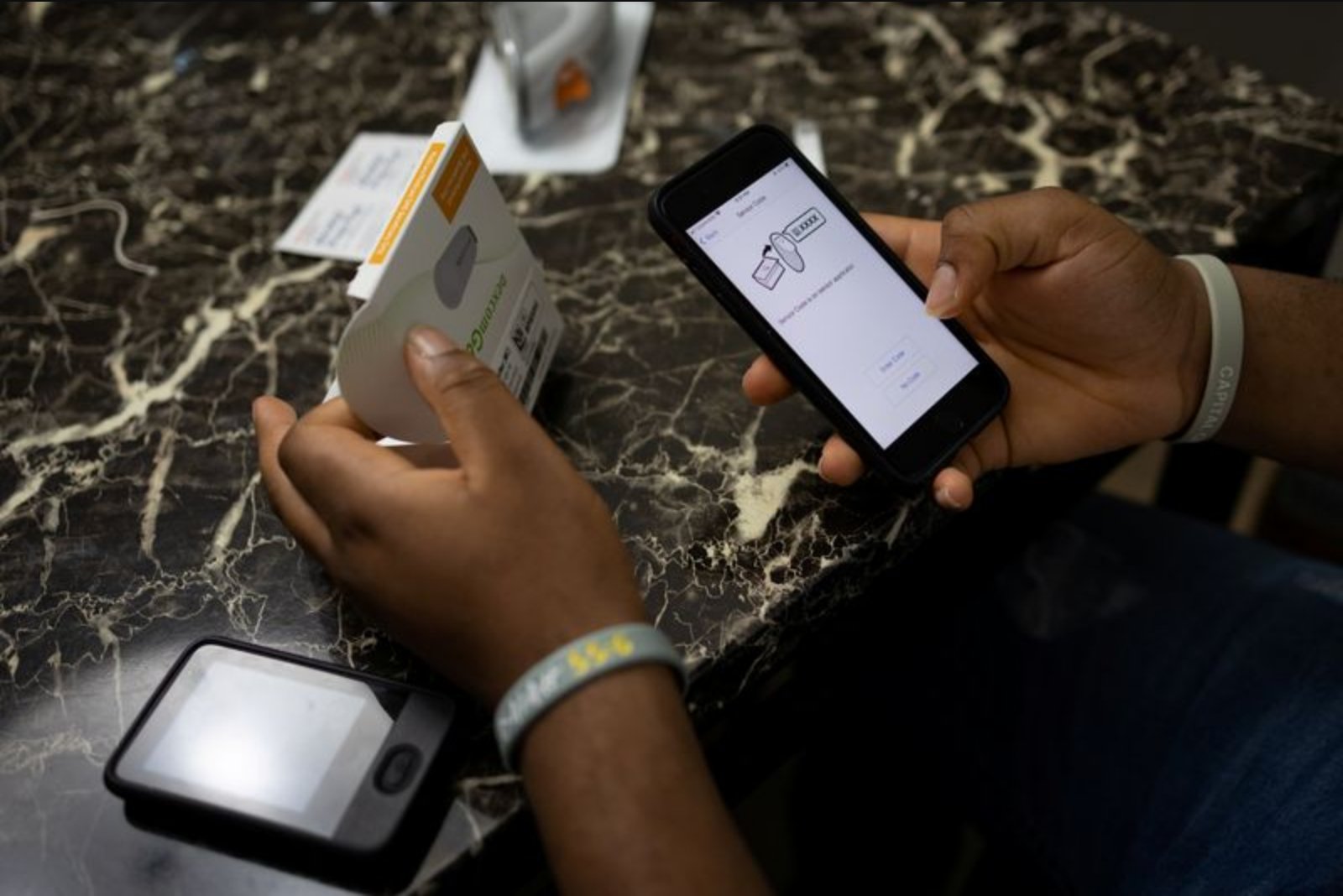
During the quarter, Dexcom expanded the U.S. launch of its Dexcom G7 15 Day sensor. It also introduced new meal-logging capabilities on the Stelo platform and released clinical data indicating benefits for people with type 2 diabetes who are not using insulin.

The Stelo device, an over-the-counter CGM intended for adults not on insulin, represents Dexcom's effort to move into a broader consumer health segment. The company is positioning Stelo to serve people with type 2 diabetes as well as individuals who monitor blood glucose levels to manage their health.


Market environment

Industry dynamics cited by the company and observers include rising awareness of diabetes management, expanding insurance coverage for CGMs and a consumer shift away from finger-prick testing toward continuous, noninvasive monitoring. These trends have helped lift demand for CGMs but also intensified competition among established players, including Dexcom, Medtronic and Abbott Laboratories.

Dexcom said demand for its CGM devices remained healthy during the quarter, and the company pointed to the recent product rollouts and platform updates as part of its growth strategy in both clinical and consumer channels.


Implications and outlook

By maintaining its $5.16 billion to $5.25 billion revenue range, Dexcom signaled confidence in its current trajectory while acknowledging a competitive and evolving market. The company highlighted incremental product features, expanded sensor availability and new clinical findings as contributors to sustained demand.

Risks

  • After-hours share decline of 4.3% indicates market sensitivity to results and guidance - this affects equity markets and investor sentiment toward medical device stocks.
  • Intensifying competition from other CGM manufacturers such as Medtronic and Abbott Laboratories could pressure market share and pricing dynamics - relevant to the medtech and healthcare equipment sectors.
  • Demand trends and reimbursement shifts are influential; while demand was described as healthy, changes in insurance coverage or consumer adoption could alter revenue outcomes - risk for healthcare payers and device makers.

More from Stock Markets

Qantas’ 20-hour gamble: engineering comfort with light, meals and cabin design Jun 18, 2026 U.S. Officials Question Whether ASML’s Top EUV System Has Reached China Jun 18, 2026 Hyundai to Acquire Remainder of Boston Dynamics From SoftBank for $325 Million Jun 18, 2026 U.S. Futures Pull Back After Stocks Rally on Iran Deal and Chip Strength Jun 18, 2026 Hyundai to Acquire SoftBank’s Remaining Boston Dynamics Shares for $325 Million, Report Says Jun 18, 2026