
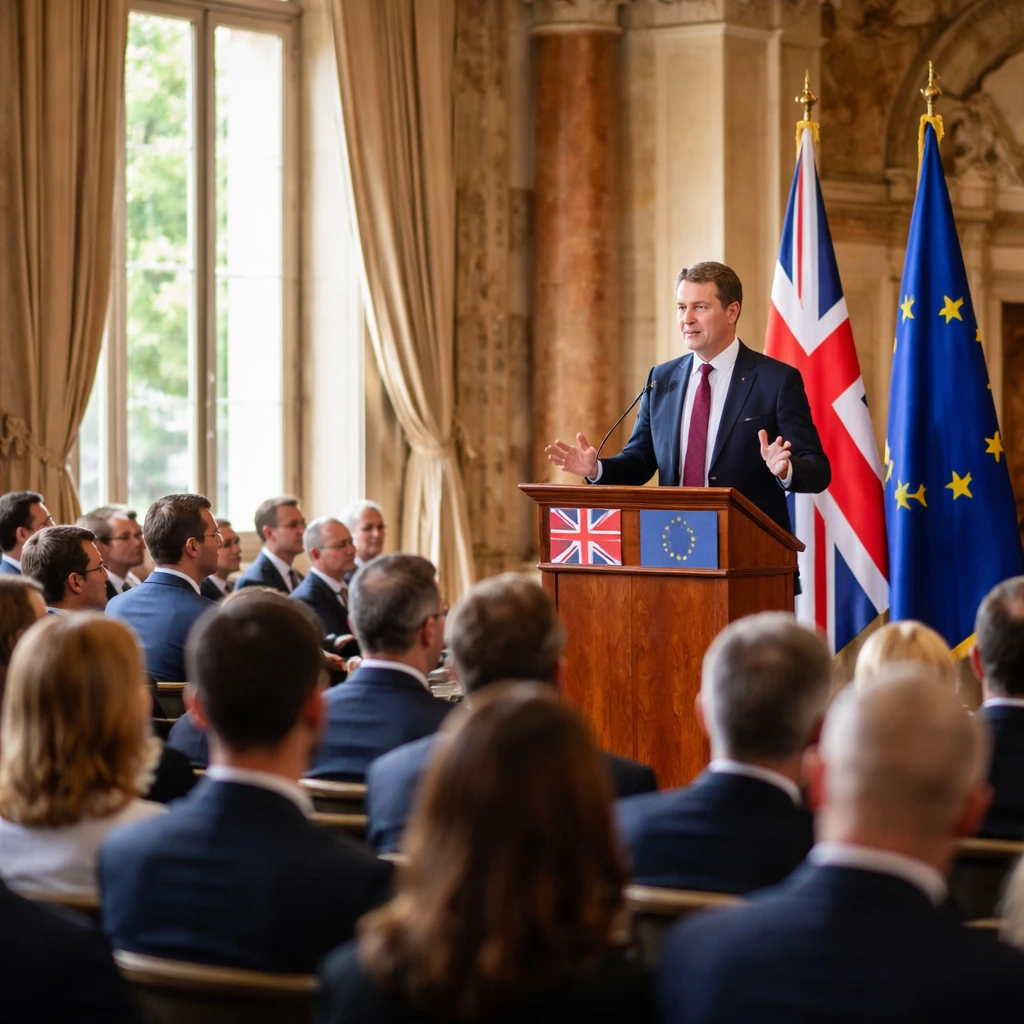
A senior British cabinet minister will use a speech in Rome on Friday to argue that the trade and cooperation agreement Prime Minister Andy Burnham reached with the European Union last week is not an endpoint but the first step in a broader realignment between the UK and the bloc.
Douglas Alexander, the Scotland secretary, is scheduled to address the Pontignano Conference, an event that promotes UK-Italy relations. According to prepared remarks, he will describe the Brussels deal as a foundation on which to build. “What was agreed in Brussels last week should be regarded as a floor – a proof of concept, not a ceiling on our ambitions,” Alexander is set to say.
The agreement Burnham secured with the EU last week covers three main areas: the liberalization of food trade, the linking of emissions trading markets, and the creation of a youth experience scheme. On Thursday, Burnham published the EU Partnership Bill, which would write the deal into law and allow Britain to align its legislation with EU rules.
Number 10 has informally referred to the legislation as the “cutting costs bill” and has challenged Nigel Farage’s Reform UK party and the Conservatives to support a measure it says will put downward pressure on food prices.
Alexander’s speech, which has been signed off by Number 10, will also touch on the shifting global landscape since the 2016 Brexit referendum. “Do we meet the age of giants by standing alone or by standing together?” he will say. “Do we keep refighting the battles of 2016, or do we start winning the arguments of 2036?”
Burnham is expected to publish a 10-year plan for Britain next month. Alexander’s comments indicate that a closer relationship with the EU will be central to that plan.
The prime minister has instructed cabinet ministers not to publicly comment on whether Britain should ultimately rejoin the EU. He said this week that returning to the EU without a confirmatory referendum would be “unthinkable.”
Conservative leader Kemi Badenoch has criticized the Brussels deal, saying it would leave Britain as a “rule taker” from the EU, and has pledged to revoke it if her party wins the next general election.
On Thursday, the government announced that net migration to the UK fell to 77,000 in the 12 months to June, less than half the previous level and the lowest figure outside the pandemic in nearly 30 years. Pro-EU ministers have pointed to the decline as reducing one of the key arguments that drove the 2016 vote to leave the EU.
The speech and the legislation together signal that the government intends to frame the EU deal as an economic measure aimed at lowering costs, while challenging its political opponents to oppose it on those grounds. The reference to a “floor” suggests that ministers see the current agreement as a basis for further cooperation, though the text of the speech does not specify what additional steps might be taken.
The EU Partnership Bill would allow Britain to align its legislation with EU rules, a mechanism that the government says is necessary to implement the agreement. The informal “cutting costs bill” label is intended to emphasize the expected impact on food prices, according to the government’s statements.
Alexander’s remarks also place the deal in the context of a changing global environment since 2016, using the phrase “age of giants” to describe the current international landscape. The questions he poses are rhetorical, contrasting isolation with collective action and past divisions with future arguments.
The prime minister’s instruction to cabinet ministers not to comment on eventual EU membership, and his description of rejoining without a confirmatory referendum as “unthinkable,” indicate that the government is seeking to keep the focus on the current deal rather than on longer-term membership questions.
Badenoch’s criticism and her pledge to revoke the deal if the Conservatives win the next election set up a political contest over the legislation. The government’s challenge to Reform UK and the Conservatives to back the bill is part of that contest.
The net migration figure of 77,000 for the 12 months to June, less than half the previous level and the lowest outside the pandemic in nearly 30 years, was announced on Thursday. Pro-EU ministers have pointed to the decline as reducing one of the key arguments that drove the 2016 vote to leave the EU. The article does not provide further detail on the composition of that decline or its causes.