
JAKARTA - Indonesia's government is weighing an increase in subsidised fuel prices for early 2027, which would mark the first such adjustment in five years, according to four people with knowledge of the deliberations. The discussions are unfolding against a backdrop of elevated global oil prices and a persistently weak rupiah, both of which are intensifying pressure on the finances of Southeast Asia's largest economy.
Stable fuel prices have been a key factor in keeping inflation at benign levels in Indonesia, a G20 member. However, a series of economic setbacks this year has pushed the rupiah to multiple record lows, made the country's stock market the worst-performing in the world, and caused investor confidence to deteriorate rapidly.
Fuel prices are a highly sensitive political issue in the world's fourth-most populous country, and past increases have historically been met with protests. On the political front, polls indicate that President Prabowo Subianto's approval ratings have declined sharply this year, largely due to his handling of the economy.
The proposal to raise subsidised fuel prices was discussed at a meeting last week, attended by officials from Bank Indonesia, state energy company Pertamina, sovereign wealth fund Danantara, and the Coordinating Ministry for Economic Affairs, according to one source, a state official with direct knowledge of the discussion. All four sources, two of whom are officials from state-linked institutions involved in the meeting, told Reuters that no decision had been reached and that the magnitude of any price increase had not been determined.
The first source said the proposal originated from the state energy company, which is concerned about its financial situation. Factors being weighed include the potential impact on Prabowo's popularity and on Pertamina's finances.
Indonesia's Government Communication Agency, in response to queries, said the government had promised not to raise subsidised fuel prices this year, but for next year, the president had not given a directive. The Finance Ministry, through a spokesperson, said it had no knowledge of any discussion about the future of fuel subsidies. The economic ministry, Bank Indonesia, Danantara, Pertamina, and the president's office did not immediately respond to requests for comment.
Fiscal Pressures Mount
Indonesia has kept subsidised fuel prices unchanged despite global oil prices being elevated since conflict in the Middle East disrupted international energy markets. The country's energy subsidy budget is expected to balloon to 500 trillion rupiah ($27.2 billion) this year, 30% higher than originally earmarked. The finance ministry has already indicated it could increase the allocation further.
A second source said Pertamina had not received full reimbursements for distributing subsidised fuel, as the government sought to keep its fiscal balance in check. By law, the government's annual budget deficit is capped at 3% of GDP, a limit that is already being tested by Prabowo's costly flagship programmes, such as distributing free meals to millions of students and pregnant women. This year's official deficit estimate is 2.85% of GDP.
Political Repercussions
Fuel price hikes have a fraught history in Indonesia. In 1998, an increase contributed to violent demonstrations against then-President Suharto, ultimately leading to his ouster. In 2015, a fuel price hike caused Prabowo's predecessor's approval rating to plummet.
Raising subsidised fuel prices could similarly hurt Prabowo's approval rating, said Djayadi Hanan, executive director of pollster Lembaga Survei Indonesia.
If the public feels economically strained, their assessment of the economic situation will be negative,he said.
When it is negative, it politically leads to public dissatisfaction with the government's performance, especially the president.
With subsidies, 90-octane gasoline is sold at 10,000 rupiah per litre, about $2.1 per gallon, roughly half its estimated economic price, while diesel is sold at 6,800 rupiah per litre, about $1.4 per gallon, less than a third of its economic price, according to finance ministry estimates using October prices.
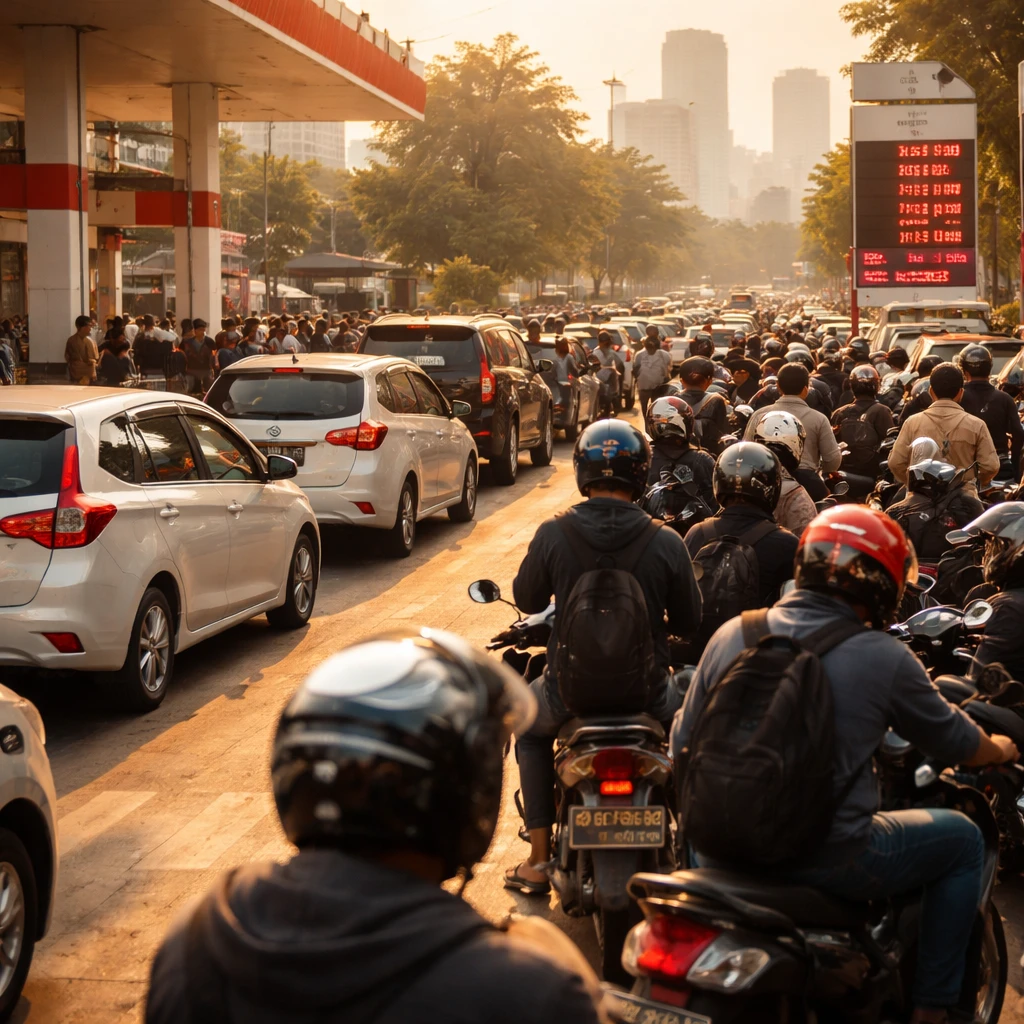
The subsidy bill has also increased because many buyers who typically consume higher-quality fuel, the price of which has risen periodically, have shifted to subsidised fuel due to the growing price difference. The energy ministry is considering an increase in the subsidised fuel volume quota, after reports of queues stretching outside fuel stations in several cities.
Indonesia is a net oil importer. The rupiah has fallen to new depths this year and sank to another record low on Thursday of 18,395 to the dollar.