
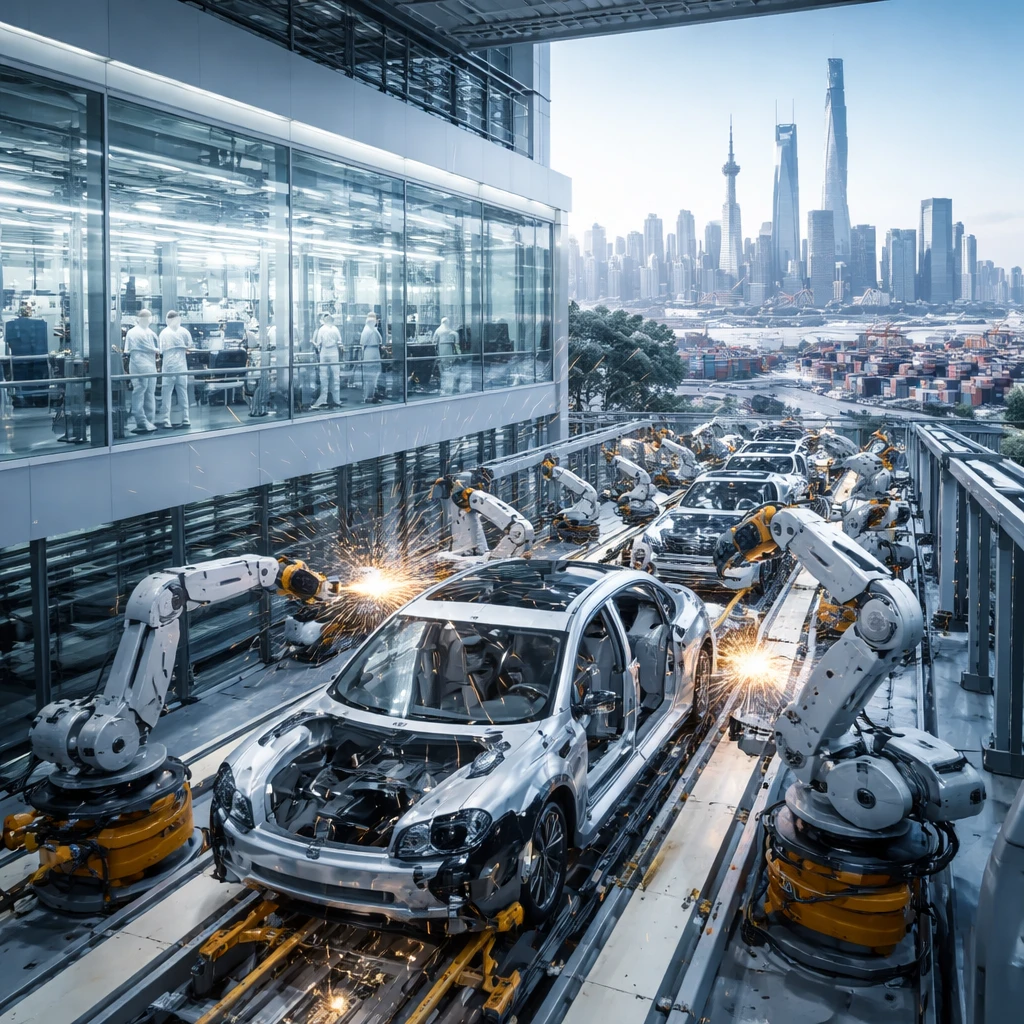
China’s provincial-level growth figures for the first six months of 2026 highlight a distinct two-speed transition in the national economy, as regions with deep exposure to advanced manufacturing surged ahead and those tied to property and conventional industry struggled to keep pace. The divergence complicates efforts to rebalance an economy described by officials and analysts as facing strong supply but weak domestic demand.
Winners: tech-heavy provinces accelerate
Among the largest provincial economies, southern Guangdong, eastern Zhejiang, Shanghai, Anhui and Shandong stood out by accelerating even as the country-wide GDP growth rate eased to 4.7% in the first half of the year, down from 5.0% in 2025. These five provinces have heavy participation in advanced manufacturing chains including semiconductors, electric vehicles (EVs), robotics, artificial intelligence and other higher-value exports.
Zhejiang led the pack, recording a 5.7% expansion in the first half. Shandong, Anhui and the financial hub of Shanghai each posted 5.6% growth. Overall, data released by local statistics bureaux show that 15 of mainland China’s 31 provincial-level economies grew faster than the national 4.7% rate in the period, while 16 grew more slowly.
Laggards: property and legacy sectors weigh on growth
Provinces with greater dependence on property markets and traditional industries were among the weakest performers. Hunan grew 2.7% in the first half, Jilin 2.4%, Shanxi 2.1% and Liaoning 2.5%, underscoring the challenges faced by regions without established high-tech manufacturing bases.
ANZ’s senior China strategist Zhaopeng Xing summed up the pattern: "The diverging growth rates reflect provinces’ differing reliance on old and new economic drivers, with regions more exposed to traditional sectors generally expanding more slowly than those with stronger new-economy industries." Only six provinces managed to accelerate relative to their 2025 growth pace, a group that included Guangdong, Zhejiang, Shanghai and Anhui, underscoring the growing importance of new-economy manufacturing for regional growth.
Anhui: a case study in advanced-manufacturing gains
Anhui’s performance illustrates how concentrated investment in new industries can shift local rankings. First-half GDP in Anhui rose to 2.74 trillion yuan ($404.9 billion), allowing the province to overtake Hunan and re-enter China’s top 10 provincial economies. The province saw industrial output of high-tech manufacturing jump 44.6%, while auto manufacturing expanded 29%.
Production of new-energy vehicles increased 20.6% and industrial robot output rose 16.2%. Exports from Anhui climbed 37.6% overall, with high-tech exports up 78.3% and car exports more than doubling. These external and industrial gains helped offset a 33.7% fall in property investment and relatively weak consumer demand, with retail sales rising just 1.6% in the first half.
Policy messaging and the consumption-investment mix
In March, President Xi Jinping urged major provinces to move beyond simply being growth engines and to take the lead in innovation, industrial upgrading and the development of what he called "new productive forces", framing provincial leadership in these areas as important for national economic stability. Shanghai’s resilience in the first half reflected strength in integrated circuits, AI and finance, while Beijing’s economy remained more weighted toward services.
Consumption and investment remained soft across much of the country. Among the top 10 wealthiest regions, only four saw goods retail sales rise by more than 2%. Shanghai’s retail sales were up just 0.7% for the first half, while Beijing’s retail sales fell 2.2%. Fixed-asset investment declined in at least 18 provincial economies during the period, although Shanghai recorded a 6.8% rise in investment and Beijing a 3% increase.
Economists widely expect local governments to speed up investment projects already in their budgets during the remainder of the year in an effort to meet a national growth objective in a range of 4.5% to 5%. At the same time, analysts note that measures of local performance are diversifying. As Zhaopeng Xing observed, "GDP is no longer the sole baton guiding local governments." Officials are increasingly judged on debt resolution, social welfare and environmental targets as well as on growth.
Implications
The first-half data make clear that China’s economic transition is producing uneven regional outcomes: strong factory activity and exports in high-tech clusters are supporting growth, while weak housing markets and soft consumer spending constrain demand in many regions. How provincial investment plans and Beijing’s policy direction interact will determine whether the two-speed pattern narrows or persists through the rest of the year.
(Exchange rate used in reporting: $1 = 6.7674 Chinese yuan)