
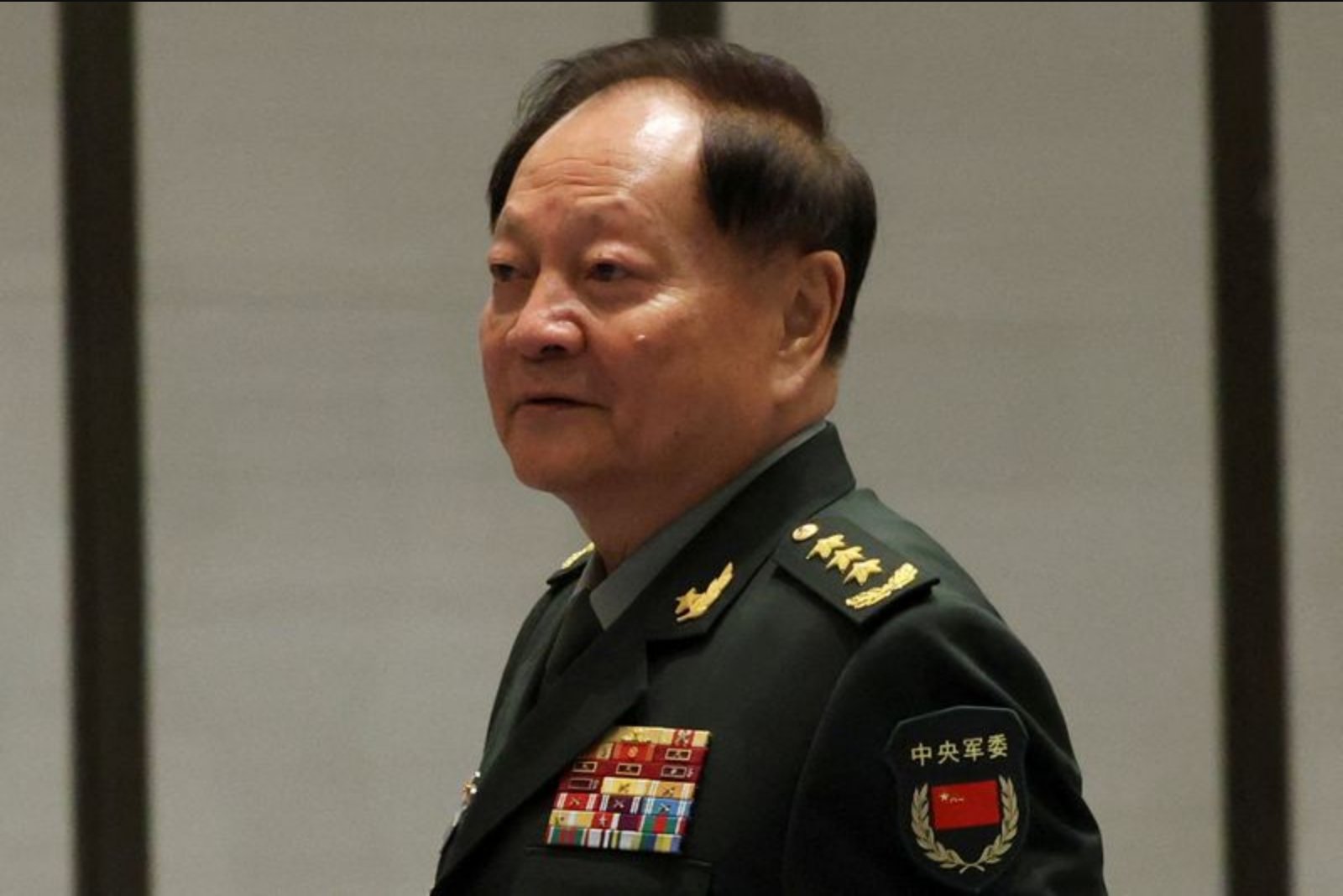
China’s decision to investigate one of its most senior military officers has thrust President Xi Jinping’s years-long anti-corruption campaign into his closest political orbit, underscoring that personal proximity to the president does not guarantee immunity. The subject of the probe, Gen. Zhang Youxia, is a Politburo member and served as senior vice-chairman of the Central Military Commission (CMC), the body that directs the People’s Liberation Army (PLA).
The defence ministry announced on Saturday that Zhang is under investigation "for suspected serious violations of discipline and law," a formal formulation used in high-profile disciplinary actions. The inquiry follows a string of anti-graft actions across the military since Xi initiated his broad crackdown after taking office in 2012.
Observers say the investigation has multiple implications: it centralizes further power around Xi, renders an already secretive military command yet more opaque, and reduces the likelihood of an imminent major military operation such as an attack on Taiwan while Beijing restructures senior leadership.
Personal proximity did not shield Zhang
Both Xi and Zhang come from families of former senior officers - the category often referred to as princelings - which has previously been associated with political advantage in China. Zhang, 75, had been expected to retire in 2022, but Xi retained him on the CMC for a third term, a move that signaled their close relationship and the general’s importance within the military hierarchy.
Despite that history, the probe demonstrates that even those with sustained personal ties to Xi can be subject to the party’s disciplinary process. "Zhang’s removal means that truly nobody in the leadership is safe now," said Jonathan Czin of the Brookings Institution, calling the investigation "astonishing" and characterising the development as a "profound shift" in Chinese politics.
Scope of the purge and its historical echoes
The anti-corruption campaign has previously reached deeply into elite military units, including the Rocket Force, which oversees nuclear and conventional missiles. In recent years, the campaign also claimed two former defence ministers as party disciplinary actions removed them from power. One former defence minister, Li, was ousted for suspected corruption related to military procurement, and the troubles of his associate Li Shangfu were earlier elements in the sequence of probes.
Analysts note that while corruption appears to be a genuine concern, such charges have often been used in Chinese political practice as a mechanism to remove officials. "I think corruption concerns are probably real, though those are typically more a pretext to remove someone in Chinese politics," Czin said, pointing to the depth of graft prior to the campaign.
Leadership shrinking and command uncertainty
The investigation of Zhang was not the only development. Liu Zhenli, chief of staff of the CMC’s Joint Staff Department, has also been placed under investigation. Those moves effectively reduce the seven-member CMC to two active senior members, with Xi alone at the apex.
That depletion raises immediate questions about how the PLA’s highest leadership will operate. "It is honestly not clear how the chain of command should be functioning - especially since so many of the officers who would otherwise be eligible to replace the disposed members of the CMC have themselves been ousted," Czin said.
Other analysts expect higher-level military initiatives to slow while Xi rebuilds the commission, either by adding new members or creating a structure that centers authority more tightly around him. Eric Hundman, director of research at BluePath Labs, suggested the reconstruction could involve additional appointments or the formation of new apparatus around Xi as the central decision maker.
Asia Society fellow Neil Thomas observed that Xi has "eviscerated the PLA top brass like no leader before him," and that the leadership renewal may be guided by the party calendar, with some analysts expecting a thorough vetting of candidates ahead of next year’s Communist Party Congress.
Official framing and implications for internal power
The PLA Daily, in a front-page editorial, presented the probe as a major achievement and accused the two generals of having "seriously undermined and violated" the Chairman Responsibility System. Under that arrangement, the chairman of the CMC - a position held by Xi - is granted "supreme military decision-making" authority and the system serves as the institutional framework for the party’s absolute leadership over the armed forces.
Invoking a violation of the Chairman Responsibility System implies that Zhang may have exercised power outside Xi’s direct control, according to Lyle Morris of the Asia Society Policy Institute’s Center for China Analysis. The PLA Daily did not supply detailed evidence of a power struggle, however, and analysts remain divided on whether Zhang posed a genuine challenge to Xi’s authority or whether the inquiry primarily serves to reinforce Xi’s consolidated control.
"For Xi to undertake such a dramatic move suggests two things: Xi has the full support of the Chinese Communist Party, and Xi is confident in his consolidation of power over the military," Morris said.
Responses within the party and to criticisms
Some commentators see the probe as an answer to critiques that the PLA anti-corruption campaign had been selective, conferring leniency on close associates. James Char of the S. Rajaratnam School of International Studies noted that by subjecting Zhang to investigation, Xi has countered perceptions that a fellow princeling would receive special treatment, pointing to Zhang having been spared previously even as his ally Li Shangfu encountered trouble in 2023.
Operational and geopolitical consequences
Analysts argue that the near-term prospect of a major military escalation - particularly against Taiwan - is diminished while Beijing addresses internal leadership gaps. The PLA staged its largest war games to date around Taiwan late last year, yet current dynamics within the military leadership suggest a period of consolidation rather than imminent large-scale offensive action.
Neil Thomas said the purge implies Xi is not contemplating a major escalation against Taiwan in the near term. Instead, the crackdown is intended to elevate a new cohort of generals who combine competence with loyalty, and who could present a more credible threat over a longer horizon. "Xi is a man on a mission," Thomas added. "He will do whatever it takes to ensure the Party and its military are politically loyal and ideologically committed."
Analysts also note political timing factors that work in Xi’s favor: with attention from the U.S. presidency focused elsewhere and Taiwan not scheduled for an election until 2028, Beijing has a window to reshape its military leadership without an immediate external deadline.
Outlook
While the PLA will continue to pursue Xi’s modernization priorities, the institution’s senior management will likely be in a holding pattern until the CMC is replenished and new command relationships are established. Whether Xi moves quickly to name replacements or conducts a slower, Congress-aligned vetting process will shape the military’s immediate trajectory and the perception of China’s strategic posture abroad.
Key points
- China has placed Gen. Zhang Youxia, a long-standing ally of President Xi and senior vice-chairman of the CMC, under investigation for "suspected serious violations of discipline and law," shrinking the active CMC leadership.
- The action concentrates further power around Xi, increases opacity in military command, and is likely to delay major military initiatives until the CMC is rebuilt and vetted.
- Sectors most directly affected include defence and national security; potential secondary impacts may touch geopolitical risk assessments and markets sensitive to China’s military stability.
Risks and uncertainties
- Opaque chain of command: With senior positions depleted and many potential replacements previously purged, it is unclear how the PLA’s command and control will function in the near term - a risk for defence readiness.
- Slowdown in military initiatives: High-level programs such as expanded joint training may be slowed while Xi consolidates new leadership, affecting defence contractors and suppliers tied to military modernization.
- Uncertain political signaling: The probe may be interpreted variously as a consolidation of power by Xi or a response to genuine corruption, leaving markets and foreign policymakers uncertain about China’s immediate strategic intentions.