
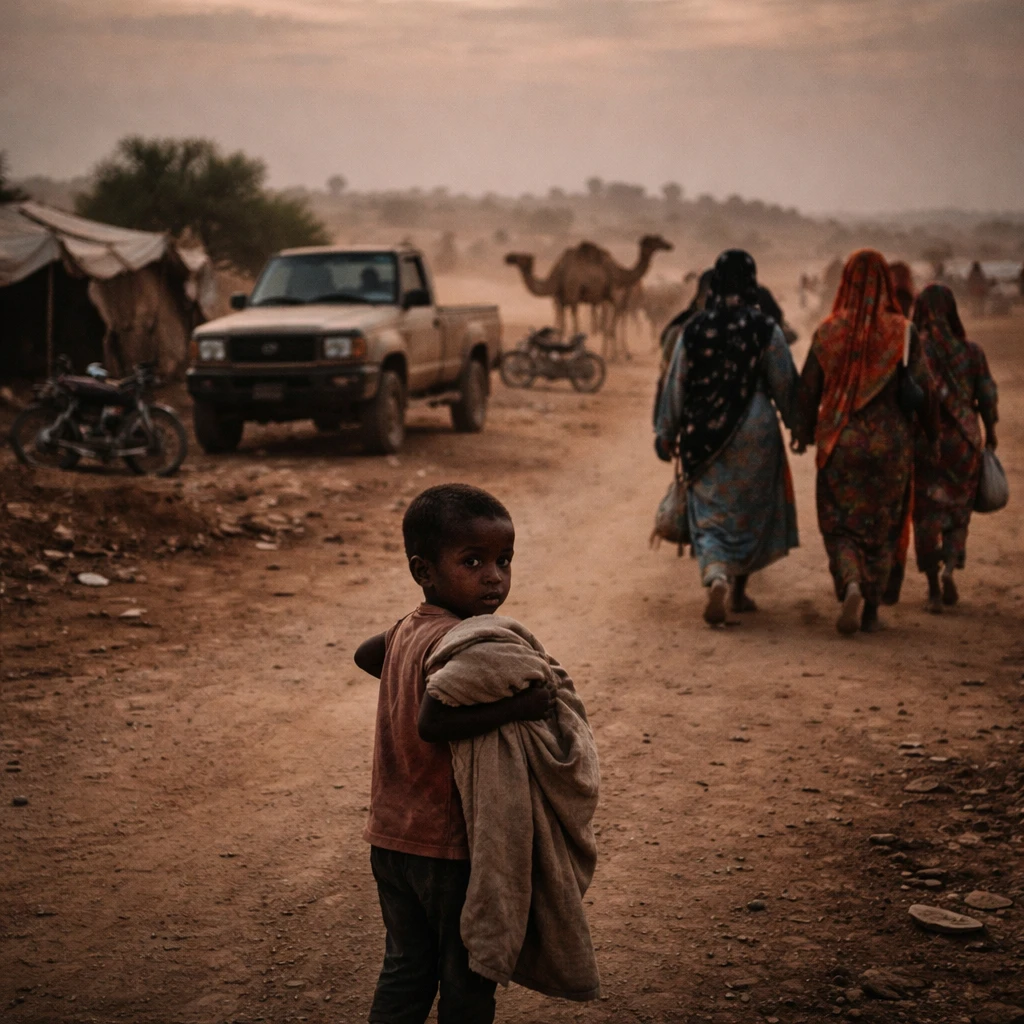
Paramilitary fighters operating in Darfur kidnapped children during the takeover of the regional capital al-Fashir in late October and in other attacks across the region throughout Sudan's civil war, witnesses told Reuters. In several of the accounts, the children were taken after fighters had killed one or both parents. The testimonies, given by more than two dozen people who fled to the North Darfur town of Tawila or to eastern Chad, paint a picture of repeated abductions and abuses against minors.
The witness pool consisted of 26 people who spoke in person or by phone. They described 23 separate incidents in which at least 56 children, aged between two months and 17 years, were taken in attacks dating back to 2023. Six of those interviewed said relatives of theirs had been seized. Reuters was not able to determine the full scale of child abductions in Darfur, nor could it independently verify all the accounts or trace the fate of the children after they were removed from their families.
Who the witnesses say took the children
Multiple witnesses identified fighters from the Rapid Support Forces - the RSF - as responsible for the abductions. In four accounts, the fighters explicitly told families that the children would be used as slaves or to herd animals. The RSF has been engaged in a war with Sudan's army since April 2023 over control of a country said to be rich in mineral reserves, with abundant arable land and Red Sea ports.
The RSF did not respond to requests for comment about the reported abductions, the abuse of minors, or the killings of parents. Previously, the RSF has denied deliberately targeting civilians and has said it placed fighters suspected of abuses under investigation.
Legal assessments
Three legal experts consulted said the abductions could amount to unlawful imprisonment and torture, and qualify as war crimes and crimes against humanity. One of those experts, Patricia Sellers, an international lawyer and former special adviser on slavery crimes at the International Criminal Court, said that the accounts may also constitute acts of enslavement and slave trading that would violate international laws and multiple international treaties.
U.N. and humanitarian remarks
Sheldon Yett, head of UNICEF in Sudan, said he had not received reports specifically describing children kidnapped to be used as slaves or to tend livestock. However, he added that the narratives collected by Reuters "are sadly consistent with the broader pattern of grave violations we continue to see against children" and did not elaborate further.
Historical links and denials
The RSF evolved from militias known as the Janjaweed that fought alongside government forces under former leader Omar al-Bashir. During the earlier Darfur conflict in the early 2000s, human rights activists and groups reported that the Janjaweed abducted children and forced them into domestic work, livestock care, or sexual servitude. Those militias were accused of genocide in Darfur at that time.
When asked about the witness allegations of abductions in the current conflict, the Sudanese army said such acts were "consistent with those of the Janjaweed militia during the previous regime." The army added in a statement that Sudan's government, which is backed by the military, "cannot accept leaving citizens hostage to the militias' violence."
The RSF has previously denied responsibility for atrocities attributed to its fighters in Darfur.
Scale of the crisis
The war has inflicted massive human suffering. Tens of thousands of people have been killed and the conflict has precipitated famine and disease, conditions the United Nations has called the world's largest humanitarian crisis. Reports and witness testimony have blamed the RSF and allied militias for mass killings, often targeting ethnic non-Arab groups.
In late October the RSF consolidated control over Darfur when it captured al-Fashir, a city that had been sheltering many displaced people and which remained under siege for 18 months. Witnesses have accused the paramilitary force of a range of abuses there, including summary killings.
Investigations by international bodies
During a U.N. Security Council briefing on January 20, deputy ICC prosecutor Nazhat Shameem Khan said her office was investigating alleged crimes committed by the RSF in al-Fashir, focusing in particular on violence against women, girls, and children. Khan said that based on evidence collected to date, her office believes that war crimes and crimes against humanity occurred in late October during the culmination of the RSF's siege of al-Fashir. The RSF did not respond to a Reuters request for comment on Khan's assessment.
Testimonies from fleeing civilians
Many of the accounts described children being taken after fighters had killed their parents. In some instances, witnesses said the children saw their parents killed. Ten people interviewed in Chad described abductions during the takeover of al-Fashir. The seizures took place both inside the city and on the road toward Tawila, a town roughly 50 km to the west where the U.N. estimates about 665,000 displaced people are sheltering.
Madina Adam Khamis, 38, said she was held captive at al-Fashir University with other women and children after trying to flee the city on October 26. She recounted watching an RSF fighter known as Abu Lulu shoot many captives, including a woman seven months pregnant, and 10 children. Khamis said Abu Lulu and his group took three girls and two boys aged between two and five years old - children whose mothers had been killed - and placed them in the back of a Toyota Land Cruiser. She also described another fighter taking a two-month-old baby from the arms of one of the girls and sitting in the vehicle with the infant. Khamis said the children were from al-Fashir but she did not know their names. "There was one child who lost her mother, the mother died in front of our eyes, and the child was touching her mother to try to get her to wake up," she said. Reuters could not independently corroborate her account.
Accounts of children taken to tend animals or held for ransom
In December the RSF told Reuters that Abu Lulu was in its custody and that it was investigating him and several other RSF soldiers over abuses committed after the takeover of al-Fashir. Videos circulated online showing Abu Lulu shooting unarmed captives, some of which Reuters verified. The RSF did not respond to requests to make Abu Lulu available for interview.
Mohammed Adam Bashir, 38, said he saw fighters take two boys of about four to five years old and a girl of roughly three after they had shot the children's mothers dead while he fled north from al-Fashir to the village of Torro on October 26. He said the children were placed in the back seat of an armoured Land Cruiser. "They pulled the children away from their two mothers who were dying," he said. "They took them to the car and then they came back to ask us for money." None of the witnesses Reuters spoke to said they observed what became of children after they were seized.
One witness, Abdulmajeed Abdulkarim, 28, said he heard children crying for their parents at night while he was held captive in a bush area near the village of Garney in the days after al-Fashir fell.
Researchers who have interviewed displaced people from Darfur have collected similar testimonies. An Amnesty International report documented the account of a child who said RSF fighters abducted him in the Zamzam displacement camp near al-Fashir and forced him to work. He said he was chained at night and made to herd sheep by day for more than six weeks. His captor reportedly called relatives to demand a ransom of five million Sudanese pounds. After the payment, the child said he was released. Reuters did not independently verify Amnesty's findings, and has previously reported that the RSF has held groups of adult survivors from al-Fashir for ransom. An RSF adviser at the time claimed that rival forces disguised in RSF uniforms were responsible for many such incidents.
Language and motive reported by witnesses
Seven witnesses said fighters referred to the children they took as "falungiat", or children of falungi, a term roughly translating to house slaves and used as a derogatory label for allies of the Sudanese army. The majority of those who gave testimony were from the Zaghawa tribe and said RSF fighters used racial slurs when addressing them. The RSF did not respond to questions about whether racial motivations played a role in the abductions.
Several witnesses described fighters seizing children at the same time as livestock. Four said RSF fighters told them the children would care for animals - a duty often assigned to children in the region.
Incidents before and after al-Fashir's fall
Sixteen witnesses described abductions that occurred prior to the takeover of al-Fashir. Imam Ali, 26, said he fled besieged al-Fashir in March 2025 with his family and was attacked southeast of Tawila by RSF fighters who arrived with camels, motorcycles, and a car. He said the fighters shot two of his brothers and abducted the other two, aged 15 and 13, along with 60 of their sheep. He has not heard from his kidnapped brothers since.
Fatima Yahya, 47, said she left Nyala, the capital of South Darfur, in October 2023 and was stopped by a group of RSF fighters in a village called Karamaje while fleeing to al-Fashir with other households. She said the fighters blindfolded two boys and one girl of about nine and placed them in the middle seats of three double-cabin Land Cruisers, with two fighters on either side. She said she did not know the children personally but believed they were from Nyala and that two had lost their mothers in bombardments there. "They told us the kids would look after the animals," Yahya said.
Limits to verification and continued uncertainty
Reuters was unable to independently verify most of the witness statements and could not determine how many children in total have been abducted or what has happened to them after being taken. The RSF did not respond to requests for comment about the reported abductions and alleged mistreatment of minors and the killing of their parents.
Legal experts emphasized that the allegations, if substantiated, could meet thresholds for serious international crimes, including enslavement and slave trading. Investigations by international bodies, including the ICC, are under way into alleged abuses in al-Fashir and the wider Darfur region, with a particular emphasis on violence targeting women, girls, and children.
Humanitarian consequences and broader implications
The testimonies collected by Reuters add to mounting evidence of grave violations against civilians in a conflict that has left large swathes of the population displaced and under siege. The capture of al-Fashir and other operations by the RSF have intensified fears for the safety of those sheltering in displacement camps and towns across Darfur.
Observers and officials cited in the testimonies warned of long-term repercussions for communities whose children have been taken or whose family members were killed in front of them. The accounts of abductions, forced labor, ransom demands, and killings underscore the complexity and severity of the humanitarian crisis unfolding in Darfur.
What remains unclear
- How many children in total have been abducted across Darfur since 2023.
- What has become of the majority of children who witnesses say were taken; few of the people interviewed had direct knowledge of their fate.
- Whether those responsible will be held to account beyond the individual investigations and denials of responsibility that have already been reported.
These accounts, given by displaced people who fled to Tawila and to eastern Chad, form part of a broader body of testimony that international organizations and researchers are compiling as they seek to document violations against civilians in the conflict. The situation remains fluid on the ground, and international investigators have said they are examining evidence of serious crimes in Darfur and elsewhere in Sudan.