
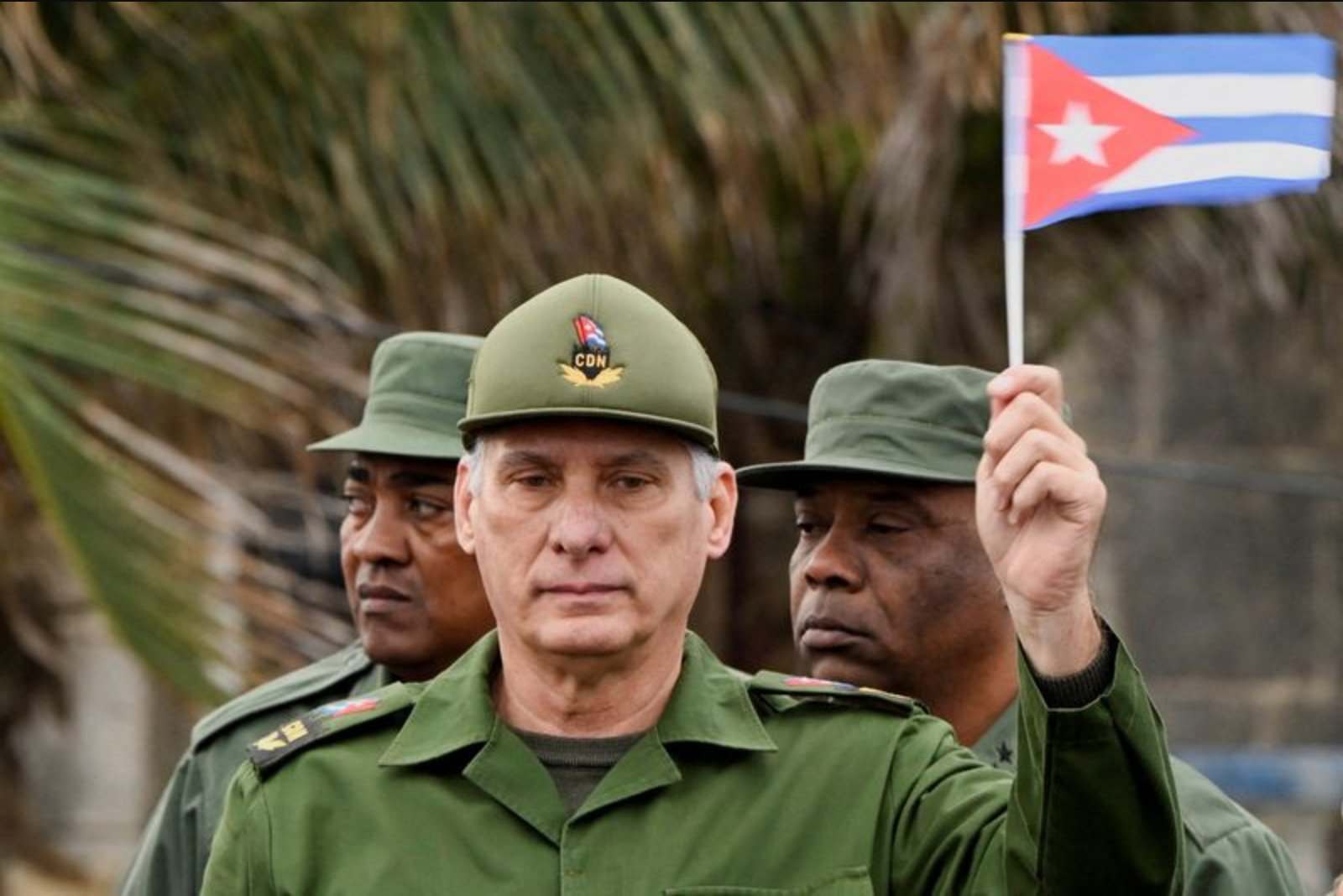
HAVANA, March 27 - Cuba and the United States have entered talks at a time of heightened strain. U.S. measures described by Cuban officials as a de facto oil blockade have intensified pressure on the island’s government and helped prompt the bilateral conversations. Havana’s president, Miguel Diaz-Canel, has insisted the talks proceed "on the basis of equality" and mutual respect, even as President Donald Trump has publicly issued a series of aggressive remarks about Cuba, including saying he can do "anything I want" with a sovereign neighbor.
Despite the confrontational rhetoric, officials aligned with the Trump administration have been the source of media leaks suggesting some form of arrangement might be achievable. The New York Times, citing four people familiar with the discussions, reported that Washington may be seeking to remove Diaz-Canel from office. According to that account and a similar one in USA Today, the United States might offer eased sanctions and promise not to act against members of the Castro family in exchange for a change in leadership.
Both Havana and Washington have reframed the public narrative repeatedly, and the reports have focused attention on a small group of individuals who could determine how any talks play out and what the consequences might be for Cuba’s political order and economy. Below are portraits of those most often mentioned as having leverage over Cuba’s future.
U.S. President Donald Trump
President Trump has made a number of strident public statements regarding Cuba in recent weeks. He has said he expected to have the "honor" of "taking Cuba." After ordering military strikes on Iran, he told audiences, "We’re talking to Cuba, but we’re going to do Iran before Cuba." At the same time, senior U.S. military leadership has sought to reassure lawmakers that American forces are not rehearsing for an invasion of Cuba. The top general in charge of U.S. forces in Latin America told a Senate hearing the military is not preparing to take over the island or staging rehearsals for such an operation.
Media reports have described a potential U.S. approach that would mirror recent events in Venezuela, where the United States deposed President Nicolas Maduro on January 3 and later engaged with acting President Delcy Rodriguez, who assumed power after Maduro was removed in a pre-dawn raid. According to the reports, Washington’s proposed arrangement with Cuba could involve pressuring Diaz-Canel to step aside in exchange for sanctions relief and assurances regarding the Castro family, although these reports are attributed to unnamed U.S. sources and have not been confirmed by either government.
U.S. Secretary of State Marco Rubio
President Trump has identified Marco Rubio as the lead U.S. interlocutor in discussions with Cuban representatives. Rubio, a Cuban American who carries the dual responsibilities of Secretary of State and National Security Advisor in this account, was born in Miami and has longstanding ties to the Cuban diaspora community, which has traditionally been hostile to the Cuban revolutionary government.
Observers note that any deal in which the Communist Party remains in control while the Castro family avoids accountability could be poorly received in South Florida, a politically sensitive region with vocal exile constituencies. Conversely, if Rubio’s approach were to aim at removing the Cuban government, that course of action would carry significant risks highlighted in reporting: the potential for violent upheaval and a large-scale migration flow, as well as disruption to cooperative efforts in areas such as counter-narcotics operations.
Those concerns are underscored by Cuba’s geography and economy - the island has 5,746 km (3,570 miles) of coastline and lies as close as 90 miles (150 km) from U.S. shores - and by the role Cuban authorities have played in collaborating on drug trafficking interdiction. A sudden collapse of the government could create openings for organized crime along a long and porous coastline, according to the accounts in the reporting.
Raul Castro
Raul Castro, now 94, fought with his elder brother Fidel in the revolution that ousted a U.S. ally in 1959 and served for decades as defense minister. He became interim president in 2006 when Fidel’s health declined and formally took the presidency in 2008. With Fidel’s death in 2016, Raul consolidated his position as the key unifying figure among those loyal to the revolutionary leadership.
Although Raul stepped down as president in 2018 and relinquished formal party leadership in 2021, he retains influence through his army general honorific and through active involvement in state affairs. When Diaz-Canel announced that Cuba had entered into talks with the United States, he said the discussions were being led by both Raul Castro and himself. The Cuban president has repeatedly referred to Raul’s involvement in matters of state.
Raul’s continuing standing within the party apparatus was evident in December 2025, when the Communist Party’s Central Committee approved unanimously his proposal to postpone indefinitely the congress that would have chosen Diaz-Canel’s successor. The proposal was framed in light of Cuba’s dire economic situation, and the unanimous approval was read by many as a sign of Raul’s enduring sway.
Miguel Diaz-Canel
Miguel Diaz-Canel became Cuba’s president in 2018 and was the first non-Castro to head the government since 1959. His tenure has been marked by multiple setbacks. Early in his administration, he faced a reversal of the rapprochement with Washington enacted by the previous U.S. president. Then the coronavirus pandemic devastated Cuba’s tourism sector, leaving many new hotels financed by significant government investment largely empty.
Diaz-Canel’s political standing suffered further after his reaction to the mass protests that erupted spontaneously on July 11, 2021. The demonstrations struck the Cuban government with a scale and intensity not seen in decades. Diaz-Canel publicly called on loyalists to confront the protesters, declaring, "The combat order has been given!" The subsequent crackdown by security forces and the continuing economic crisis have damaged his public standing at home and shaped perceptions abroad.
Any negotiated outcome that would involve Diaz-Canel stepping aside before the completion of his term - he has two years remaining as president and a five-year term as party leader ahead - would be without recent precedent in Cuba’s post-revolution political history.
Raul Guillermo Rodriguez Castro
Known by the nickname "El Cangrejo," Raul Guillermo Rodriguez Castro, 41, is widely portrayed as one of Raul Castro’s closest confidants. He served as a bodyguard to his grandfather and was often at Raul’s side during his presidency. He has been reported to hold the rank of lieutenant colonel.
Rodriguez Castro’s lineage ties him to both the political leadership and the economic structures that underpin the state. He is the son of Raul’s daughter Deborah Castro Espin and the late General Luis Alberto Rodriguez Lopez-Calleja, who headed GAESA, the military-controlled conglomerate that assumed control of Cuba’s most important businesses, including hotels, banking, logistics and retail, during Raul Castro’s time in power.
Rodriguez Lopez-Calleja died in 2022 at the age of 62. Media accounts have suggested Rodriguez Castro may have taken on responsibilities in parts of his late father’s business interests. Those dual ties - familial and commercial - position Rodriguez Castro at an intersection between the party and the state’s most powerful economic institution, making him a figure of interest to negotiators and analysts alike.
Sources have reported that Rodriguez Castro has held talks with U.S. contacts. Axios, citing three unnamed sources, reported on February 18 that he was in secret discussions with Rubio. The Miami Herald, citing unnamed sources, reported on February 26 that officials close to Rubio met Rodriguez Castro on the sidelines of a regional Caribbean Community meeting in St. Kitts and Nevis. The Cuban government did not respond to requests for comment about Rodriguez Castro’s biography or any role he might play in negotiations. Rodriguez Castro himself has not spoken publicly or granted interviews.
Manuel Marrero
Manuel Marrero, 62, was appointed prime minister by Diaz-Canel in 2019 and was subsequently ratified by the National Assembly. He was elevated to the Politburo in 2021, placing him among the small group of officials commonly considered possible successors to Diaz-Canel. Marrero trained as an architectural engineer and led the tourism ministry from 2004 until his appointment as prime minister in 2019.
According to Cuba’s official online encyclopedia EcuRed, Marrero previously served as president of Grupo Gaviota, the tourism arm of GAESA. In that role he helped oversee the construction of two resorts. His long association with the tourism sector and with GAESA-linked operations links Marrero closely to one of Cuba’s most important economic engines.
Oscar Perez-Oliva Fraga
Oscar Perez-Oliva Fraga has emerged in recent years as a rising figure inside Cuba’s policy and economic apparatus. After becoming foreign trade minister in 2024, he accumulated additional posts, adding the titles of deputy prime minister and member of the National Assembly in 2025. He also has family ties to the Castro brothers: his maternal grandmother Angela Castro was a sister to Fidel and Raul, which gives him a familial connection without carrying the Castro surname directly.
When Cuba introduced a plan to attract investment from nationals living abroad, Perez-Oliva Fraga was given prominent airtime on government television to explain the policy. Observers have speculated that he might play a role akin to that of Delcy Rodriguez in Venezuela, though that characterization is built on analysts' conjecture reported in the media and not on official confirmation of any designated function in U.S.-Cuba talks.
What the mix of actors implies
The cast of players described above combines U.S. policymakers with deep ties to the Cuban exile community, Havana’s aging revolutionary generation and a younger cohort with links to both the party and the military-controlled economic structures. The reported contours of the U.S. approach, as described in media accounts citing unnamed sources, would involve trading changes in leadership for sanctions relief and for assurances pertaining to the Castro family. That proposed arrangement, if accurately reported, raises complex questions about political transition, economic stability and security cooperation.
At the time of reporting, governments on both sides have made guarded public statements, and the full content and status of any talks remain opaque. Media reports and anonymous sources have raised scenarios, but official confirmation of any specific plan has not been produced. The talks are unfolding against a backdrop of economic strain in Cuba, visible fractures in public sentiment, and an enduring role for the military-linked conglomerate GAESA in the national economy.
Summary
Cuban and U.S. officials are engaged in bilateral talks amid heightened tensions, with leaks to the press suggesting Washington may seek a change in Havana’s leadership in return for easing sanctions. Key figures involved include President Donald Trump and his appointed U.S. representative Marco Rubio; in Havana, Raul Castro, President Miguel Diaz-Canel, Raul Guillermo Rodriguez Castro, Prime Minister Manuel Marrero and Oscar Perez-Oliva Fraga are among those with potential influence. The island’s economic backbone, including tourism and GAESA-controlled enterprises, and the security implications of any abrupt political shift are central to the stakes of the negotiations.