
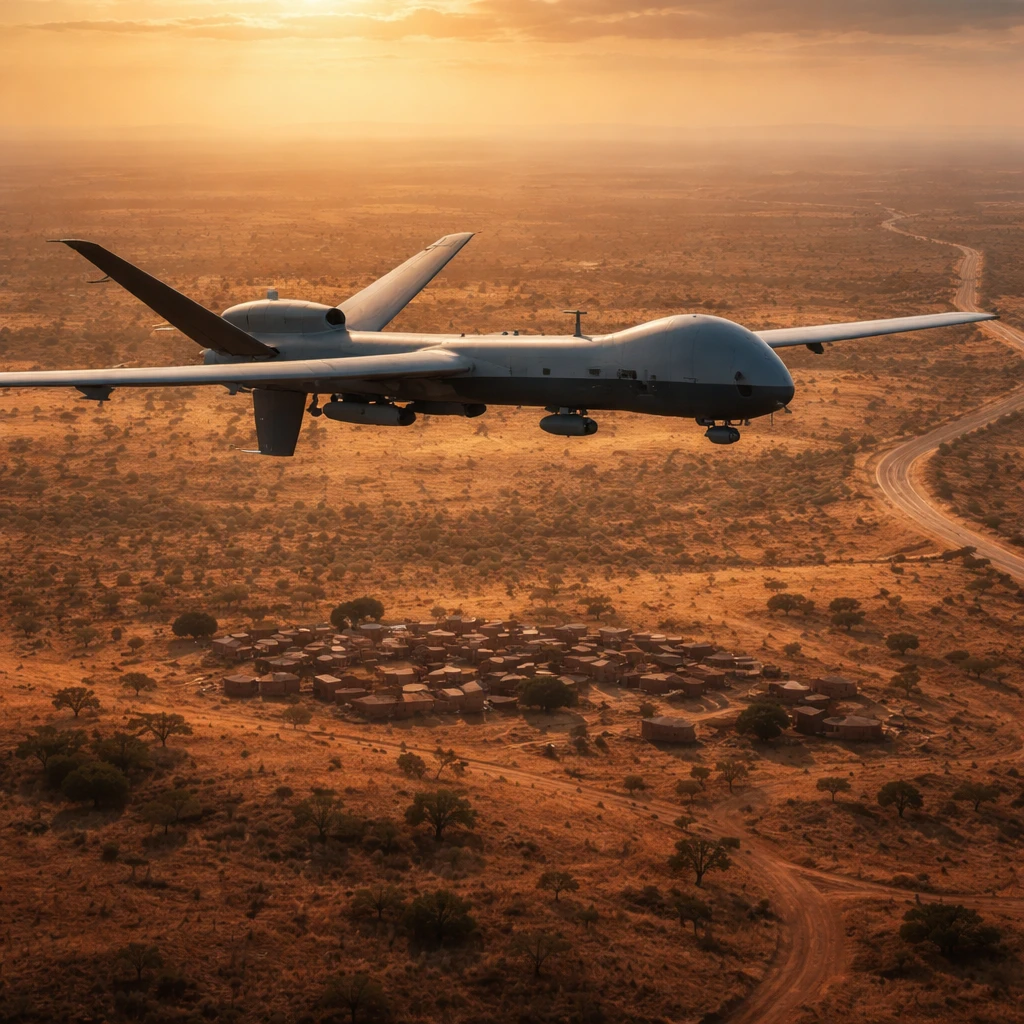
The United States is reported to be close to an arrangement with Mali that would permit U.S. aircraft and unmanned aerial systems to fly over Malian territory to gather intelligence on jihadist networks linked to al Qaeda, according to a current U.S. official and a former U.S. official. The initiative follows a diplomatic step last month in which Washington removed sanctions on Mali's defense minister and other senior officials whom it had accused of associating with Russian mercenaries - a specific demand made by the Malian government, the officials said.
U.S. officials view the sanctions relief as the opening move in a broader effort to secure Malian agreement for intelligence-gathering flights across the country's expansive terrain, where jihadist groups have been consolidating ground. Those operations are intended to locate and monitor militant activity conducted by groups such as Jama'at Nusrat al-Islam wal-Muslimin, commonly abbreviated as JNIM.
Operational drivers and immediate objectives
Part of Washington's stated rationale for resuming overflight activity is to assist in the search for an American pilot who was seized while working for Christian missionaries in neighboring Niger. U.S. officials said the pilot is believed to be in Mali and held by the local al Qaeda affiliate, JNIM. The State Department declined to comment on the matter. A Malian government spokesperson did not respond to a request for comment.
Following the lifting of sanctions on February 27, Mali's government issued a public statement welcoming the decision and saying it would help "improve relations between our two countries, while reiterating respect for national sovereignty." The recent diplomatic moves build on a push by the U.S. to rebuild ties with Bamako after a period of strained relations under the previous U.S. administration.
Diplomatic engagement and the regional context
Washington dispatched its top envoy to Africa, Nick Checker, to Bamako last month to meet with Malian Foreign Minister Abdoulaye Diop. The trip, according to the State Department, was intended to signal a desire to chart a new course in bilateral relations and move beyond perceived policy missteps by the prior U.S. administration. Diop publicly praised U.S. efforts to relaunch the partnership, emphasizing a new approach premised on mutual respect for sovereignty and non-interference.
The Trump administration has altered U.S. policy in the Sahel by reducing emphasis on pressing for elections in countries that have experienced military takeovers, a stance the Malian government and several other Sahel capitals have welcomed. That shift contrasts with the approach of the previous U.S. administration, which the State Department description implied had created tensions with partners in the region.
Setbacks and limits to cooperation
Despite moves toward rapprochement, the effort to restore ties has faced obstacles. In December, Mali, Niger and Burkina Faso took measures to implement a reciprocal travel ban on Americans after being placed on a U.S. travel restriction list. Reuters reporting indicated that relations with some Sahel governments have been sensitive, and that the U.S. had previously lost access to key regional facilities after disagreements over governance and military cooperation.
Operationally, it remains unclear whether Mali has formally agreed to permit U.S. missions, or on what timeline such permission would be granted. Reuters was unable to determine whether steps were being taken in Bamako to deliver authorization or when any action might be expected. A former U.S. official suggested, however, that cooperation was likely to materialize because it would be in Mali's interest to benefit from U.S. intelligence, surveillance and reconnaissance - abbreviated ISR - where national capabilities may fall short.
"They will derive direct benefit from U.S. ISR activities where their national capabilities are insufficient," the former official said, adding that any overflight program would complement probable ongoing cooperation with other U.S. government entities.
Past cooperation and basing considerations
The U.S. has previously shared intelligence with Mali that contributed to a strike on senior JNIM leadership last year, indicating channels of operational collaboration already exist. If Mali grants permission for flights, it is not yet known where U.S. aircraft would be based. The Ivory Coast has previously been discussed as a potential option due to its border with Mali. Ghana has also hosted U.S. contractors; late last year, contractors operated from Ghana when the administration began surveillance flights over Nigeria, preceding a Christmas Day strike the U.S. attributed to Islamic State positions.
Security and economic effects inside Mali
Mali, a landlocked nation in the Sahel roughly twice the size of France and a significant gold producer, faces a deteriorating security environment. Militants aligned with al Qaeda and other groups have widened their influence across the region despite nearly a decade of interventions by France and Western partners, and subsequently through efforts by Russian mercenaries. Over the past year, suspected jihadist attacks have targeted gold mining assets and key highways, contributing to shortages of fuel that have affected businesses and schools in the capital.
These disruptions underscore the dual security and economic stakes for Mali and its partners. The U.S. push to resume intelligence operations reflects a narrowly defined operational objective - tracking and degrading jihadist capabilities - while also intersecting with broader diplomatic and economic considerations tied to regional stability.
Outlook
At present, the pact to resume intelligence flights remains near agreement but not finalized. U.S. and Malian officials have signaled mutual interest in renewing operational cooperation, while tangible authorization for overflight missions and the logistics of basing remain unresolved. The outcome will depend on steps taken by Malian authorities and on how the diplomatic relationship evolves in the coming weeks.