
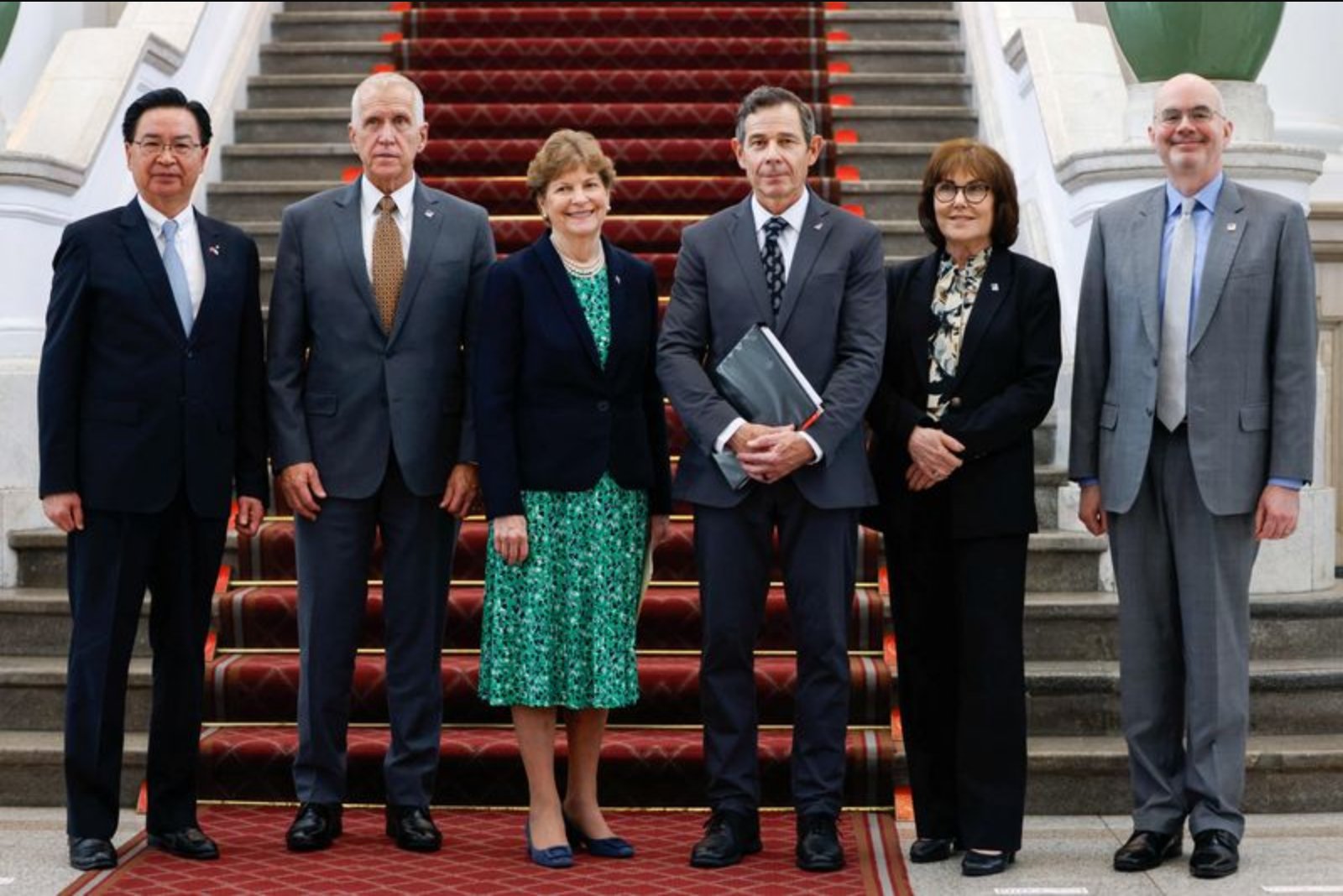
TAIPEI - U.S. lawmakers who arrived in Taipei on Monday called for quick approval of President Lai Ching-te’s proposed $40 billion special defence budget, warning that postponement could erode Taiwan’s ability to deter mounting Chinese military pressure even as the United States accelerates arms sales and broader security assistance.
The delegation was led by Republican Senator John Curtis and included three other lawmakers. Curtis, who is described as a long-standing friend of Taiwan, spoke after meeting Lai in the presidential office and framed the visit as a message of solidarity.
"We’re here to enforce that message and demonstrate to the people here in Taiwan that we are together a very important part of the safety and the unity around this world," Curtis told reporters. He added a personal endorsement of the special defence budget: "I’d like to personally endorse the special defence budget and tell you back in Washington, D.C., that my colleagues are watching, that this is important. We want to make sure that as we invest in this part of the world, that you are also investing and that we’re in this together."
Taiwan’s legislature, which is dominated by opposition parties, continues to debate Lai’s request for the additional defence funding. Despite the budget impasse, the legislature has authorised the government to sign agreements for four U.S. arms sales packages worth roughly $9 billion, allowing those purchases to move forward prior to full budget approval.
Also attending a briefing with reporters were Raymond Greene, the top U.S. diplomat in Taiwan, and Joseph Wu, Taiwan’s National Security Council Secretary-General.
Democratic Senator Jeanne Shaheen, who serves as the Ranking Member of the Senate Foreign Relations Committee, reiterated U.S. concern about intensified pressure from Beijing. "We are concerned by the increased pressure from Beijing, including military activity around Taiwan that raises the risk of miscalculation," she said.
The delegation’s visit comes amid an uptick in Chinese political and military activity targeting Taiwan. The article notes that China has escalated pressure on the island, including conducting war games - the most recent of which took place in December, shortly after Washington approved an $11 billion arms sale package to Taiwan.
The United States is also preparing a second arms sale package for Taiwan valued at about $14 billion, according to previously reported sources. Lawmakers and U.S. officials framed the push for Taiwan to pass the special defence budget as complementary to U.S. sales and security support, emphasizing a shared responsibility for regional stability.
This visit by U.S. legislators underscores the close, if informal, security relationship between the United States and democratically governed Taiwan - a relationship that persists despite the absence of formal diplomatic recognition. The lawmakers stressed that continued investment by Taiwan in its own defence capabilities is a critical element of deterrence alongside U.S. arms transfers and diplomatic backing.
Contextual notes
- President Lai Ching-te has proposed a $40 billion special defence budget that remains under debate in the opposition-led legislature.
- Four U.S. arms sales packages worth about $9 billion have been cleared for government signature before the budget is finalized.
- An earlier $11 billion U.S. arms sale was followed by Chinese war games in December, and a further $14 billion package is being prepared.