
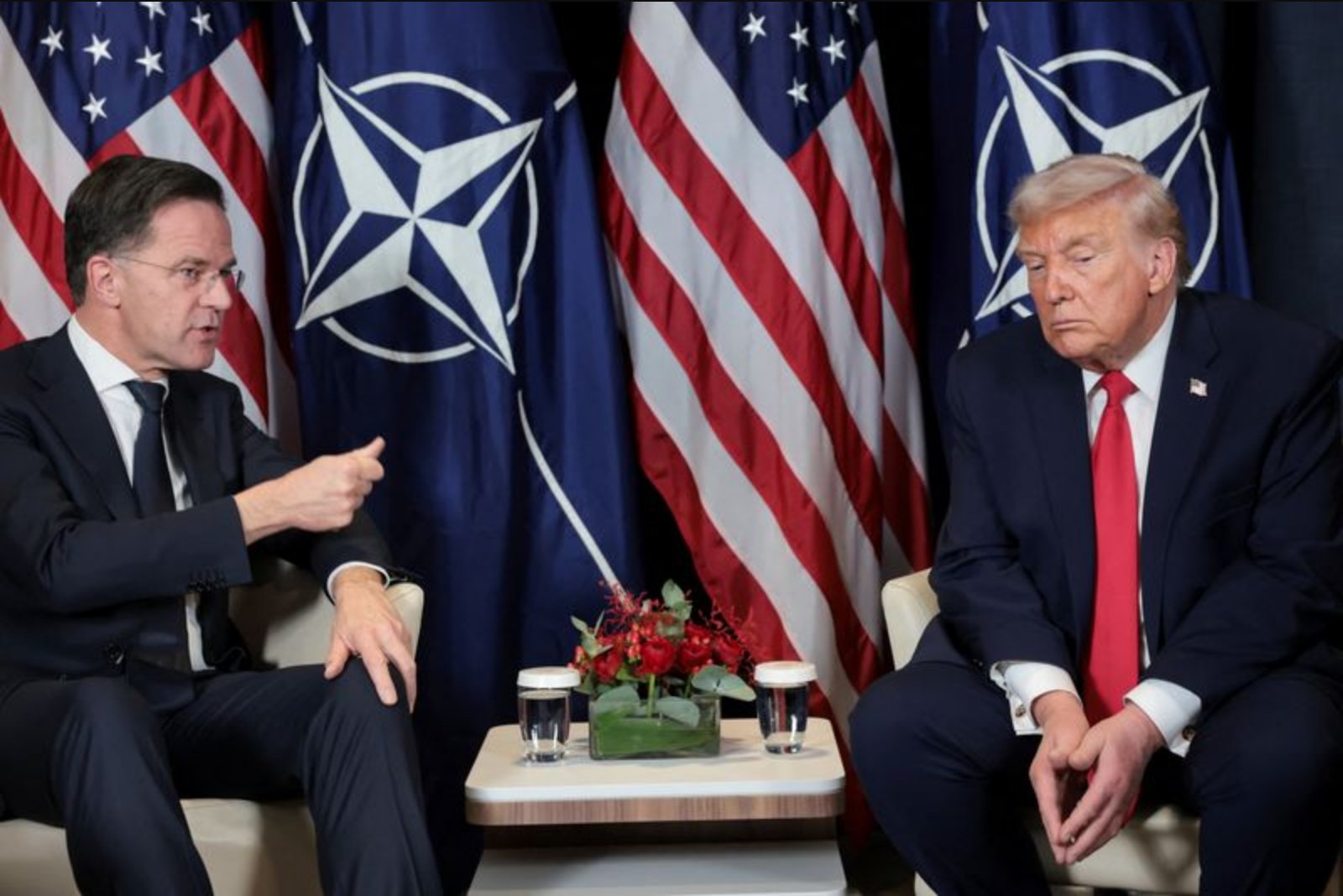
The U.S.-Israeli military campaign against Iran, launched with air strikes on Feb 28, has triggered a rupture in relations between Washington and its European allies that threatens to leave NATO in a markedly weakened state, diplomats and analysts say. The immediate catalyst for the latest division is U.S. frustration over European governments' refusal to dispatch their navies to help reopen the Strait of Hormuz to international shipping.
In a Wednesday interview, President Donald Trump questioned whether he should continue to support the alliance and said, "Wouldn’t you if you were me?" He has also said he is considering withdrawing the United States from NATO, a move that has provoked alarm across Europe and among allied officials who long relied on transatlantic security guarantees.
In a speech later the same day, Trump chastised some U.S. partners but stopped short of formally renouncing NATO, a step many observers feared he might take. Nevertheless, his recent rhetoric, together with other public criticisms of European governments, has generated unprecedented doubt about whether the United States would respond militarily to an attack on a NATO ally - even if Washington did not formally exit the alliance.
Analysts and diplomats describe the current moment as uniquely fraught. "This is the worst place (NATO) has been since it was founded," said Max Bergmann, who leads the Europe, Russia, and Eurasia Program at the Center for Strategic and International Studies in Washington. He said it is difficult to find a comparable period in which the alliance's cohesion and reliability were so seriously questioned.
For decades European capitals treated NATO as the central pillar of their security architecture against a more assertive Russia. That certainty is fraying as officials in multiple countries confront the prospect that the U.S. commitment may not be automatic. Where NATO Secretary-General Mark Rutte dismissed the notion of Europe defending itself without the United States in February as a "silly thought," several senior figures now describe independent European defense planning as the default assumption.
Former French armed forces chief General Francois Lecointre, who served from 2017 to 2021, said NATO's name itself may need re-evaluation if the United States' role cannot be relied upon. "NATO remains necessary, but we must be capable of thinking of NATO without the Americans," he said. "Whether it should even continue to be called NATO - North Atlantic Treaty Organization - is a valid question."
White House spokeswoman Anna Kelly reiterated the administration's position, saying, "President Trump has made his disappointment with NATO and other allies clear, and as the President emphasized, 'the United States will remember.'" A NATO representative did not immediately respond to requests for comment.
Although NATO has weathered serious strains before - including during Trump's first presidential term between 2017 and 2021 when he contemplated withdrawal - officials say the current situation differs from previous frictions. Many European leaders had hoped that official gestures, summit diplomacy and appeals to shared interests would keep Trump aligned with the alliance. That confidence has diminished amid mounting complaints from the U.S. side that NATO partners have not sufficiently supported American needs in a time of crisis.
U.S. officials and the president have cited NATO's refusal to assist directly in operations to reopen the Strait of Hormuz and the imposition of restrictions on U.S. use of certain allied airfields and airspace as evidence that the partnership has become a one-way commitment. European officials counter that they have not received concrete U.S. requests for assets required for a mission to reopen the strait and express frustration at inconsistent U.S. messaging on whether any such operation would take place during ongoing hostilities or only afterwards.
Jamie Shea, a former senior NATO official, said the standoff is damaging to partners who have sought to demonstrate greater willingness and capability to shoulder their own defense responsibilities since Trump returned to office. "It’s a terrible situation for NATO to be in," he said, calling the current blow to allied cohesion especially painful given recent efforts by Europeans to increase their contributions.
The current crisis follows a pattern of behavior that has already unsettled some allies. Earlier this year, Trump intensified his January threats to try to acquire Greenland from Denmark. More recently, Europeans have interpreted a number of U.S. actions as conciliatory toward Russia - even as Moscow is identified by NATO as its principal security challenge. Those moves include reports that Moscow provided targeting data to Iran for attacks on U.S. assets in the Middle East, and U.S. steps to lift sanctions on Russian oil in an effort to ease global energy prices that rose amid the conflict.
At a meeting of G7 foreign ministers near Paris last week, a sharp exchange reportedly took place between U.S. Secretary of State Marco Rubio and Kaja Kallas, the European Union's foreign policy chief. According to several people familiar with the discussions, Kallas asked when U.S. patience with Russian President Vladimir Putin would expire in the context of Ukraine peace negotiations. Rubio replied that the United States was focused on ending the war while continuing to support Ukraine, and suggested that the EU could take a lead on mediation if it wished.
Legally, a U.S. withdrawal from NATO faces major obstacles. A 2023 law requires a president to secure the consent of two-thirds of the U.S. Senate before officially exiting the alliance - a legislative threshold that is exceedingly difficult to achieve. Nonetheless, analysts warn that presidential control over the armed forces means the United States could effectively undermine NATO's mutual defense guarantee by choosing not to commit U.S. military forces to defend an ally, even without a formal withdrawal.
Not all observers view the episode as existential. One French diplomat described President Trump's remarks as a momentary temper flare-up. The president has altered his posture toward NATO in the past. On the 2024 campaign trail he suggested he would encourage Russian action against NATO members that did not meet defense spending expectations. Yet at the June 2025 NATO summit he offered effusive praise for European leaders, calling them people who "love their countries," and at that point the alliance appeared to be in a restored equilibrium with Washington.
Next week, Secretary-General Mark Rutte is scheduled to travel to Washington in a bid to repair relations and persuade the U.S. president to remain committed to the alliance. Diplomats and analysts note several pragmatic reasons for Europeans to keep the United States engaged in NATO, even as they plan more for independent defense. The U.S. military contributes capabilities that NATO cannot readily replace, including crucial satellite intelligence and other high-end systems.
Even if diplomatic efforts succeed in keeping NATO formally intact, many officials and analysts believe the relationship will be altered in fundamental ways. Julianne Smith, who served as U.S. ambassador to NATO in the Biden administration, said the transatlantic partnership is entering a new phase. "I do think we're turning the page of 80 years of working together," she said. "I don’t think it means the end of the transatlantic relationship, but we’re on the cusp of something that’s going to have a different look and feel to it."
The immediate political dispute over naval deployments to the Strait of Hormuz has thus become a catalyst for a broader strategic reassessment. European capitals are increasingly contemplating the practical and doctrinal implications of a NATO in which U.S. support might not be guaranteed in every contingency. At the same time, the United States faces the question of whether it will exercise its military primacy selectively in ways that leave allies unsure of Washington's commitments.
For policymakers, the dilemma is stark. Maintaining a unified NATO offers collective deterrence and capabilities no single European country can easily reproduce. Yet political misalignment between Washington and its partners, reflected in public rebukes and inconsistent policy moves, risks hollowing out the trust that underpins the alliance's mutual defense pact.
As Rutte prepares to attempt another round of persuasion in Washington, European leaders must decide how far they will go in expanding their defense autonomy while keeping open channels to the United States. The trajectory of that debate will determine whether NATO endures as the cornerstone of European security in a form close to its Cold War origins, or whether it evolves into a different, less U.S.-centric arrangement.