
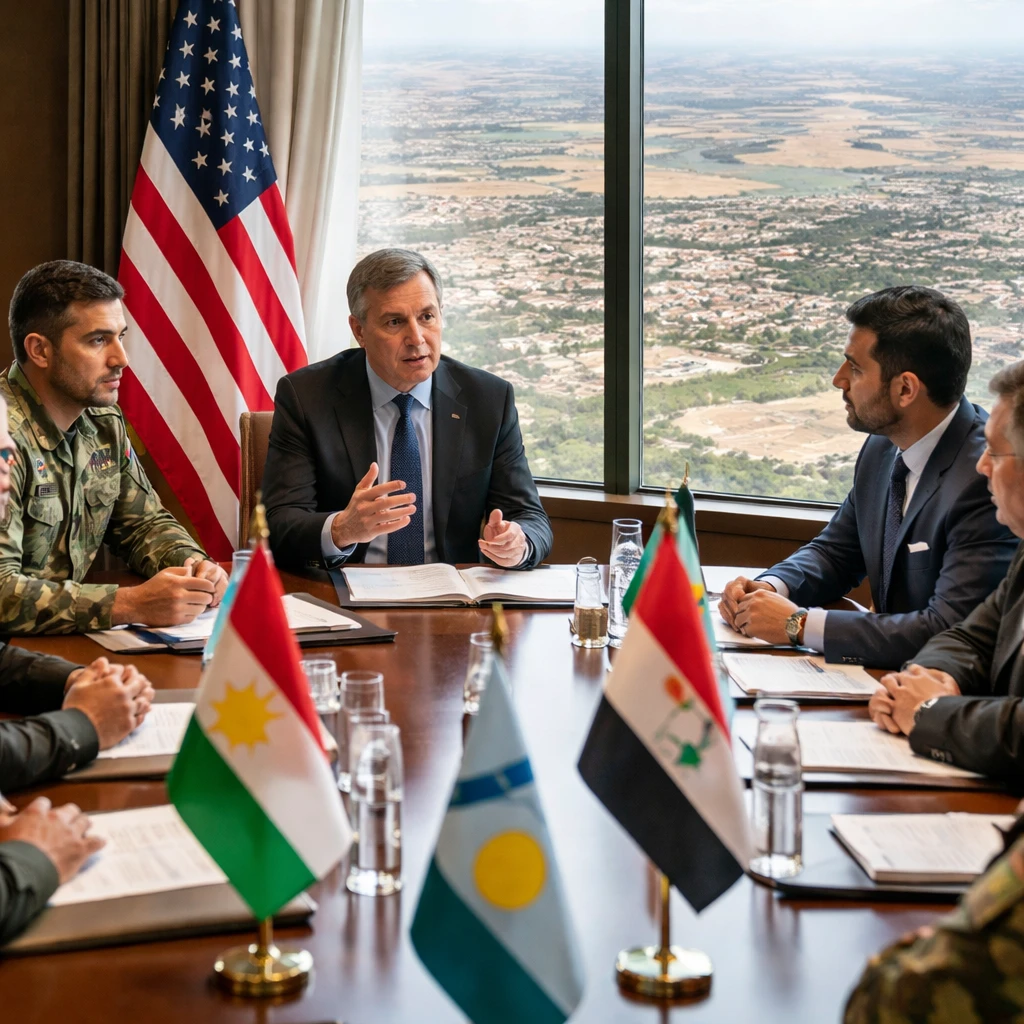
A U.S. envoy has called for the continuation of a ceasefire between the Syrian government and Kurdish-led Syrian Democratic Forces (SDF) amid escalating clashes in northeastern Syria. The Syrian government has regained control over significant territory, prompting a fragile truce where both sides have agreed on integration plans and confidence-building measures, despite mutual accusations of ceasefire violations. High-level diplomatic engagements are ongoing, involving Kurdish and Iraqi Kurdish leaders, focusing on political resolutions and strategic military withdrawals around key mixed-ethnicity areas such as Hasakah city.
Key Points
- A fragile ceasefire holds between Syrian government forces and Kurdish-led Syrian Democratic Forces amid recent territorial shifts in northeastern Syria.
- U.S. diplomatic efforts focus on enforcing the ceasefire and fostering confidence-building to support integration schemes outlined in a January 18 agreement.
- Meetings between Kurdish and Iraqi Kurdish political leaders address implementing the deal and possible mutual military withdrawals near ethnically mixed areas such as Hasakah city.
In the midst of ongoing unrest in northeastern Syria, a U.S. diplomatic representative has emphasized the critical need to uphold the current ceasefire agreement between the Syrian government and the Kurdish-led Syrian Democratic Forces (SDF). This call follows recent confrontations sparked by the Syrian government’s successful efforts to regain control of extensive areas, as they seek to reestablish authority over the region.
The conflict escalated after the SDF, a coalition prominently featuring the Kurdish YPG militia, resisted the government’s demands to integrate their fighters and administrative strongholds into Syria’s state framework. On Tuesday, a ceasefire was proclaimed whereby the government provided the SDF with a four-day window to devise an integration plan for the remaining autonomous enclaves. Under this arrangement, Damascus has pledged not to deploy troops into two principal SDF-held cities, contingent on reaching a mutual agreement.
Tom Barrack, the U.S. envoy, conveyed on Thursday his discussions with SDF commander Mazloum Abdi and influential Kurdish political figure Ilham Ahmed, reaffirming American endorsement of the integration roadmap established on January 18. Barrack articulated that all stakeholders concurred on the necessity of fully respecting the ceasefire as the foundational step, alongside collaboratively executing confidence-building strategies to nurture trust and secure sustainable peace.
However, since the ceasefire's announcement, both the Syrian government and the SDF have accused each other of breaches. Once a close ally of Washington in Syrian operations, the SDF’s position has been destabilized owing to increasing U.S. alignment with Syrian President Ahmed al-Sharaa’s administration. Barrack noted earlier this week that the initial rationale behind the SDF's existence has largely diminished, with the group now confined chiefly to Kurdish-majority territories.
In parallel diplomatic efforts, Commander Abdi engaged with Nechirvan Barzani, the president of Iraq’s Kurdish autonomous region, on the same day. Iraqi Kurdish political leader Wafa Mohammed from Barzani’s Kurdistan Democratic Party highlighted that the meeting was convened upon the Iraqi Kurdish leadership’s initiative to deliberate the SDF-Sharaa agreement. Mohammed acknowledged significant U.S. and international pressure urging the SDF to resolve their disputes and implement the accord, yet expressed skepticism over the potential for these efforts to yield positive outcomes, citing the SDF's mistrust of assurances offered by Sharaa.
Additional discussions reportedly cover a strategic withdrawal proposal, involving both parties pulling their forces back approximately 10 kilometers from Hasakah city’s outskirts, which remains under SDF control and is characterized by a demographically mixed populace.
In recent days, the Syrian government’s forces have reclaimed critical assets formerly under SDF oversight, including the nation’s largest oil fields, key agricultural zones, and detention facilities housing Islamic State captives.
The SDF’s historical control extended over a quarter or more of Syria’s territory, where they have aimed to maintain substantial autonomy to safeguard their governance and cultural rights. The group remains wary of Damascus’s intentions, fearing domination despite commitments from Sharaa to protect all Syrian citizens’ rights.
A Syrian foreign ministry official, who spoke anonymously, reiterated the government's preference for political solutions and assured that Kurdish rights were respected, asserting that Kurds would not face marginalization akin to prior eras under the ousted leadership of Bashar al-Assad. The official warned that all options remain viable if cooperative dialogue via negotiations is not heeded, urging the YPG to engage constructively at the negotiating table.
These developments carry implications beyond the immediate conflict zone, affecting regional stability, energy production, and political alliances within Syria and its neighboring Kurdish regions. The precarious nature of the ceasefire and the ongoing political negotiations will remain critical in shaping the trajectory of northeastern Syria’s future.
Risks
- Ongoing accusations of ceasefire violations by both Syrian government and SDF raise risks of renewed hostilities, threatening regional stability.
- Distrust by the SDF toward Syrian government promises undercuts prospects for successful political integration and long-term peace.
- Territorial control of vital economic resources such as oil fields may become contested, impacting Syria's energy sector and local economies.