
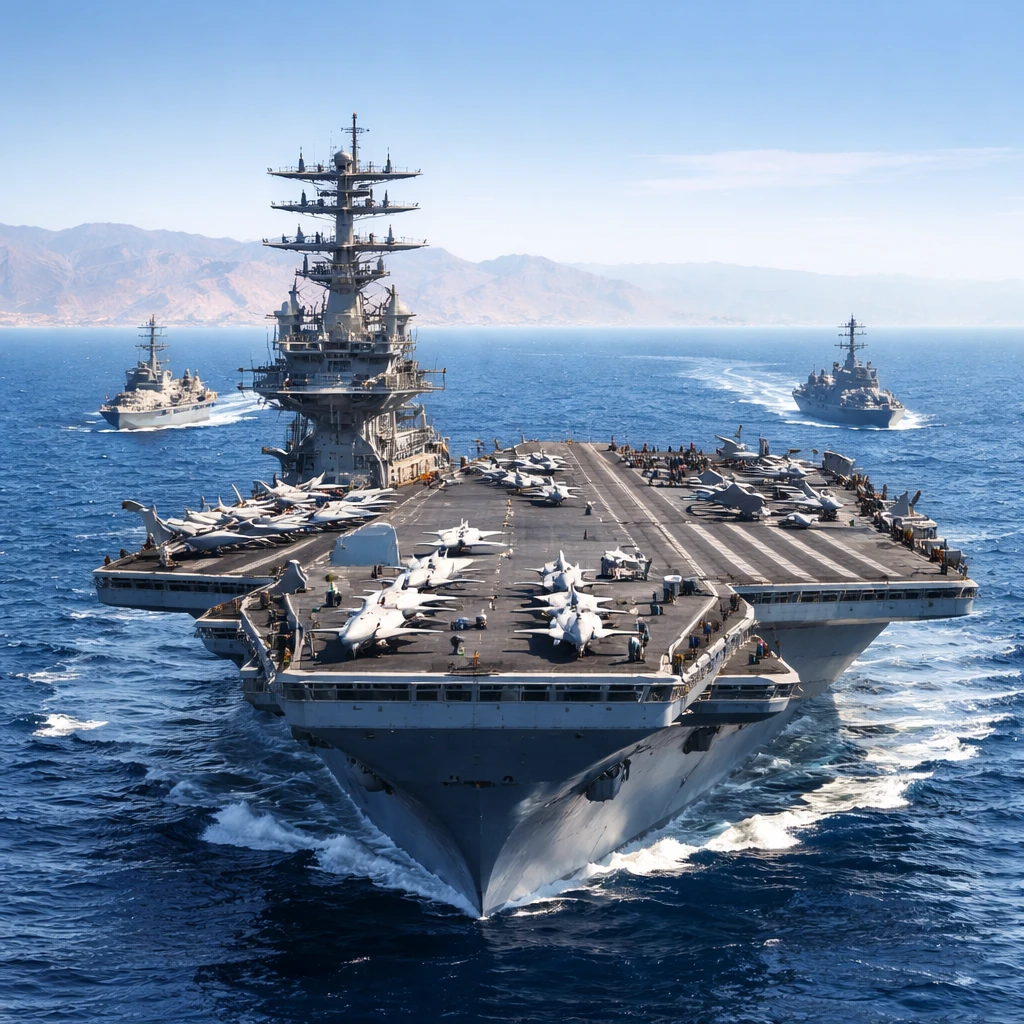
The U.S. is dispatching a carrier strike group, including the USS Abraham Lincoln, alongside destroyers and fighter jets, to the Middle East within the next few days, according to two U.S. officials speaking on Thursday. This maneuver responds to escalating tensions following a harsh crackdown on Iranian protests, despite a recent cooling in rhetoric from President Donald Trump.
This deployment began last week as the listed naval forces transitioned from the Asia-Pacific region. In addition to naval reinforcements, officials disclosed that the United States is contemplating supplementing its regional presence with additional air defense systems, signaling an emphasis on bolstering defensive capabilities.
Historically, increased American troop presence in the Middle East often coincides with periods of regional strain, and experts highlight that such deployments can serve defensive purposes. Notably, a significant U.S. military buildup last summer preceded targeted strikes on Iran’s nuclear sites in June 2025, with the military underscoring the clandestine nature of that operation.
President Trump has issued stern warnings against Iran linked to the recent protest-related fatalities but has softened his tone in recent days as the protests declined in intensity. Shifting attention to other geopolitical priorities, including the U.S. interest in acquiring Greenland, the President expressed hope on Wednesday that military confrontation with Iran would be avoided.
In an interview at the World Economic Forum in Davos, Switzerland, Trump underscored his stance on Iran’s nuclear ambitions, referencing the significant air strikes of June 2025. He stated, “They can’t do the nuclear. If they do it, it’s going to happen again.” This underscores ongoing U.S. resolve to prevent Iran’s advancement toward nuclear weapons capability.
It has been at least seven months since the International Atomic Energy Agency (IAEA) last verified the quantity of Iran's highly enriched uranium, although regulations call for monthly monitoring. Iran is required to report on the status of the nuclear sites previously targeted by the U.S., including materials such as approximately 440.9 kilograms of uranium enriched up to 60%. This level of enrichment approaches weapons-grade, which is near 90%, and represents sufficient material potentially for up to 10 nuclear devices, as estimated by the IAEA's standards.
The question remains whether protests in Iran might intensify again. These began modestly on December 28 within Tehran’s Grand Bazaar, driven by economic hardships, and then rapidly spread across the country.
The U.S.-based human rights organization HRANA has confirmed 4,519 deaths related to the unrest, including 4,251 protesters, 197 security personnel, 35 minors, and 38 bystanders not directly engaged in the conflict. Additionally, HRANA is reviewing reports of 9,049 more deaths related to the turmoil. Meanwhile, an Iranian official reported a confirmed death toll surpassing 5,000, which includes 500 members of the security forces.
As such, these developments highlight a complex situation involving military preparedness, nuclear monitoring challenges, and domestic unrest within Iran, all of which bear significant implications for the region and U.S. policy.