
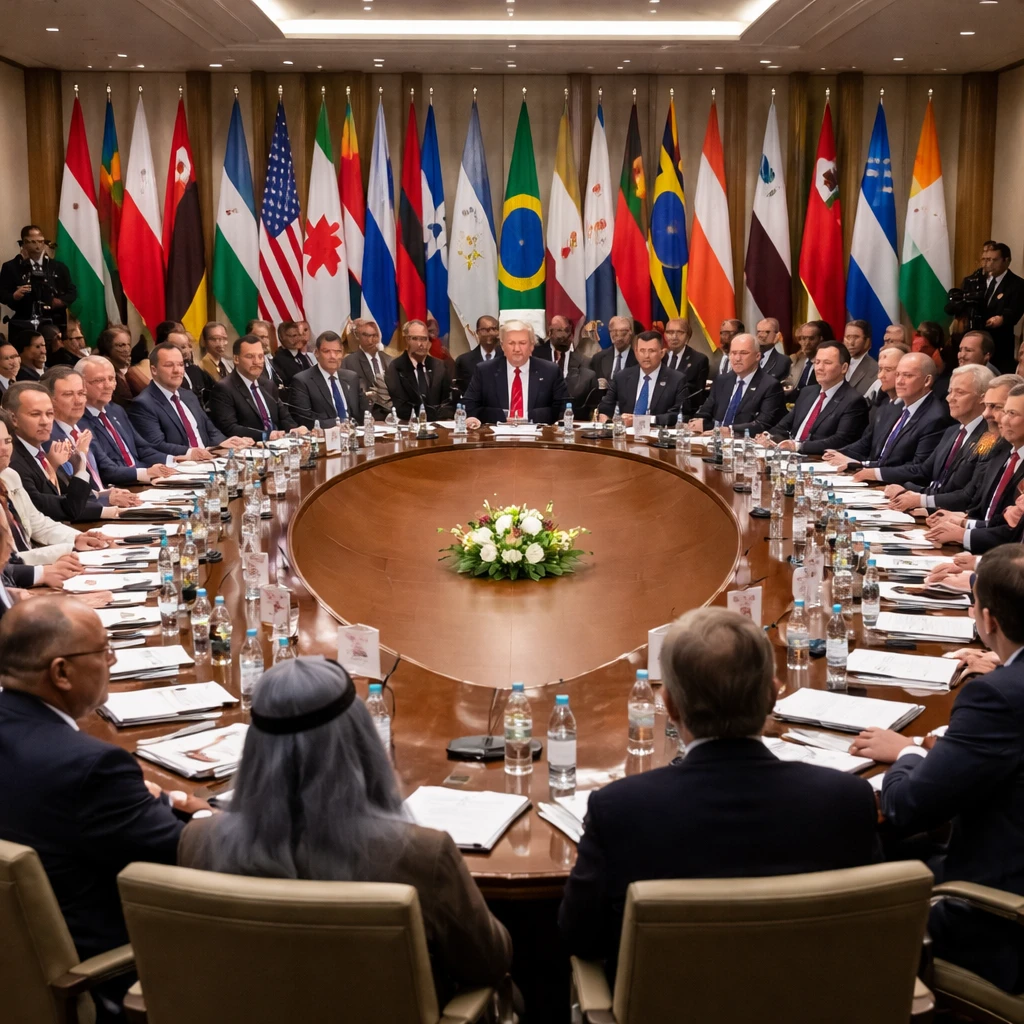
In September, U.S. President Donald Trump introduced the concept of a 'Board of Peace,' initially as a mechanism to bring an end to the Gaza conflict. The plan has since evolved to encompass a broader international mandate aimed at resolving various global disputes. According to a draft charter obtained by this reporting team, Trump will serve as the first chairman, with the board tasked with promoting peace and addressing conflicts around the world.
The proposed charter outlines that member states will be appointed for three-year terms by default. However, countries that contribute $1 billion each to finance the board’s operations could obtain permanent membership status. The White House has already named several founding members of the board's Executive Board, including U.S. Secretary of State Marco Rubio, Trump’s special envoy Steve Witkoff, former British Prime Minister Tony Blair, and Trump’s son-in-law Jared Kushner.
A high-ranking White House official disclosed that roughly 35 world leaders have committed to joining out of approximately 50 invitations sent. The group of participants includes Middle Eastern allies such as Israel, Saudi Arabia, the United Arab Emirates, Bahrain, Jordan, Qatar, and Egypt. NATO members Turkey and Hungary, both led by nationalist figures with cordial relations with Trump, have also accepted, alongside Morocco, Pakistan, Indonesia, Kosovo, Uzbekistan, Kazakhstan, Paraguay, and Vietnam.
Notably, Armenia and Azerbaijan have accepted the invitation, following a peace agreement mediated by the U.S. last August involving direct talks with Trump. Belarusian President Alexander Lukashenko, often marginalized by Western nations for his government’s human rights record and support for Russia’s military actions in Ukraine, has also accepted the offer amid improving relations with Washington.
The response from global powers such as Russia and China remains pending. Both nations, significant players on the U.N. Security Council, have historically been wary of initiatives that might challenge their influence. While Russia’s ties with the U.S. have somewhat warmed under Trump's administration — with the president often accusing Ukraine of impeding peace — formal participation in the board has not yet been confirmed. China, despite recent trade compromises with the U.S., has also refrained from issuing an official stance.
Addressing concerns that the 'Board of Peace' might aim to supplant the United Nations, Trump emphasized his support for the U.N.'s continuation, pointing to its formidable potential despite his past criticisms regarding its effectiveness.
Several close U.S. allies have exercised caution or declined invitations. Norway and Sweden have refused to participate. Italy expressed hesitancy, with officials citing constitutional challenges that might arise from joining a board led by a single nation's leader. France has also indicated it will refuse membership, prompting Trump to threaten punitive tariffs on French wines and champagnes. Canada has agreed "in principle" but is finalizing participation details, while the United Kingdom, Germany, and Japan have yet to take definitive public positions. German Chancellor Friedrich Merz is reportedly not attending the board signing at the World Economic Forum in Davos. Ukraine is reviewing the invitation but maintains reservations about associating with Russia on any such forum given ongoing conflict. The Vatican, via statements from the Holy See, confirmed that Pope Leo has been invited and is reviewing the proposal.
The U.N. Security Council gave a mandate to the Board of Peace in November, initially restricted to Gaza and effective through 2027. The resolution approved the board's role as a transitional administration tasked with establishing frameworks and coordinating funding for Gaza's redevelopment under Trump’s peace plan, contingent on reforms by the Palestinian Authority. It further authorized the deployment of a temporary International Stabilization Force there. Despite this mandate, Russia and China abstained in the vote, expressing dissatisfaction with the lack of explicit U.N. involvement in Gaza’s future governance.
The board is expected to report biannually to the U.N. Security Council on its activities. Outside Gaza, the board’s legal scope, enforcement abilities, and coordination with the U.N. and other entities remain ambiguous. The President of the board, per the draft charter, holds significant executive authority, including veto power and the ability to remove members under defined conditions. The board pledges to conduct peace-building operations in accordance with international law.
The creation and advancement of this initiative have generated complex diplomatic reactions, highlighting divisions among traditional U.S. partners and raising questions about its future role amidst existing global institutions.