
World January 26, 2026

Ukrainian Painters Battle Cold and Cuts to Keep Art Alive Amid Bombardment

Artists in Kyiv fight freezing studios and disrupted utilities as winters grow harsher under sustained attacks on energy infrastructure

By Avery Klein
Ukrainian Painters Battle Cold and Cuts to Keep Art Alive Amid Bombardment

As attacks on Ukraine's heating and power systems continue, artists in Kyiv are improvising to keep studios warm enough to work. Painters describe frozen tubes of paint, makeshift heating from camping stoves and boiled kettles, and the tension of having members of their collective serving at the front - one reported missing in action. Despite the cold and darkness, they persist in producing work and using art as a form of endurance.

Key Points

  • Sustained attacks on heating and power infrastructure have left many Ukrainians facing an unusually harsh winter, affecting daily life and creative work.
  • Artists in Kyiv are improvising heating solutions, such as gas camping stoves, to keep studio temperatures above freezing and prevent paint from solidifying.
  • The art collective is directly impacted by the conflict - at least three members are in the military and one is missing in action, illustrating overlap between cultural and defense-related strains.

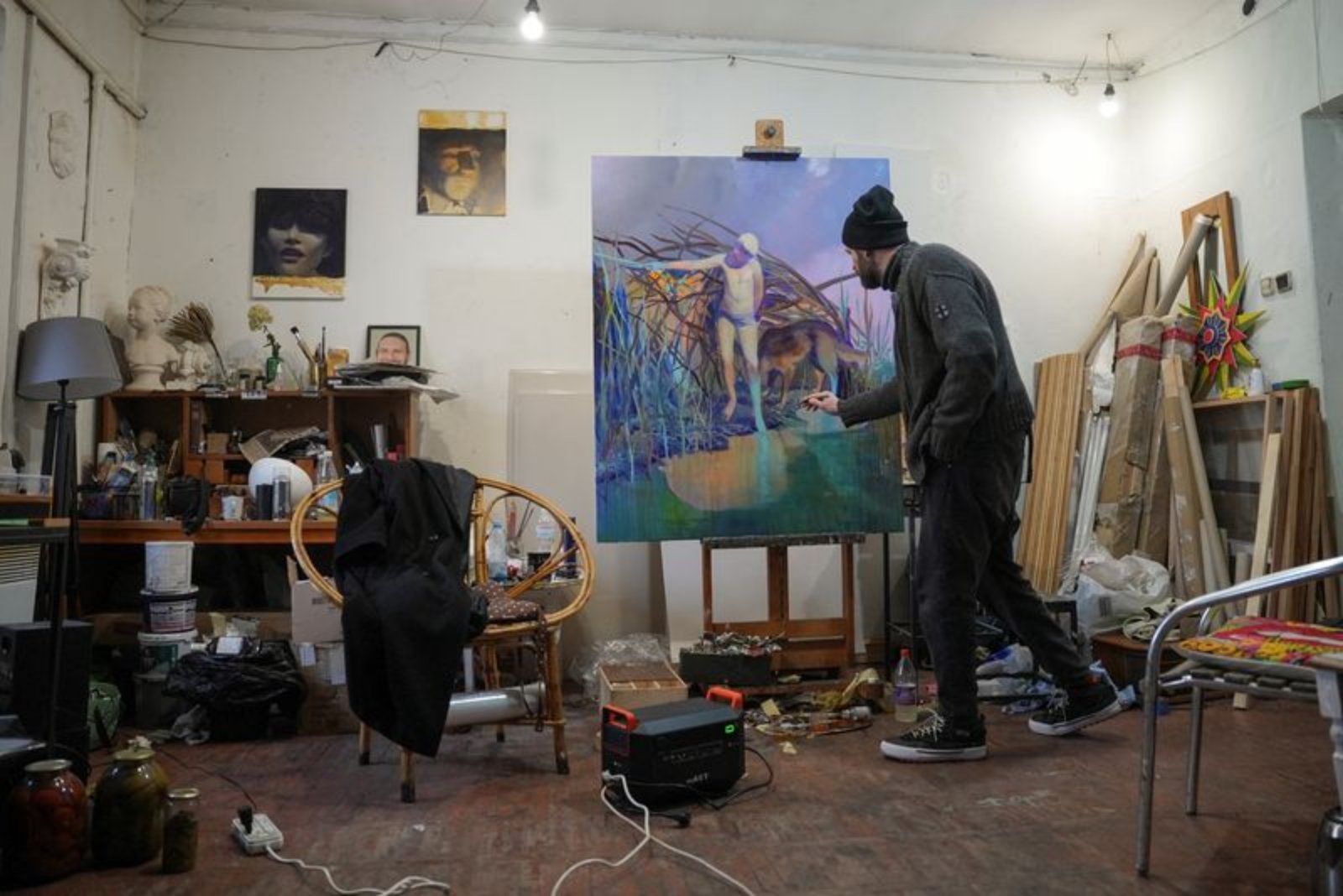
In a small Kyiv studio where icicles cling to the tap in the bathroom sink, surrealist painter Yuriy Denysenkov is careful to preserve warmth long enough to coax paint from its tube. He describes how Russia's sustained bombardment of Ukraine's heating and power system has contributed to what many residents consider the coldest and darkest winter since the conflict began four years ago.

"The paint freezes and it’s hard to squeeze it out," he says, managing to force a streak of dark blue onto a palette. He moves quickly, noting that working briskly helps him feel a little warmer as he lays down rapid brush strokes on a moody scene of a child testing a puddle with a dog nearby.

Elsewhere, steam forms from the breath of 70-year-old Oleksandr Liapin as he applies paint to a whimsical canvas. His image depicts an astonished white rabbit in a room where a candle hangs on the ceiling, rendered in bright yellow, pink and orange in a naive style. Outside the studio the temperature reads minus 10 Celsius (14 F), but a gas camping stove brought indoors has nudged the interior temperature above freezing, after boiling a kettle.

Both artists' descriptions emphasize how basic materials and simple warmth have become central to continuing their practice. Icicles on plumbing, paint that solidifies in tubes and the need to generate heat with portable stoves are recurring details in their accounts.

The art collective that includes these painters also feels the weight of the wider conflict. At least three members are currently serving in the military and one is missing in action. Liapin frames his work as a form of resistance and a means of communication: "The world sees that we’re living on and fighting. That’s why they’re helping us," he says, adding that his primary instrument in this struggle is his paintbrush.

Their stories underline how interruptions to heating and power affect daily life and creative practice, forcing artists to adapt to low temperatures and limited utilities while members of their community serve at the front.

Risks

  • Ongoing bombardment of heating and power systems increases the risk of prolonged exposure to cold for civilians and complicates operations for cultural institutions - impacting the energy and utilities sectors.
  • Low indoor temperatures can render artistic materials unusable, disrupting production and livelihoods in the arts and cultural sector.
  • Active military service among collective members, including a missing person, creates uncertainty for the continuity of collaborative creative projects and the small organizations that support them.

More from World

Who Can Compete in Women’s Events at Milano-Cortina? The Olympics and the Patchwork of Transgender Eligibility Rules Feb 2, 2026 U.S. Olympic hospitality site renamed 'Winter House' after protests over ICE shootings Feb 2, 2026 Greenland’s premier says U.S. still aims for control despite ruling out military action Feb 2, 2026 Kremlin says Russia has long offered to process or store Iran’s enriched uranium Feb 2, 2026 Long-Awaited Rafah Reopening Prompts Hope and Anxiety Among Palestinians Stranded Across Border Feb 2, 2026