
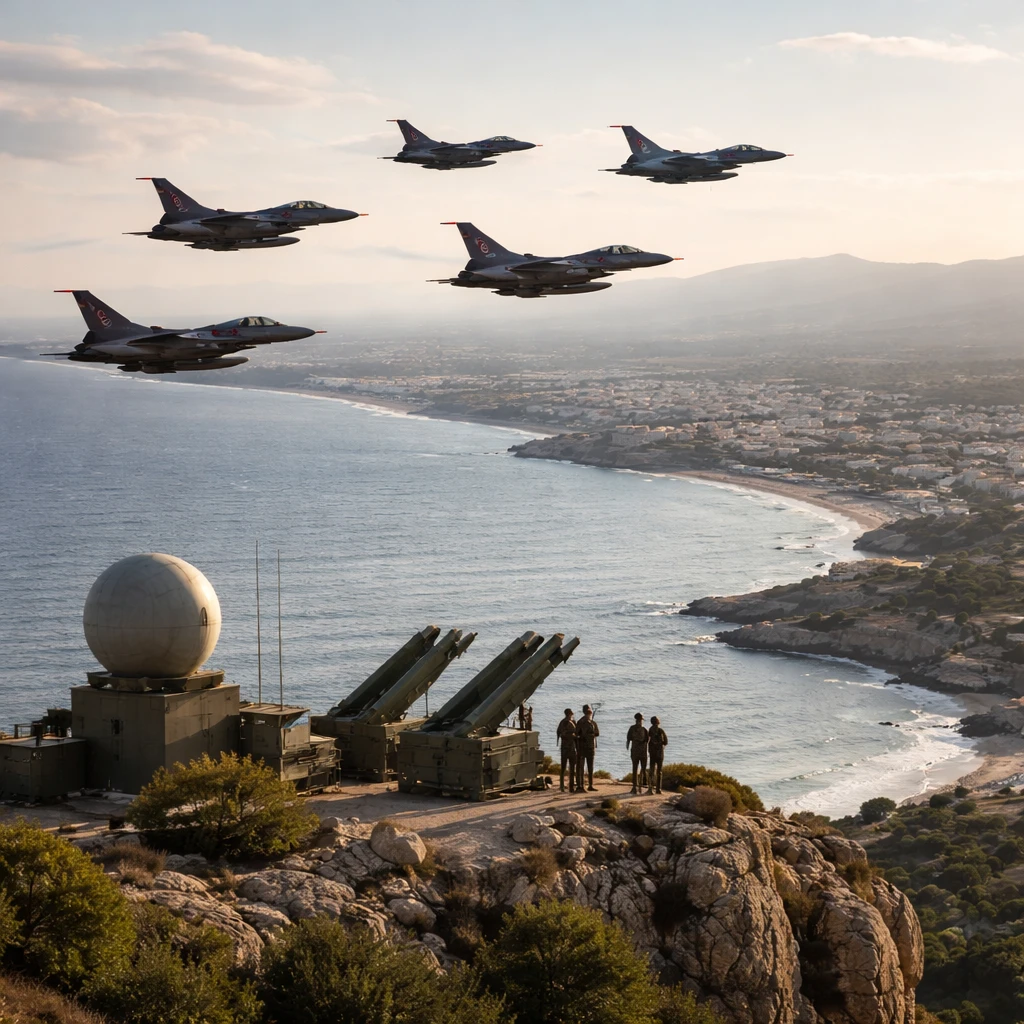
ANKARA, March 9 - Turkey said on Monday that it had sent six F-16 fighter jets along with air defence systems to the Turkish Republic of Northern Cyprus, stating the measures were intended to strengthen security for the Turkish community on the island.
The defence ministry issued a statement linking the deployments to recent developments in the region and to the wider context of the U.S.-Israeli war against Iran. The ministry said: "In the context of the latest developments in our region, six F-16 fighter jets and air defence systems have been deployed to the Turkish Republic of Northern Cyprus as of today." It added: "As a result of the evaluations to be made depending on the developments, additional measures will continue to be taken if necessary."
European countries have recently increased military deployments to the ethnically-split island. Those moves followed an incident last week in which a drone struck Britain’s Akrotiri air base in Cyprus; security officials suspect the drone was fired by Lebanon’s Iran-backed Hezbollah group.
The military build-up has prompted sharply different reactions across the island and beyond. Nikos Christodoulides, the president of the internationally recognised Greek Cypriot administration in the south, was quoted by Kathimerini newspaper as describing Turkey’s deployments as a "reaction" to European statements asserting that the island’s security falls under the responsibility of the European Union. Christodoulides also characterised Turkey as an "occupying power" in Cyprus.
Those comments were criticised by Turkish Cypriot leader Tufan Erhurman, who said the priority should be ensuring the security of the entire island for both Cypriot communities. The disagreement underlines the continuing political and security fault lines between the north and south of the island.
Omer Celik, spokesman for President Tayyip Erdogan’s ruling AK Party, framed the deployments as non-directed defensive measures. He said they were not aimed at any specific actor but were intended solely for security purposes and to "consolidate the power balance" on the island. He also signalled that Ankara could take further steps, telling broadcaster NTV: "But we must add this: other steps may come too, whether it is air defence systems, drone centres."
There was no immediate comment from Greece.
The move comes after other recent military incidents in the region. Last week, NATO defences shot down a ballistic missile that had been fired from Iran into Turkish airspace. Following that incident, Ankara, a NATO member, warned Iran on Saturday against firing more missiles towards it.
Turkey has warned that the recent European deployments to Cyprus carry a risk of drawing the island into the broader conflict. The island remains divided, with the south governed by the internationally recognised Greek Cypriot administration and the north recognised only by Turkey.
Context and implications
The deployments deepen an already tense security environment on Cyprus, where military postures have adjusted in response to regional hostilities linked to the U.S.-Israeli war against Iran. Ankara presents its actions as precautionary and reversible, while officials in the south view them through a prism of occupation and international responsibility.