
In a significant shift during his visit to Davos, Switzerland, U.S. President Donald Trump stepped back from his earlier confrontational approach regarding Greenland, halting immediate plans to impose tariffs on several European countries and highlighting progress toward a strategic agreement concerning the Arctic territory. Over recent weeks, Trump's declarations had unsettled the NATO alliance by suggesting the use of tariffs as leverage to acquire Greenland, the large Danish autonomous territory with a population of about 57,000. However, following talks with Dutch Prime Minister Mark Rutte, President Trump emphasized the emergence of a "long-term" deal focusing on security and resource interests in the region.
Trump articulated that the framework under discussion aims to safeguard Western interests in the Arctic by enabling the deployment of advanced missile-defense systems described metaphorically as a "Golden Dome," alongside securing access to critical mineral deposits. In his remarks to the press, Trump asserted, "It's a deal that's forever," underscoring a commitment to a durable understanding that he believes benefits all parties involved. When pressed on whether Greenland's status might change, Rutte confirmed that conversations did not extend to discussions of sovereignty or territorial transfer, highlighting a concentrated effort on defense and economic issues.
Earlier in the day, President Trump had engaged in extensive, critical commentary toward European nations, renewing the rhetoric of strained relations with traditional allies. His approach raised eyebrows among European diplomats, as it risked deepening a rift already present due to previous threats involving tariffs and territorial claims. Analysts described the latest diplomatic pivot as a de-escalation rather than a resolution, noting the absence of concrete details regarding how Trump's vision of "ownership" or control over Greenland's strategic assets aligns with the expressed positions of Greenland's government and Denmark, both of which have consistently rejected the notion of a sale.
According to a NATO spokesperson, negotiations among the United States, Denmark, and Greenland are set to continue, aiming chiefly at preventing economic or military footholds by Russia or China in the Arctic. Specific timelines and venues for these discussions remain undisclosed. Trump has reportedly tasked Vice President JD Vance, Secretary of State Marco Rubio, and special envoy Steve Witkoff to spearhead further diplomacy.
Contrasting sharply with the assertive U.S. stance, Russian President Vladimir Putin downplayed concerns, stating through Russian media that Greenland holds no strategic consequence for Russia. Meanwhile, Denmark emphasized respect for its sovereignty and the self-determination rights of the Greenlandic people. Danish Foreign Minister Lars Lokke Rasmussen indicated a preference for resolving the matter through private diplomacy rather than public commentary. However, the Greenlandic government had not issued any statements regarding the recent developments at the time of reporting.
President Trump's announcement on his social media platform Truth Social noted that the United States and NATO have crafted a "framework of a future deal" concerning not only Greenland but the broader Arctic region, explicitly linking this progress with his decision to halt planned tariffs set for February 1st. This reversal continues a pattern during Trump's second term of retracting or modifying significant policy threats or proposals before related deadlines.
The generally unexpected change in approach was welcomed by financial markets, as the S&P 500 experienced its most substantial daily gain in two months, rising 1.16%. This recovery came after the previous day's downturn, attributed in part to Trump's hawkish remarks on Greenland.
Throughout his stay in Davos, Trump's agenda was marked by a mix of sharp criticism and assertive diplomatic posturing. He admonished European nations on topics including renewable energy, immigration, and defense, positioning himself as a guardian of Western values. When discussing Greenland, while removing the prospect of military action, Trump praised U.S. military capabilities and cited recent operations such as the expulsion of Venezuela's Nicolas Maduro as demonstrations of strength.
He downplayed the territorial ambitions by labeling Greenland a "small ask" for a "piece of ice," maintaining that no other nation or group is better positioned than the United States to secure the island's strategic importance. Despite multiple misstatements referring to Greenland as Iceland, Trump underscored that any refusal on the part of Denmark or Greenland would not be forgotten.
In addition to the territorial discourse, Trump criticized allies including the UK, Switzerland, France, Canada, and the NATO alliance, touching on grievances involving energy policy, trade imbalances, and defense spending. His comments elicited muted reactions from his global audience in Davos, including mild laughter and silence, reflecting the controversial nature of his approach.
Notably absent from the speech was a robust domestic economic message, particularly on cost-of-living concerns that have posed political challenges for the administration. Although aides had indicated a forthcoming economic focus, housing affordability initiatives were only briefly mentioned an hour into the address.
Insider sources have interpreted Trump's Greenland involvement as part of his broader objective to leave a legacy through expanding U.S. territory in a manner unprecedented since the 1959 incorporations of Alaska and Hawaii. His Davos itinerary was also set to include a meeting with Ukrainian President Volodymyr Zelenskiy and efforts to enlist global leaders for his Board of Peace initiative, an endeavor aiming to mediate international conflicts but potentially complicating the United Nations' role, according to diplomatic observers.
Overall, Trump's softened rhetoric and ushering of diplomacy signal a temporary easing of tensions concerning Greenland and Arctic interests, with continued negotiation required to reconcile U.S. strategic aims and respect for Danish and Greenlandic sovereignty.
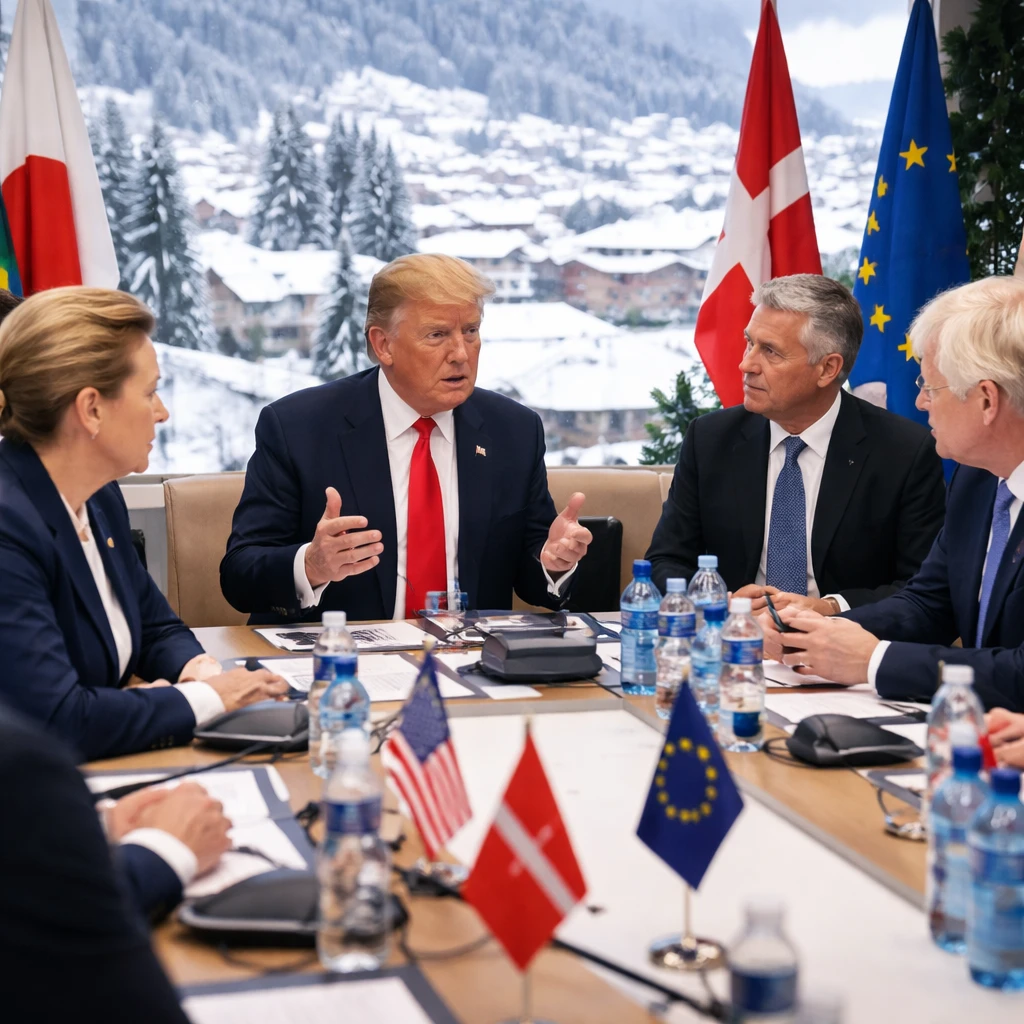
At the World Economic Forum in Davos, President Donald Trump withdrew prior threats to impose tariffs on European nations and escalating tensions over Greenland, proposing a framework aimed at Arctic security cooperation among Western allies. While the specifics of the agreement remain undisclosed, the U.S. aims to prevent Russian and Chinese influence in the region, engaging Denmark and Greenland in ongoing negotiations to balance strategic interests with sovereignty concerns. The shift in tone eased market anxieties and reduced strain in transatlantic relations amid days of sharp rhetoric and diplomatic challenges.
Key Points
- President Trump has halted tariff threats against European allies pending negotiations over Greenland and the Arctic region.
- A proposed long-term security and resource framework involving the U.S., Denmark, and Greenland aims to prevent Russian and Chinese influence in the Arctic.
- The diplomatic shift has been welcomed by markets and allies, easing concerns over potential transatlantic conflicts and trade disruptions.
Risks
- Uncertainty remains regarding the specifics of the agreement and the U.S. demand for Greenland's 'ownership,' conflicting with Danish and Greenlandic rejection of sale proposals.
- Potential ongoing tensions among NATO allies could impact diplomatic relations and cooperative defense efforts in the region.
- Market volatility may continue as traders react to shifts in geopolitical strategy and related trade policies, affecting sectors reliant on stable international relations.