
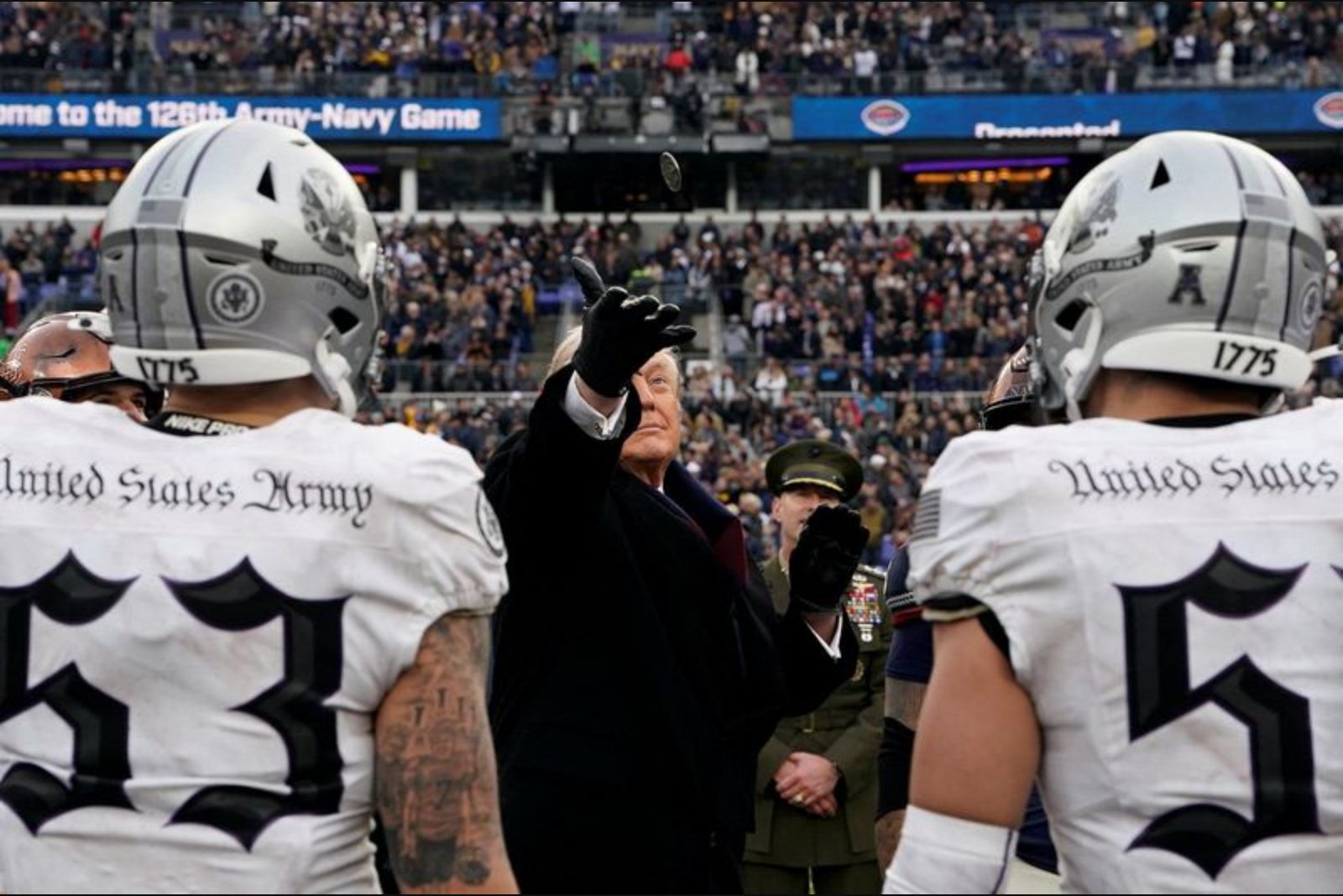
President Donald Trump signed an executive order on Friday intended to secure a single, nationwide television window in December for the Army-Navy football game. The game has been staged on the second weekend of December since 2009 and traditionally occupies a standalone position on the college football calendar; the Heisman Trophy presentation typically follows later that night.
The presidential directive addresses growing discussion about changes to the College Football Playoff (CFP) format. Current CFP scheduling for the recent two years has placed first-round games on the weekend after the Army-Navy matchup. The order highlights that talk of expanding the playoff has included plans that could add another round of games, which would require additional weekend dates and could create overlap with the Army-Navy slot if expansion is adopted.
Friday's order links the scheduling issue to a broader public-interest rationale. It states: "Such scheduling conflicts weaken the national focus on our Military Service Academies and detract from a morale-building event of vital interest to the Department of War." The text goes on to set out a policy preference: "Accordingly, it is the policy of the United States that no college football game, specifically college football's CFP or other postseason games, be broadcast in a manner that directly conflicts with the Army-Navy Game."
The administration's directive does not unilaterally alter league schedules or network programming. Rather, it instructs the Federal Communications Commission chairperson to engage with the CFP committee, the NCAA and media partners to protect the Army-Navy window. Executive orders are internal directives for federal agencies and the executive branch; they do not themselves compel private broadcasters or sporting bodies to change contracts or broadcast plans.
Complicating the scheduling landscape is an existing restriction on the National Football League. The order notes that the second weekend of December is the final weekend during which the NFL is not permitted to schedule Saturday games under the Sports Broadcasting Act of 1961. That detail helps explain why the Army-Navy game has historically occupied a weekend with limited competing professional football on television.
Before the move to the second weekend of December, the Army-Navy contest was more commonly held on the last weekend in November or the first weekend in December. The change implemented in 2009 was made with the dual aims of avoiding conflict with conference championship games and improving television ratings for the service academies' rivalry.
This year's Army-Navy matchup is due to be played on Dec. 12 at MetLife Stadium in East Rutherford, N.J. The CFP first-round games are scheduled for Dec. 18-19. The Army-Navy game has been held every year since 1930 and, in total, has been contested 126 times.
Whether the president's order will effectively prevent overlapping broadcasts remains unclear. The order's legal scope is limited to directing federal officials and agency cooperation. It explicitly tasks the FCC chairperson with consultation among the CFP committee, the NCAA and broadcast partners, but it does not create a binding prohibition on private scheduling decisions by leagues or networks.
Summary
The executive order aims to protect an exclusive television window for the Army-Navy game on the second weekend of December by directing the FCC chairperson to coordinate with college football authorities and broadcasters. The move responds to potential scheduling pressure from a possible expansion of the College Football Playoff and notes the NFL's Saturday restriction under existing law. The order's enforceability is uncertain because executive orders guide federal agencies rather than directly controlling private broadcasters or athletic organizations.
Key Points
- The order designates preserving an exclusive Army-Navy broadcast window as U.S. policy and names the CFP and other postseason games as potential conflicts.
- The directive asks the FCC chairperson to work with the CFP committee, the NCAA and media partners to guard against broadcasts that would directly conflict with the Army-Navy game.
- Broadcasting and sports sectors are implicated - networks, college football organizers and federal communications authorities will be involved in any coordination efforts.
Risks and Uncertainties
- Enforceability - executive orders are directives to the executive branch and federal agencies; they do not by themselves compel private broadcasters or sporting bodies to change scheduling.
- Playoff expansion - if the CFP expands to include more games, at least one additional round would be required, increasing the risk of calendar conflicts with the Army-Navy window.
- Broadcasting constraints - existing laws and scheduling practices, such as the NFL's Saturday restriction noted in the order, add complexity to coordinating calendars across leagues and networks.