
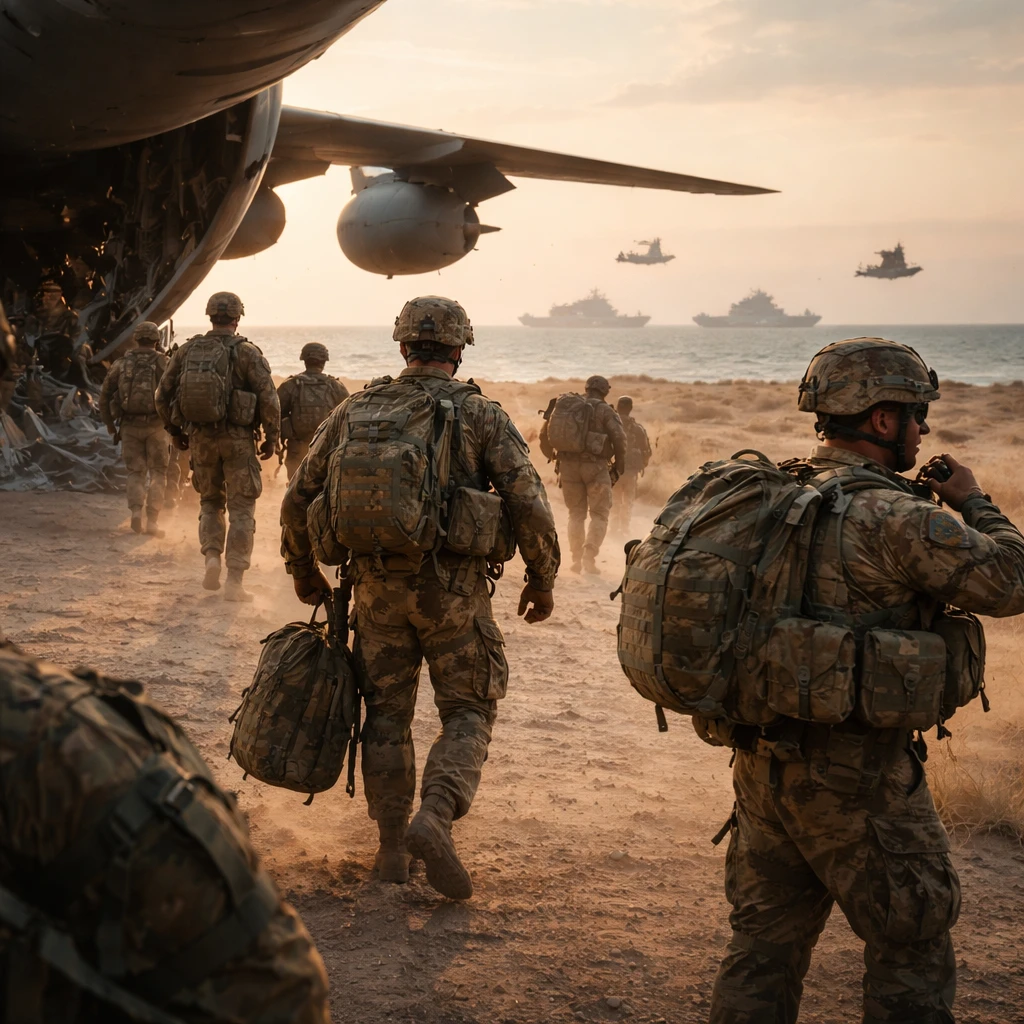
Two U.S. officials said on Monday that thousands of soldiers from the Army's 82nd Airborne Division have begun arriving in the Middle East, joining an expanding U.S. military presence in the region as the administration considers further actions in the war involving Iran.
The paratroopers, who are based at Fort Bragg in North Carolina, augment earlier deployments of sailors, Marines and Special Operations forces. Around 2,500 Marines reached the region over the recent weekend, and the incoming Army personnel are expected to increase operational capacity.
The officials, speaking on condition of anonymity, did not disclose exact destinations for the soldiers. They said the arriving forces include elements of the 82nd Airborne Division headquarters, logistics and other support units, and one brigade combat team.
No decision has been taken to move U.S. troops into Iran, the officials said, but the reinforcements are intended to build capacity for possible future operations in the theater. The additional forces provide commanders with more options if the White House decides to pursue ground or maritime measures related to the conflict.
Among the options discussed within the administration is a potential operation to seize Kharg Island, a center for Iran's oil exports that handles about 90 percent of those shipments. Officials have flagged that such an operation would carry elevated risk because Iran can target the island with missiles and unmanned aerial systems.
Senior planners have also explored the prospect of using ground forces inside Iran to remove highly enriched uranium. That option would likely require U.S. troops to operate deeper inside Iranian territory and for longer periods in order to locate and extract material that may be stored underground.
Internal discussions have further considered positioning U.S. forces on Iranian shores to help secure safe passage for oil tankers through the Strait of Hormuz. While securing maritime traffic would be accomplished primarily through air and naval assets, planners say that it could also entail deploying personnel to coastal areas.
President Donald Trump said on Monday that the United States was in talks with a "more reasonable regime" to end the war with Iran, while reiterating a stern warning to Tehran to open the Strait of Hormuz or face "U.S. attacks on its oil wells and power plants."
Officials caution that any employment of U.S. ground troops - even if limited in scope - could present significant political challenges for the administration. That concern stems from low public support among Americans for the campaign and from the president's pre-election pledges to avoid committing U.S. forces to new, protracted engagements in the Middle East.
U.S. combat operations linked to the campaign began on February 28. Since that date, forces have carried out strikes against more than 11,000 targets. As of the current phase of operations, more than 300 U.S. service members have been wounded and 13 have been killed as part of the effort identified by officials as Operation Epic Fury.
The arrival of 82nd Airborne elements further broadens the range of military options available to policymakers, while also increasing the logistical and command footprint in theater. Officials emphasized that the current deployments are intended to provide flexibility rather than to presage a specific course of action.
As the situation evolves, military planners and civilian leaders will weigh operational risks and political consequences alongside the tactical benefits provided by additional ground forces in the region.