
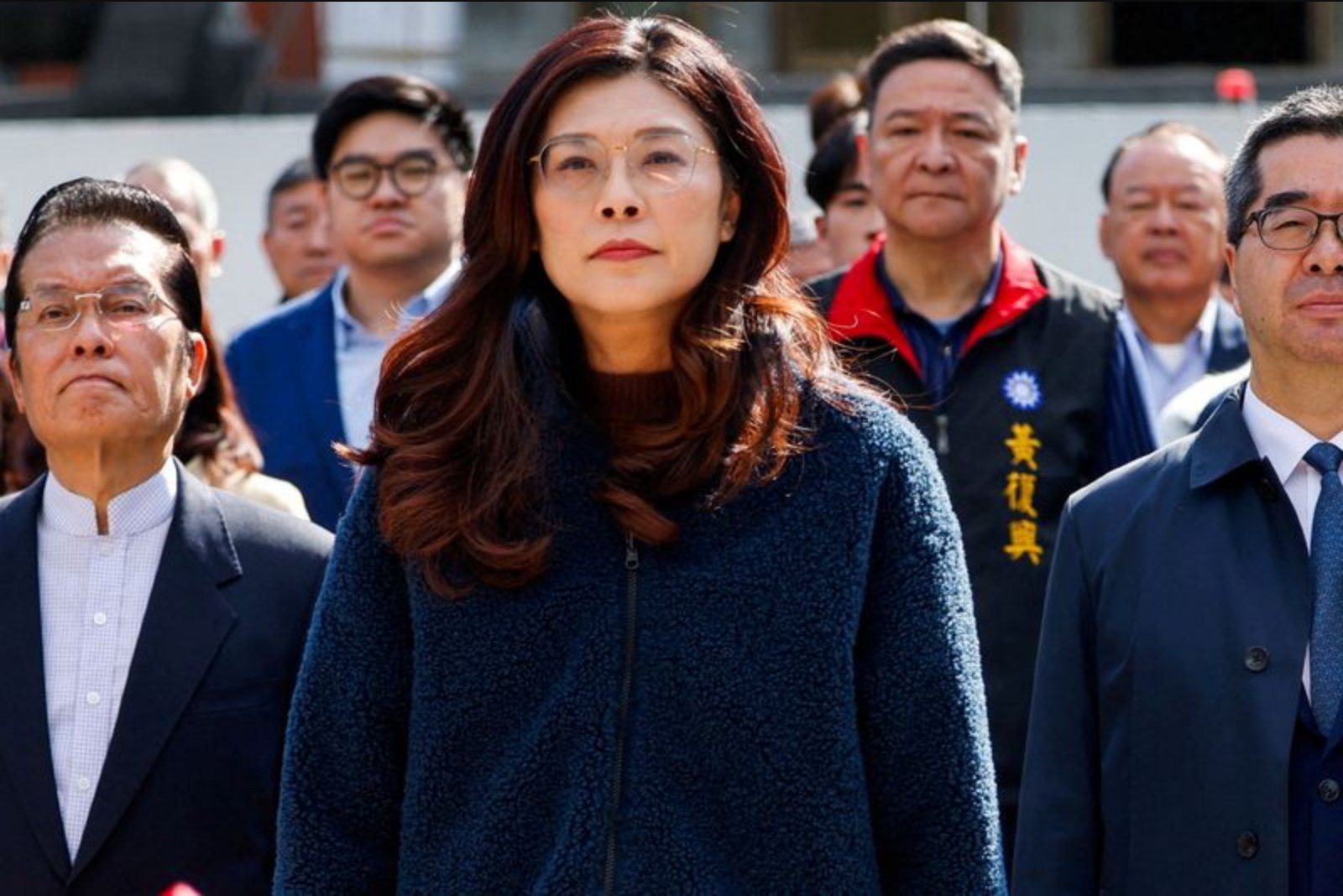
TAIPEI, April 6 - Cheng Li-wun, chairwoman of Taiwan's largest opposition party the Kuomintang (KMT), left for China on Tuesday for what she describes as a peace-oriented visit that could include a meeting with President Xi Jinping. Her trip comes at a moment of growing Chinese military pressure on Taiwan and amid domestic political standoffs over defence funding.
Cheng is travelling while Taiwan's opposition-dominated parliament has delayed consideration of a government proposal for an additional $40 billion in defence spending - a package the U.S. government has supported. The timing of her trip has amplified debate inside Taiwan about how best to preserve security and stability across the Taiwan Strait.
In the run-up to the visit, the KMT and the ruling Democratic Progressive Party (DPP) traded sharply contrasting social media messages that used the symbolism of war and peace to frame competing narratives. The KMT released a video on Sunday that said, "Peace is the only foundation for prosperity, and the hope for Taiwan’s future," showing young people in relaxed settings - on the ground, in a pool, and looking up at the stars with smiles.
The DPP replied on Facebook, accusing the KMT of attempting to "cooperate with the Chinese communists’ scheme to weaken Taiwan’s defence capabilities," and pointing to the legislature's postponement of the defence spending plan.
Cheng told foreign reporters last month that "peace cannot possibly be achieved through defence capabilities alone" and argued that political efforts have equal importance in preserving stability across the strait. She is scheduled to be in Beijing from Thursday, and her visit occurs roughly one month before U.S. President Donald Trump is due to meet Xi in Beijing.
While bilateral talks in Beijing could produce goodwill measures on trade issues such as agriculture and aircraft parts, officials and observers have indicated the leaders are also expected to address deeply contentious items including Taiwan, where no significant breakthroughs are anticipated. In a February phone call, Xi told Trump that the U.S. "must carefully handle arms sales to Taiwan."
This journey marks the first trip by a KMT leader to China in a decade, although Chinese authorities have not confirmed whether Xi will meet Cheng. Taiwan's Mainland Affairs Council, which shapes China policy, urged Cheng last week to press Beijing to cease military threats and to respect the right of Taiwanese people to determine their own future. Beijing has declined to engage with President Lai Ching-te, labeling him a "separatist."
China maintains it prefers "peaceful reunification" but has not renounced use of force to bring Taiwan under its control. In recent weeks Beijing has intensified efforts to convince Taiwanese that reunification would bring benefits, including references to energy security, claims Taiwanese officials have rejected.
As part of this broader push, the Eastern Theatre Command - the military formation that would oversee any operation against Taiwan - released a cartoon depiction on Friday that illustrated what it described as "Taiwan province" during the traditional Tomb Sweeping Festival, observed on Sunday, should the island be united with China. The image showed people laying flowers at a "Monument for the complete reunification of the motherland," in front of signage indicating the site as Taipei’s Machangding Memorial Park, the location linked in the depiction to historical events involving the execution of an accused communist spy in 1950.
Public opinion polls in Taiwan have consistently recorded minimal backing for Beijing's "one country, two systems" formula. When asked by reporters at a news conference about her stance on "reunification," Cheng said discussions on that topic are premature. "What we need to deal with now is how to create peaceful and stable cross-strait relations," she said.
Summary - Cheng Li-wun, leader of Taiwan's KMT, has departed for China on a visit she describes as aimed at peace-building and possibly meeting President Xi Jinping. The trip occurs against a backdrop of escalated Chinese military posturing and a domestic parliamentary delay in approving $40 billion in additional defence spending. The visit has sparked contrasting public messaging from Taiwan's major parties and comes ahead of a scheduled summit between U.S. President Donald Trump and Xi in Beijing.
Key points:
- The KMT chair's visit to China is presented by her party as a peace mission and may include talks with President Xi, though a meeting has not been confirmed by China. - Markets and sectors impacted: defence, agriculture, aerospace supply chains.
- Chinese authorities have increased public persuasion efforts for "peaceful reunification," including military-affiliated messaging; Taiwan's public shows little support for Beijing's reunification model. - Markets and sectors impacted: energy, defence, cross-strait trade.
- Domestic political disputes in Taiwan have delayed a $40 billion defence spending plan that the U.S. government supports, intensifying debate over how to balance military preparedness and political engagement. - Markets and sectors impacted: defence contractors, government procurement.
Risks and uncertainties:
- Uncertainty over whether a meeting between Cheng and Xi will take place - this could affect short-term diplomatic signaling and market perceptions in sectors tied to cross-strait relations, such as trade in agricultural products and aircraft components.
- Escalating Chinese military pressure and public persuasion campaigns create continued geopolitical risk for Taiwan's security environment, with potential implications for defence spending, energy policy, and investor confidence in the region.
- Domestic political gridlock over the proposed $40 billion increase in defence spending raises questions about Taiwan's ability to respond to security threats, affecting defence procurement cycles and related industries.
Tags: Taiwan, China, KMT, Defence, Cross-strait