
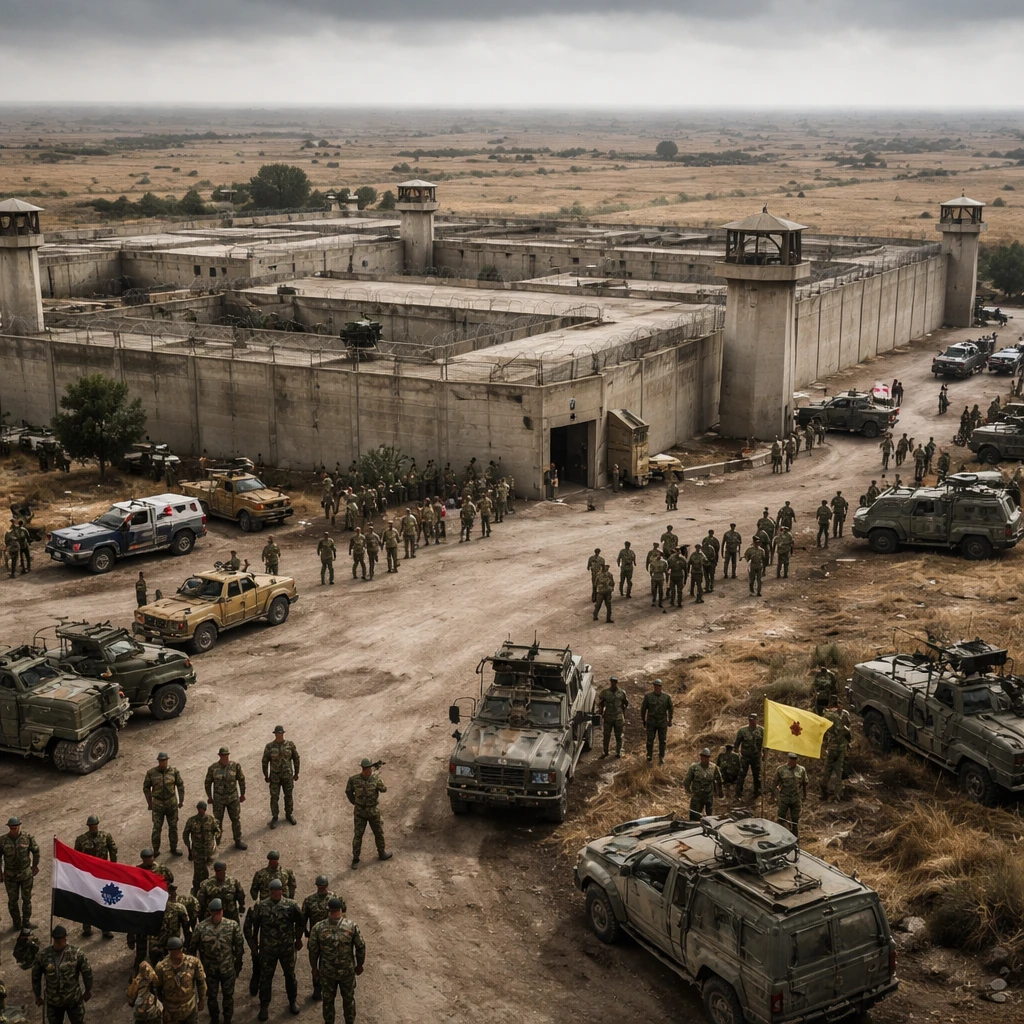
On Friday, Syrian government troops advanced their foothold in the northern region by taking command of a prison facility previously controlled by Kurdish-led Syrian Democratic Forces (SDF). This takeover, facilitated through negotiated Kurdish withdrawal from the al-Aqtan prison in Raqqa province, is viewed by a senior government official as indicative of a positive trajectory for the cessation of hostilities between the two sides.
Amid rapid territorial gains over the past two weeks, the Syrian Army, under President Ahmed al-Sharaa, has reclaimed significant northern and eastern zones from Kurdish factions. This momentum has consolidated Sharaa's authority nationally. Notably, earlier this week, Sharaa's forces began encircling the last remaining Kurdish-held urban centers in the northeast.
In a strategic move, Sharaa declared an immediate ceasefire, imposing a Saturday night deadline for the SDF to propose a plan for integrating with the Syrian Army. This timeline aims to expedite an extensive agreement reached on January 18 requiring the Kurdish semi-autonomous entities—established over the past decade—to reintegrate into Syria’s centralized government. The SDF had consistently resisted such reintegration efforts throughout the previous year.
Additionally, the accord mandates that the government assume control over multiple detention facilities formerly managed by the SDF. These prisons hold fighters and civilians affiliated with the Islamic State (IS), a jihadist Sunni group that the SDF fought alongside U.S. partners for years. Earlier this week, the government seized one prison and one detention camp following disorderly SDF withdrawals, which temporarily enabled some IS-related detainees to escape.
To mitigate further security risks, the government engaged in negotiations to facilitate the Kurdish evacuation of al-Aqtan prison. Conversations concluded overnight with Kurdish fighters exiting the facility peacefully. A senior Syrian government official expressed optimism that these developments bolster the prospects of a political resolution before the Saturday deadline, rather than a return to combat.
Nevertheless, the official noted that the government has yet to receive formal feedback from the SDF regarding its integration proposal or the nomination of a deputy defense minister candidate—a position Sharaa requested the SDF to fill.
SDF sources hinted at the possibility of extending the response deadline, but Syrian officials indicated no current discussions about such an extension. Despite hopes for diplomatic engagement, military posturing intensifies on both sides. Syrian military units are reportedly mobilizing, with reinforcements and equipment observed near Hasakeh, a significant Kurdish-controlled city in the northeast. Similarly, Kurdish forces there have bolstered their defensive positions.
International mediators, including senior officials from the United States and France, who have played pivotal roles in ceasefire coordination, have reportedly urged Sharaa to refrain from advancing troops into remaining Kurdish-held territories. French Foreign Ministry spokesperson Pascal Confavreux emphasized calls for the Syrian government to protect all civilians, including Kurds.
The United States, having historically supported the SDF, now recognizes Sharaa as its principal Syrian partner and has assisted with transferring detained IS fighters from Syria into Iraq.
The swift loss of territory witnessed among the SDF marks the most major alteration of Syria’s territorial control map since Sharaa’s forces overthrew former ruler Bashar al-Assad at the end of 2024. While Sharaa has pledged to govern inclusively, including Kurdish minorities, skepticism persists among Kurdish populations in the northeast, as well as Druze and Alawite communities in other regions.
In an effort to foster reconciliation, Sharaa issued a decree on January 16 officially recognizing Kurdish as a national language on par with Arabic. This symbolic gesture seeks to acknowledge Kurdish cultural presence within Syria’s framework.