
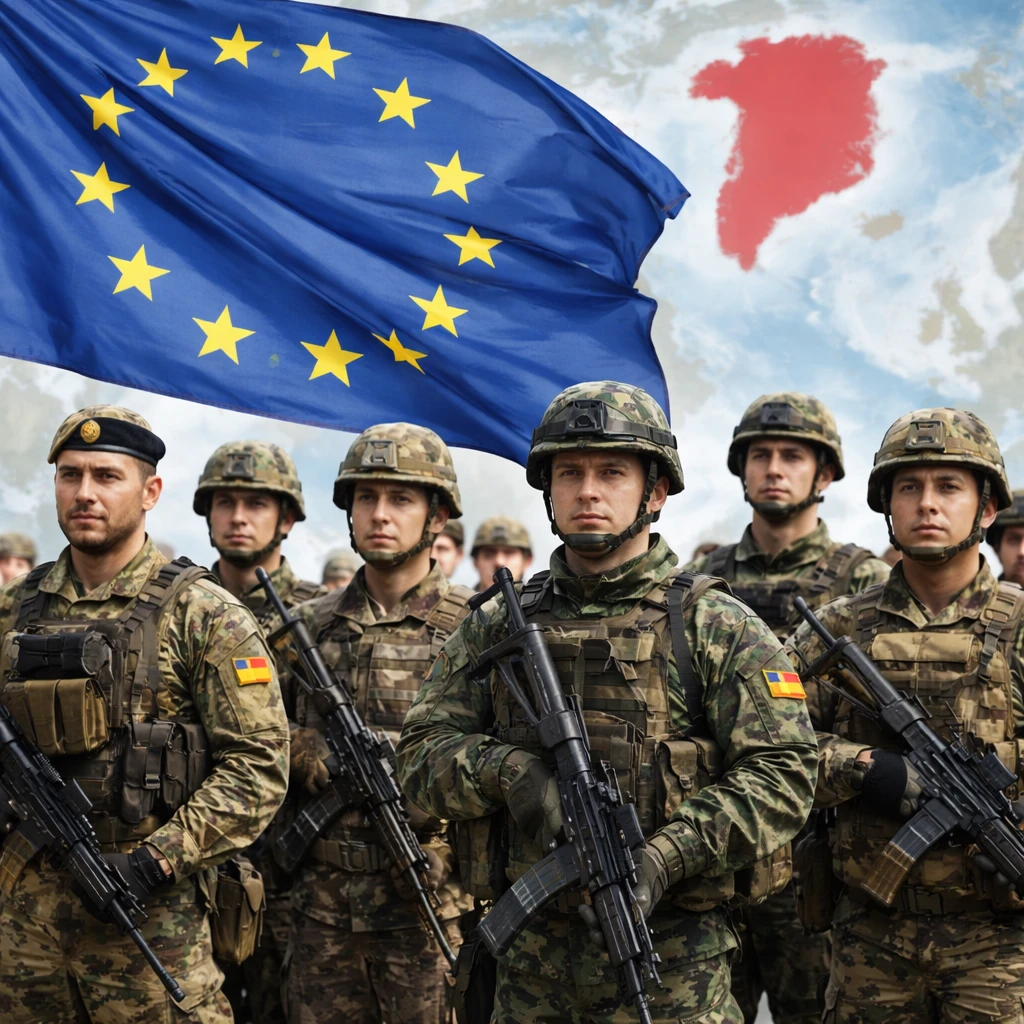
In discussions preceding a critical EU leaders' meeting, Spain has voiced strong support for the establishment of a joint European military force to enhance collective security. Speaking with Reuters, Spanish Foreign Minister Jose Manuel Albares highlighted the importance of consolidating the European Union's tangible defense assets and fostering cooperation among member nations equipped and willing to collaborate.
Albares acknowledged the legitimate hesitation among European citizens about assembling under a common military banner but argued that achieving a significant collective force is more feasible as a bloc rather than through individual national armies. He asserted, "A joint effort would be more efficient than 27 separate national armies," framing the concept as a path to streamline and strengthen the EU's defense capabilities.
This stance gains heightened urgency in the context of an imminent emergency summit scheduled for Thursday in Brussels, intended to coordinate a unified EU reaction to U.S. President Donald Trump's controversial push to buy or potentially annex Greenland. Despite Trump's social media claims that he and NATO Secretary General Mark Rutte had outlined a deal framework, EU officials have confirmed the meeting will proceed as planned to address the issue precisely.
During a concurrent meeting in Delhi with Indian Foreign Minister Subrahmanyam Jaishankar, Albares reaffirmed that the creation of a European army is not designed to replace the North Atlantic Treaty Organization (NATO). He underscored the essential role transatlantic partnerships play, stating the new defense structure aims to convey that Europe will not succumb to military or economic coercion.
Spanish foreign officials also indicated that, despite Trump's recent softening of his Greenland acquisition rhetoric following talks with Rutte, Spain remains eager to advance dialogue within NATO frameworks should this approach be solidified.
The idea of an integrated European military has roots dating back to 1951 as a mechanism to counterbalance Soviet influence and ensure post-war German military control, but was halted when France’s parliament rejected the proposal in 1954. Albares framed the current initiative as a continuation of the European Union’s foundational objective: "The idea of European defence was part of the origin of the EU. It is up to my generation to finish this task."