
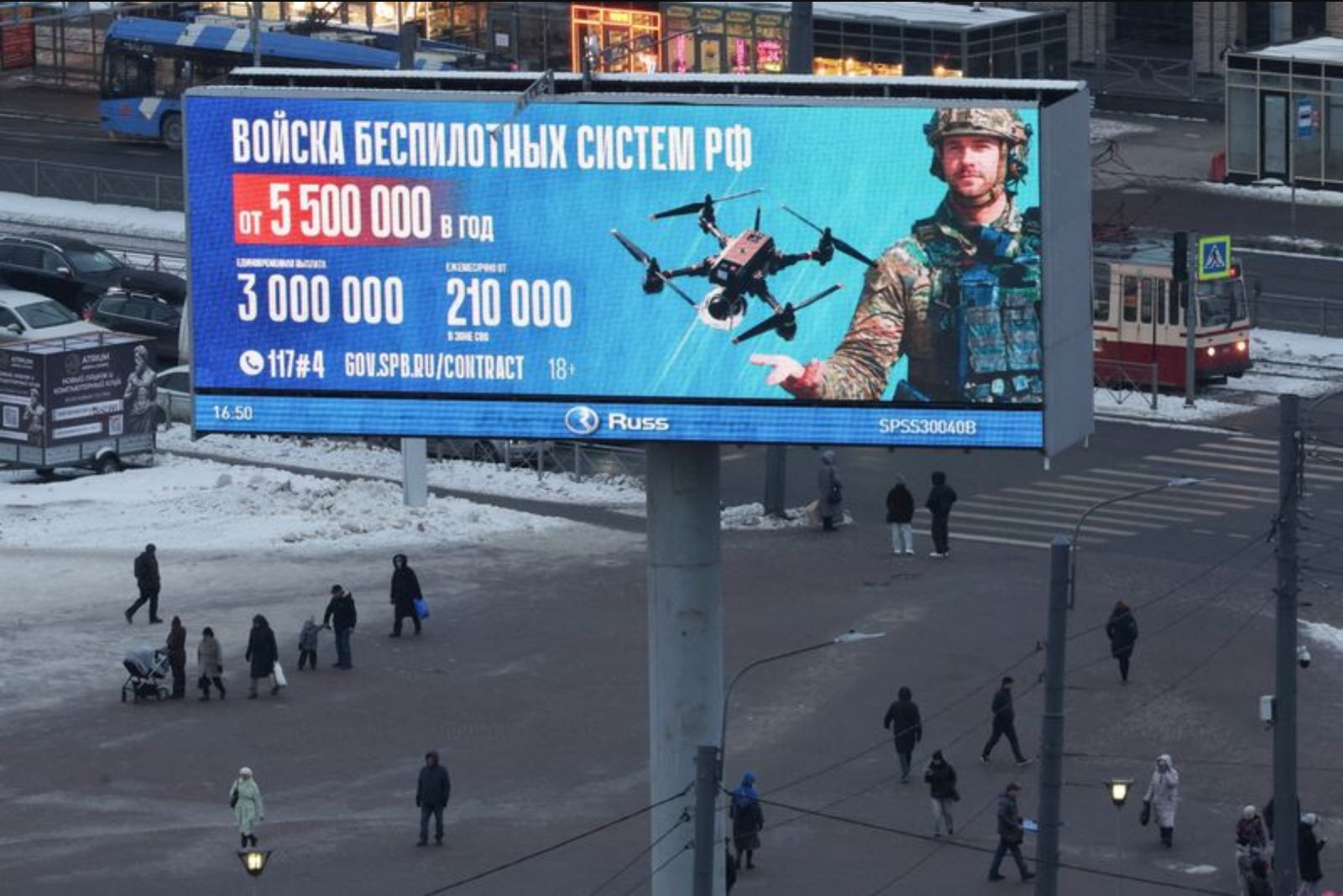
MOSCOW, April 2 - Documents and regional orders reveal a concerted effort within Russia to attract students and workers into military service tied to drone operations, offering substantial financial compensation and other incentives.
Universities across the country have circulated offers aimed at recruiting drone operators, engineers and technical specialists. At the same time, authorities in the Ryazan region have issued directives asking private and public companies to set internal quotas for staff to sign contracts with the Defence Ministry, according to a regional decree and published documents.
State of the recruitment effort
Officials cast the campaign as part of a rolling volunteer recruitment system rather than a broad mobilisation. Dmitry Medvedev, deputy chairman of the Security Council, told state media on Friday that the system continues to attract volunteers through generous financial packages, noting that more than 400,000 people signed up last year and over 80,000 have done so so far this year.
At the same time, the push to sign up students - particularly those with technical skills - appears intended to funnel skilled personnel into drone units, which both sides have relied upon in the prolonged conflict in Ukraine. Documents underline the premium placed on operators and engineers for these units, which are regarded as playing an increasingly central role in the ongoing war of attrition.
University offers and financial terms
Far Eastern Federal University in Vladivostok is among the institutions advertising substantial support for students who enlist. The university promises students who sign up for a minimum of one year - extendable academic leave - and guarantees exemption from tuition fees upon their return, in addition to free accommodation and grants. The institution also pledges to cover the costs of any military equipment and weaponry required.
These educational and logistical guarantees accompany what the documents describe as a sizeable monetary package: a first-year salary starting from 5.5 million roubles, a one-off payment of 2.5 million roubles following completion of free training, a monthly allowance of 240,000 roubles, and a separate one-off payment of 200,000 roubles from the university. The university described the offer in a document published on March 19, saying: "This is not only an opportunity to prove yourself, but also a unique platform for social and career advancement, backed by unprecedented support measures."
The Moscow State University of Civil Engineering has published a similar announcement, inviting students to become drone operators, engineers or technical specialists. The Russian State Hydrometeorological University in St Petersburg has also promoted enlistment, with its materials showing a drone operator position offering payments from 7 million roubles per year.
Recruitment reporting and public campaign
There have been media reports suggesting universities were given formal recruitment quotas to meet; those reports remain unconfirmed and could not be independently verified. The student-targeted outreach coincides with new public advertising: billboards deployed as part of a recruitment campaign depict a young drone operator wearing high-technology glasses with a futuristic visual effect, under the slogan "the new indispensables."
Officials and state channels have framed the activity as a voluntary recruitment surge rather than a return to large-scale mobilisation. Kremlin statements this week reiterated that a general mobilisation is not on the agenda, even as military operations continue in Ukraine and diplomatic efforts mediated by the United States remain stalled amid the Iran war.
Company quotas in Ryazan region
In the central Ryazan region, Governor Pavel Malkov issued a decree directing private and public companies to establish recruitment quotas for signing employees to contracts with the Defence Ministry. The decree, published on a government website and publicised by state media, set specific targets: firms with up to 300 workers should supply two army recruits, companies with up to 500 employees should provide three recruits, and companies with more than 500 employees should produce five recruits.
The decree specified the quota period would run from April to September but did not state what penalties, if any, companies would face for failing to meet the targets. It also indicated that Governor Malkov would personally oversee compliance with the requirements.
Context and operational risks
Those considering service as drone operators are being offered payments that, by local standards, are substantial. The documents and public statements highlight the value placed on operators and technical staff in the drone units, while also acknowledging their vulnerability: drone operators typically operate at some distance from front-line trenches but are considered high-value targets who can be hunted down and killed if their positions are revealed.
Currency conversion figures cited alongside university offers indicate that 1 US dollar equals 80.3705 roubles.
What remains unclear
Certain aspects of the recruitment drive are not fully verified in official records available to the public. Reports that universities have been mandated to meet recruitment quotas are unconfirmed. The Ryazan decree does not outline enforcement mechanisms for company quotas, leaving uncertainty over how compliance will be measured or enforced.
Officials maintain that recruiting large numbers through volunteer packages is an effective approach, while publicly denying a general mobilisation is planned.