
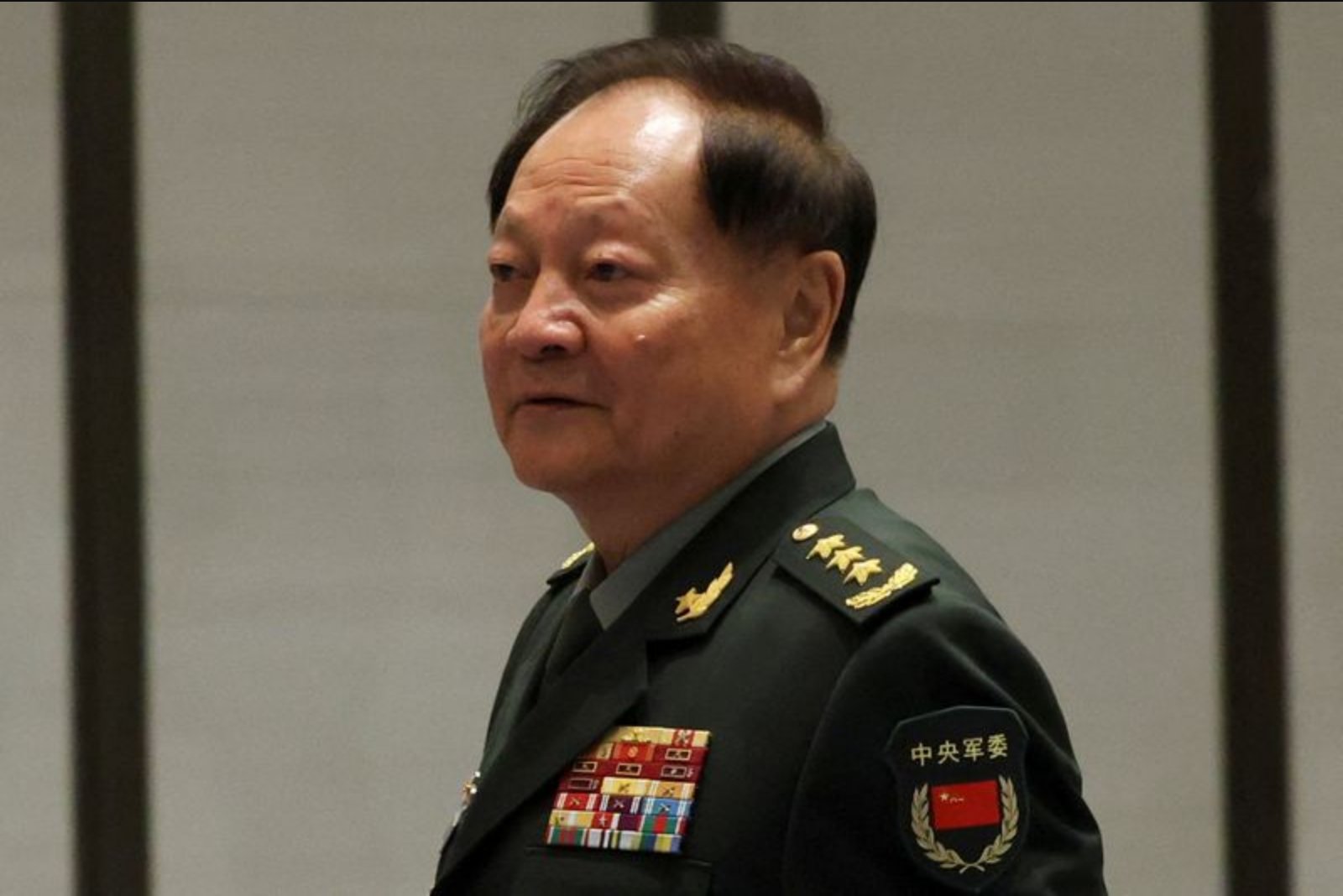
China’s announcement that Zhang Youxia, the vice-chairman of the Central Military Commission (CMC), is under investigation marks the fall of a senior military figure whose engagement with U.S. counterparts had become an important channel for senior-level communication, according to former U.S. officials and defense analysts.
The Chinese defense ministry disclosed the probe on Saturday. Zhang served as the CMC’s second-in-command under President Xi Jinping and was widely regarded in Washington as a senior and recognizable military leader. His removal is the latest and most prominent of several high-level purges inside China’s armed forces that have accompanied Xi’s broader anti-corruption campaign.
For U.S. policymakers, Zhang’s sudden loss is more than a personnel change. After a 17-month freeze on nearly all military-to-military communications following a visit to Taiwan by then-Speaker Nancy Pelosi, Xi permitted Zhang to engage with U.S. officials during the Biden administration. That reopening of senior contact was seen by American officials as an important, high-level channel distinct from interactions with China’s defense ministry.
In China’s political-military hierarchy, vice chairs of the CMC outrank the defense minister. American engagement has long favored direct contact with the commission’s vice chairs because the Defense Ministry lacks command authority over China’s armed forces. With Zhang removed, the CMC is reported to be left with only one general on its roster - Zhang Shengmin, identified as a career political commissar - intensifying concerns about the commission’s depth of experienced commanders.
Several former U.S. officials told Reuters they were taken aback by the development. Drew Thompson, a senior fellow at the S. Rajaratnam School of International Studies in Singapore and a former U.S. defense official who had engaged with Zhang, questioned how Xi would assemble military leadership in a crisis with so few generals on the commission, saying: "Who does Xi Jinping convene in a crisis if there’s only one person on his commission?"
Thompson described Zhang as the active-duty PLA officer most likely to offer Xi candid assessments of China’s forces and the potential human costs of conflict, and warned of a risk that Xi could be surrounded by flatterers who tell him what he wants to hear. "There’s a risk that Xi Jinping is given bad advice by sycophants who tell him what he wants to hear," he said. "That creates a risk of miscalculation."
A senior U.S. administration official declined to elaborate on what they described as "reports of palace intrigue," and added that the Trump administration is "building a military capable of denying aggression anywhere in the First Island Chain." The Pentagon and the Chinese Embassy in Washington did not respond to requests for comment.
U.S. efforts to improve military lines of communication with China have included repeated talks between U.S. Defense Secretary Pete Hegseth and China’s defense minister Dong Jun since September. Officials say those discussions are intended to address China’s force modernization, its nuclear weapons buildup, and what Washington views as increasingly assertive behavior toward U.S. allies and operations in the Indo-Pacific.
But U.S. officials historically have preferred engagement with the CMC’s vice chairs over the defense ministry precisely because the ministry lacks operational command. Zhang had been a familiar figure to U.S. defense personnel for more than a decade. He joined a week-long military delegation to the United States in May 2012 when he was a lower-ranking general, establishing a longer record of interaction with American counterparts.
David Stilwell, a former U.S. Air Force general who served as the State Department’s senior diplomat for East Asia during the first Trump administration, recalled Zhang’s atypical demeanor during that trip. Stilwell said Zhang was the only Chinese officer who volunteered to fly aboard a U.S. Osprey tiltrotor aircraft and that he sought out conversations with U.S. soldiers and a chance to try U.S. weapons. "He is very different from his fellow PLA brothers. He could have fit in very well in the U.S. military," Stilwell said, adding that Zhang had struck Americans as a professional officer rather than a political one.
Stilwell and other former officials said that while engagements with CMC generals were often formal and scripted, Zhang’s presence provided a degree of candid counsel. Without him, Stilwell said he feared the PLA might be more inclined to embrace an internally reinforced narrative that they were prepared for a venture regarding Taiwan. "I think what you lose with Zhang Youxia gone is a voice of reason," Stilwell said.
High-level meetings between U.S. officials and CMC generals have been sporadic over the past two decades. The last known senior-level interaction before Zhang’s removal was between Zhang and Jake Sullivan, the Biden White House national security advisor, during meetings in Beijing in August 2024.
Analysts familiar with Chinese military affairs note that exchanges with senior PLA leaders under Xi have often been tightly managed. Eric Hundman, a Chinese military expert at the Washington-based security consultancy BluePath Labs, described CMC-level engagements as typically scripted and said the PLA has a clear sense of its own capabilities. He questioned how much Xi listens to military leaders on the subject of timing for potential action regarding Taiwan, and warned that if Xi receives poorer-quality advice, that would be cause for concern. "The PLA knows its capabilities fairly well and is not interested in moving on Taiwan before they think they’re ready. My question mark has always been how much Xi Jinping listens to them on that point," Hundman said. "To the degree that he’s getting worse advice, that would worry me," he said.
Implications for U.S.-China Military Dialogue
Officials and analysts emphasize that Zhang’s downfall is consequential not only because of his personal stature, but because it narrows Washington’s access to a senior Chinese military perspective at the level of the Central Military Commission. That narrowing comes while the U.S. seeks to monitor and influence discussions about the PLA’s modernization and nuclear trajectory, and to reduce the risk of dangerous incidents between the two militaries in the Indo-Pacific.
For now, the full contours and fallout of Zhang’s investigation remain unclear. The move joins a series of high-profile personnel actions inside China’s military leadership that have occurred in the context of Xi’s anti-corruption efforts, and it has prompted U.S. officials and outside analysts to reassess the channels through which candid military counsel reaches China’s top political leader.