
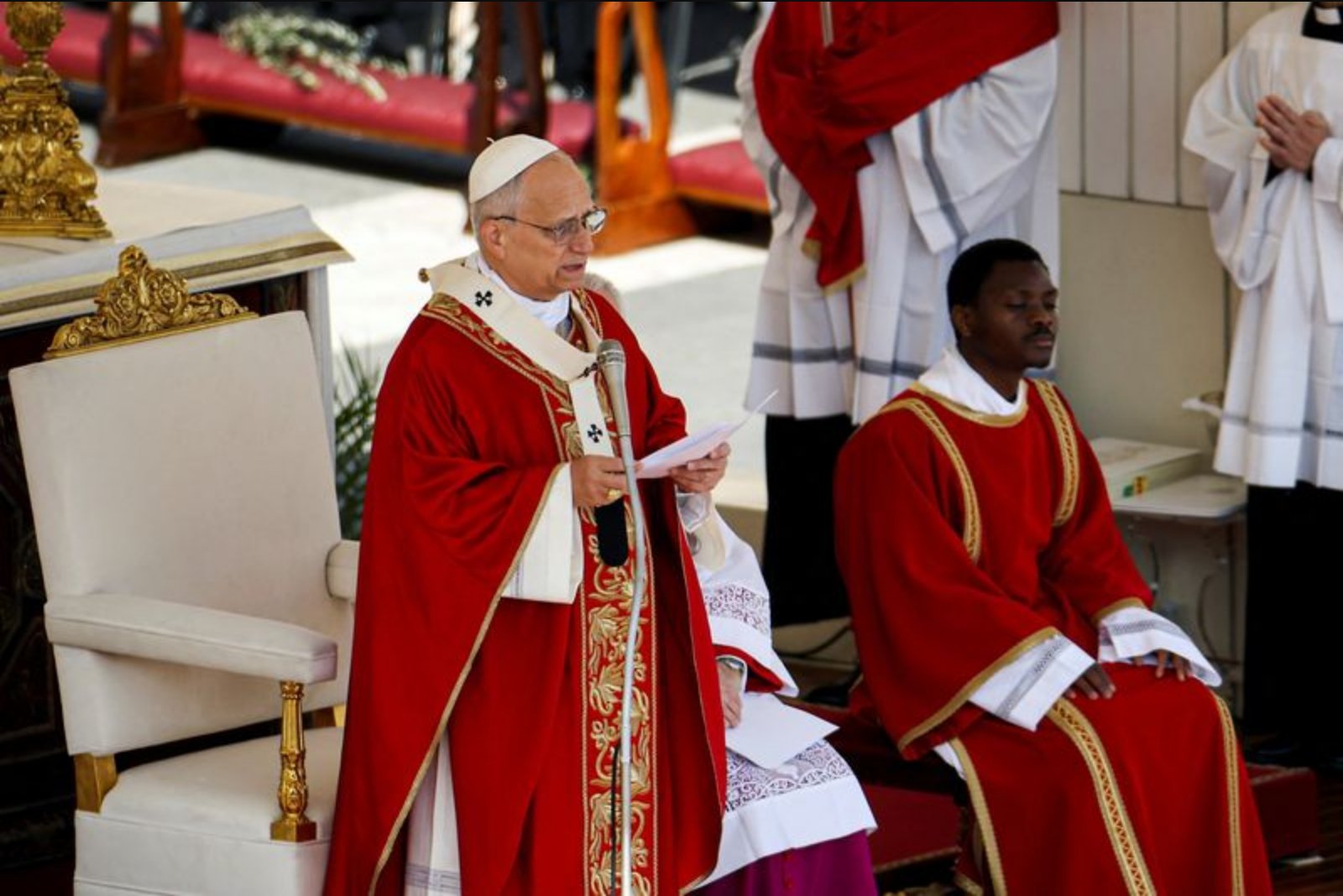
On Palm Sunday, addressing a large crowd in St. Peter's Square under bright sunshine, the pope delivered an unusually forceful denunciation of war, saying that God refuses to listen to the prayers of leaders who initiate armed conflict and who have "hands full of blood." The remarks came as the Iran war entered its second month.
Opening the holy week that culminates in Easter for the world's 1.4 billion Catholics, the pontiff labeled the fighting "atrocious" and warned against using Jesus to justify military action. "This is our God: Jesus, King of Peace, who rejects war, whom no one can use to justify war," he told the assembled faithful.
He cited a biblical passage to underline his point: "(Jesus) does not listen to the prayers of those who wage war, but rejects them, saying: 'Even though you make many prayers, I will not listen: your hands are full of blood.'" The pope did not identify individual leaders in his remarks.
In a closed appeal at the conclusion of the Palm Sunday liturgy, the pope expressed sorrow for Christians in the Middle East who are bearing the consequences of what he described as an "atrocious conflict," and he said some may be unable to celebrate Easter because of the violence.
Observers noted that the pope has been increasingly vocal about the Iran war in recent weeks. He has repeatedly urged an immediate ceasefire and has characterized military airstrikes as indiscriminate, saying such strikes should be prohibited.
The pope's criticism came against a backdrop in which some U.S. officials have used Christian language to frame the joint U.S.-Israeli strikes on Iran on February 28 that helped expand the conflict. The U.S. Defense Secretary, who has begun leading Christian prayer services at the Pentagon, prayed at a recent service for "overwhelming violence of action against those who deserve no mercy."
In his homily on Sunday, the pope referenced the Gospel account of Jesus facing arrest and rebuking a follower who struck the arresting man with a sword. He underscored that Jesus did not arm himself, defend himself, or fight any war. "He revealed the gentle face of God, who always rejects violence. Rather than saving himself, he allowed himself to be nailed to the cross," the pope said.
The tenor of the pope's words was noteworthy given his reputation for careful phrasing. By invoking scripture and explicitly rejecting the use of Christian language to justify violence, his Palm Sunday address added moral pressure to calls for de-escalation in the region.
Contextual note: The pope's statements were delivered publicly in St. Peter's Square on Palm Sunday and reflect his ongoing appeals for a ceasefire and his criticisms of airstrikes as indiscriminate. He did not name specific world leaders in the address.