
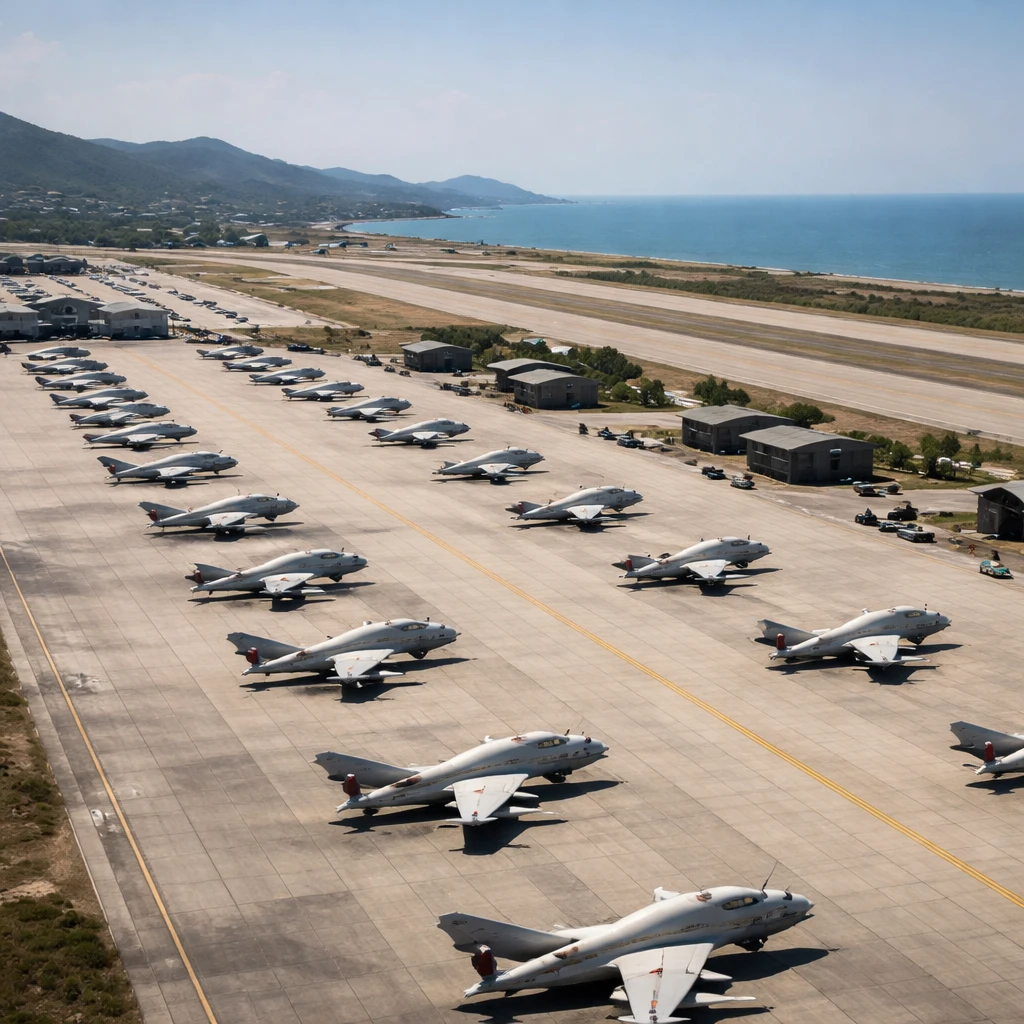
Satellite photographs published in a February study show what appear to be retired supersonic fighters, modified into attack drones, staged at airfields near the Taiwan Strait, according to the Mitchell Institute for Aerospace Studies. The imagery depicts lines of compact, swept-wing aircraft whose silhouettes match the J-6 fighter - a type that first entered service with China in the 1960s.
The institute, based in Arlington, Virginia, identified the converted aircraft at five air bases in Fujian Province and one in Guangdong Province, all located close to the Taiwan Strait. Senior fellow J. Michael Dahm, who compiled the open-source intelligence and commercial satellite imagery used in the report, said China’s People’s Liberation Army has deployed an estimated 200 or more of these obsolete fighters retrofitted as drones to airfields near the strait.
"They will attack Taiwan, U.S. or allied targets in large numbers, effectively overwhelming air defenses," Dahm said, describing how the jets-turned-drones would be used. He characterized their intended role as more analogous to cruise missiles than to typical autonomous or remotely piloted unmanned aerial vehicles.
The Mitchell Institute report, titled "China Airpower Tracker," places the converted J-6s within a broader expansion of Beijing’s airpower mix. Experts cited in the report say the converted jets sit alongside bombers armed with stand-off missiles, modern fighters, ballistic and cruise missiles, and swarms of contemporary UAVs as part of China’s growing capability to project force toward Taiwan.
China already dominates the global commercial drone market and is investing heavily in military drone technologies as it builds capabilities that could be used to try to seize control of Taiwan by force if it chose to do so.
Function and scale
According to the report’s assessment and Dahm’s analysis, the primary purpose of these converted J-6 drones is to saturate and exhaust Taiwan’s air defenses in the first wave of an attack. A senior Taiwanese security official cited in reporting on the subject said the objective is to force Taiwan to expend costly interceptors on these targets, which would present a cost-efficiency challenge when trying to protect high-value assets.
Dahm estimated that more than 500 J-6 airframes have been converted to drones in total. The drone adaptation of the J-6 has been designated the J-6W. China’s air force displayed one such converted fighter at the Changchun Air Show in northeast China in September; an information board photographed at the exhibition described it as a J-6 UAV and noted it as a modified version of the J-6 fighter.
The display material said the fighter’s cannons and other equipment were removed before the platform was fitted with an automatic flight control system and terrain matching navigation technology. According to the board, the UAV performed its first successful flight in 1995 and can be used either as an attack aircraft or as a training and target platform for fighter pilots, anti-aircraft guns, surface-to-air missiles or radar operators.
Expert assessments and operational implications
Peter Layton, a visiting fellow at Griffith University in Australia and a retired Australian air force group captain who has worked at the Pentagon, described how such systems could be integrated into a broader strike campaign. He said China could launch a "large attack wave" consisting of strike aircraft, missiles on different trajectories, and a mix of fast and slow drones. "There would be a lot of diverse things all coming at the same time," he said. "It would be an air defense nightmare."
Layton noted that the converted J-6 drones do not represent China’s most advanced UAV technologies, but emphasized they would still be costly to defeat. He warned that small, high-speed interceptor drones now being deployed in other conflicts would be ineffective against the J-6 variants, arguing that "Those J-6s would need a proper expensive missile."
Military attaches and security analysts cited in the report also say China is testing drones for use in deception operations in potential rehearsals of a Taiwan invasion. Separately, China is developing new UAVs, including a stealth attack drone that experts say would be capable of operating from an aircraft carrier, further expanding its range of unmanned strike options.
Taiwanese response and defenses
Taiwan’s defense establishment has taken notice. In a parliamentary report this week, the defense ministry outlined plans to rapidly acquire a new generation of counter-drone systems. The ministry referred to a 2022 analysis by its think tank, the Institute for National Defense and Security Research, which described these converted fighters as "a form of asymmetric warfare that cannot be ignored."
A senior Taiwanese security official told reporters that the key purpose of the drones is "to exhaust Taiwan’s air defense systems in the first wave of an attack." The official warned that to prevent China from striking high-value targets, Taiwan would inevitably confront the cost-efficiency dilemma of using expensive interceptors to engage these converted aircraft at a distance.
Responses and broader assessments
Requests for comment to China’s defense ministry and Taiwan Affairs Office received no response. The Pentagon also did not respond to a request for comment.
The report’s publication comes amid contrasting public assessments from U.S. agencies. This month, the U.S. intelligence community said its assessment is that China is not currently planning to invade Taiwan in 2027. That view differs from the Pentagon’s annual report on China’s military power from late last year, which stated China "expects to be able to fight and win a war on Taiwan by the end of 2027."
The Mitchell Institute analysis adds a further layer to the discussion by documenting the physical deployment of repurposed fighter airframes near Taiwan and by highlighting how such platforms could be employed in the opening hours of a conflict. Dahm said the Chinese airfields closest to the Taiwan Strait where the J-6 drones are based would be vulnerable to counter-attack from Taiwan and its allies in a conflict, and that "the idea is to launch all the drones in the first hours of a PLA operation."
Technical origins
The J-6 itself is a twin-engined platform derived from the Soviet-era MiG-19 of the 1950s. That jet and other Soviet-derived aircraft made up the core of China’s fighter inventory until the mid-1990s, according to assessments cited in the report. The drone-adapted J-6 has been identified in satellite images and on display material with the designation J-6W.
While these J-6-based drones are not China’s most technologically advanced UAVs, the report and analysts emphasize their potential value to Beijing as relatively inexpensive, expendable strike platforms that can be deployed in large numbers to complicate and degrade an opponent’s air defenses.
Conclusion
The Mitchell Institute’s imagery-based findings underscore the increasing role of repurposed and modern unmanned systems in the region’s military balance. Analysts quoted in the report warn that the deployment of hundreds of converted jet drones near the Taiwan Strait could create an early, saturating threat to Taiwan and any allied forces tasked with defending high-value targets, while prompting Taipei to accelerate investments in counter-drone and air-defense capabilities.