
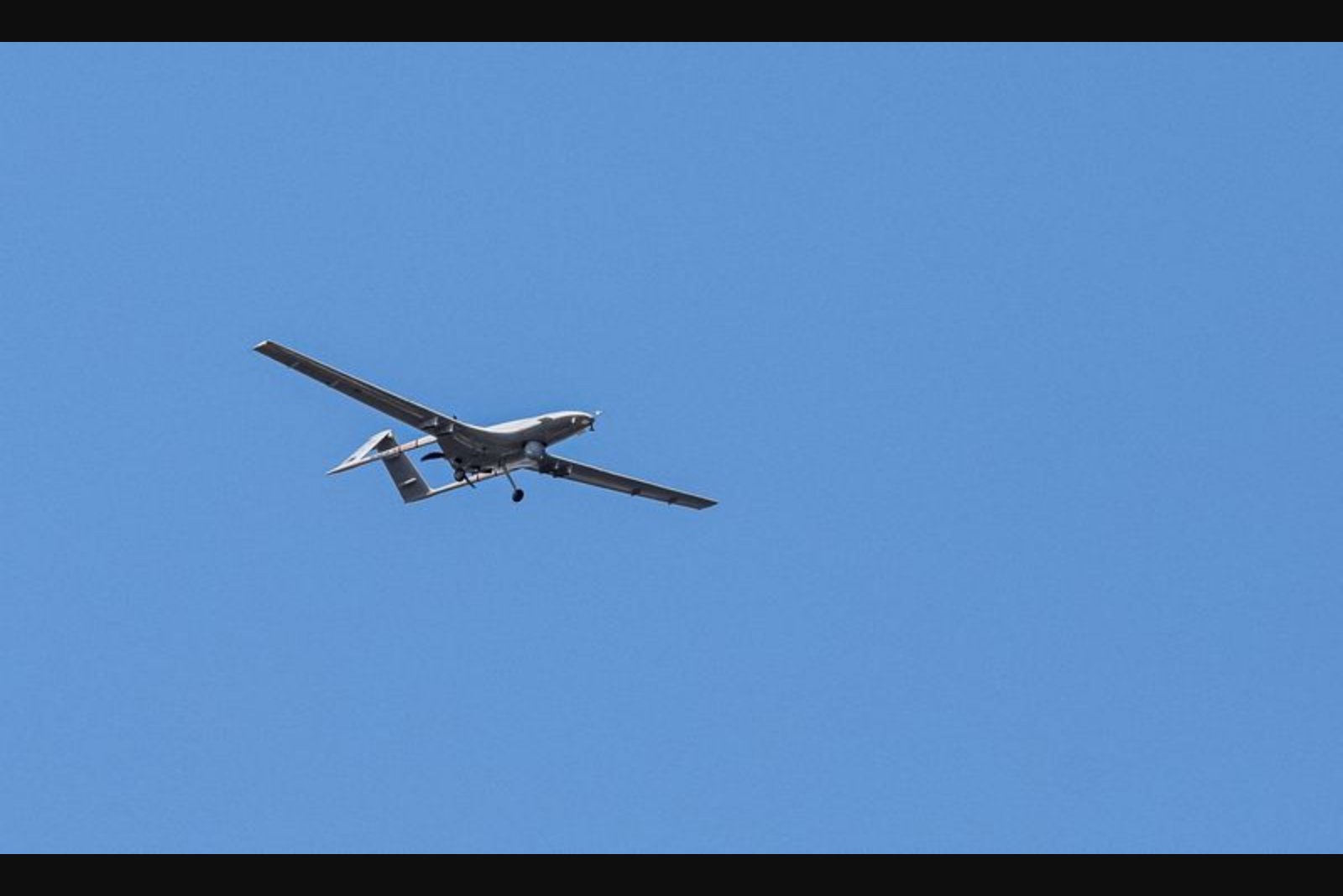
Commercial satellite imagery and analysis by weapons experts indicate that eastern Libya's military commander, Khalifa Haftar, appears to have taken delivery of combat-oriented unmanned aerial vehicles at Al Khadim airbase, a desert facility about 100 kilometres east of Benghazi. Images covering a period between late April and December show at least three drones parked on the base's northern apron, with additional imagery suggesting supporting ground control equipment was present into the following year.
The aircraft visible on the imagery are assessed by three independent weapons specialists to most likely include a Chinese-made Feilong-1 (FL-1) - an advanced surveillance and attack platform - and two smaller unmanned systems consistent with Turkish Bayraktar TB2 models. The reviewers cautioned that identification is not definitive, but they judged the dimensions and certain design features to be most similar to those types. A truck bearing satellite-control equipment was also visible near the apron in imagery dated January 12, suggesting operational intent.
The appearance of these systems at Al Khadim has not been previously reported. If confirmed, the deployment would mark a notable reinforcement of Haftar's eastern military posture and could alter negotiating leverage in efforts to form a unified Libyan government, analysts said.
Libya has been subject to a United Nations arms embargo that requires U.N. approval for weapons transfers. The embargo has been in place since 2011. United Nations departments and the Security Council committee responsible for exemptions did not provide information indicating whether any formal approvals were sought or granted for the movement of these drones into eastern Libya. A Security Council resolution cited by U.N. peace-building officials last year expressed "grave concern" about continuing violations of the embargo.
U.N. investigators and independent monitors have previously documented high-tech weaponry entering Libya during the post-2011 conflict, transforming parts of the country into a prominent theatre for drone combat. During the 2014-2020 contest for control of Libya, Haftar's Libyan National Army attempted to displace the U.N.-recognised government in Tripoli. External backers including the United Arab Emirates, Egypt and Russia provided critical support to Haftar in that period, according to U.N. investigations, while Turkey backed the Tripoli administration. China has been described as avoiding taking a side.
Although a ceasefire was agreed in 2020 and the active frontlines have cooled, the country remains divided with Haftar's administration dominant in the east and a Tripoli-based government led by Prime Minister Abdulhamid Dbeibah in the west. Analysts, weapons experts and U.N. investigators say there is evidence both sides are seeking to rebuild air power.
Anas El Gomati, head of the Sadeq Institute, a Libyan think tank, said the arrival of these drones at Al Khadim "would be a huge symbolic win" for Haftar, strengthening his control over the east and much of the south, including major oilfields, and improving his bargaining position in talks to unify Libya. Gomati also noted the weapons could be used to safeguard supply lines to the Rapid Support Forces paramilitary group in neighbouring Sudan, though he observed Haftar has denied supporting the RSF. Gomati added that the LNA is not known to possess the technical expertise required to operate such advanced unmanned platforms and posed the question: "who's operating them?"
Analysts who reviewed satellite imagery identified a drone type not previously seen in Libya parked outside a hangar on the northern apron at Al Khadim during a window from late April to July. A separate image from May 3, supplied by U.S. satellite imaging company Vantor, showed the same type on the runway, a detail military-technology expert Wim Zwijnenburg said suggested active use. Zwijnenburg and two other analysts, Jeremy Binnie of Janes and Joseph Dempsey of the International Institute for Strategic Studies, agreed that the aircraft's shape and wing configuration made a Feilong-1 identification more likely than a Wing Loong II, though they noted limited available imagery and few released photographs made certain identification difficult.
Later imagery, from Dec. 17, showed two smaller unmanned aircraft on the same apron. Their length, wingspan and twin-boom tail design were consistent with the Turkish TB2 model, Dempsey said. The TB2 has been widely exported and attracted attention when used by Ukraine, but the experts noted that similar-looking designs have been produced in several countries, including China, the UAE and Belarus. However, the appearance in imagery of two ground control units with distinctive double-antennae setups between July and March lent weight to the TB2 assessment, the analysts said.
Satellite pictures reviewed by Reuters and imagery from California-based Planet Labs show Al Khadim has undergone notable renovation since early last year, including the construction of at least three new hangars on the apron where the drones were observed. Another structure visible under construction was judged by the U.N. panel to be likely intended for the "stationing and launching of Turkish Bayraktar UAVs" in a draft report.
Russia has forces present at Al Khadim and uses Libya in support of operations across West and Central Africa, the reporting noted, but the experts who analysed the imagery did not believe Russian personnel were operating the specific drones visible in the images. Military-technology expert Zwijnenburg observed that while Moscow has been known to use Chinese-made surveillance drones and components, there is no record of Russia deploying a fully assembled Chinese combat drone.
Attempts by Haftar's forces over several years to acquire Chinese drones have been reported by watchdogs and investigators, the sources said. Justyna Gudzowska of The Sentry cited law enforcement operations that targeted sanctions violations as evidence of a persistent effort to obtain such systems. Investigators in the United States, Canada and Italy have linked Chinese drones or drone parts to attempts to smuggle unauthorised military equipment into eastern Libya since 2019.
In June 2024, Italian authorities, acting on U.S. intelligence, intercepted a shipment of drone components bound for Benghazi. U.N. experts who later inspected the seized components found they were consistent with parts from two Feilong-1 drones, and a draft of the panel's 2025 report concluded the model was covered by the embargo. Chinese officials have disputed that those components were military equipment, telling the U.N. panel they appeared to be parts of a scrapped model intended for emergency rescue and disaster relief.
The presence of these newer drones at Al Khadim, if confirmed as operational, would represent an increase in the LNA's capabilities following the 2020 departure of a fleet of Wing Loong II drones that had been documented at the same base by the U.N. monitoring panel. The panel's earlier reports stated the UAE assisted the LNA in building up air power in prior years and that the Abu Dhabi contribution "most probably" included supplying and operating Wing Loong systems, a claim the UAE has repeatedly denied.
Turkey previously supplied the Tripoli-based government with TB2 drones and air-defence equipment, which analysts say were key to repelling Haftar's 2019-2020 assault on Tripoli and contributed to a stalemate in which neither side achieved decisive victory. The balance shifted further toward Tripoli in October 2022, when Tripoli signed a contract with Turkey to procure Bayraktar Akinci drones, a more capable platform with higher altitude and larger payload capacity.
At the same time, bilateral relations between Turkey and Haftar's eastern administration have warmed. Ankara has sought to protect economic and energy interests in Libya and to secure ratification by the eastern-based parliament of a contentious maritime boundary agreement originally signed with western authorities in 2019. In August, Ibrahim Kalin, head of Turkey's National Intelligence Organisation, met with Haftar and his son Saddam in Benghazi to discuss enhanced cooperation on intelligence and security matters, according to a statement from the LNA. Saddam Haftar, who serves as the LNA's deputy commander, visited Ankara three times last year and met with senior Turkish officials, including Defence Minister Yasar Guler. Turkey's defence ministry described the engagement as a step toward a "unified Libya." Reuters could not determine whether those talks included arrangements for drone provision or operations.
Reuters sought comment from the LNA and from the governments of China and Turkey, as well as from the drone manufacturers cited in expert assessments - Xi'an-based Zhongtian Feilong and Istanbul-based Baykar - but did not receive responses to detailed questions. The Tripoli-based government also did not comment. The Security Council committee that handles embargo exemptions did not provide answers about potential requests or approvals related to the drones.
In the absence of definitive supply chains or operational details, several core uncertainties remain: who supplied the drones, whether any U.N. exemptions were applied for and granted, and who is actually piloting and maintaining the systems at Al Khadim. The satellite images and expert reviews indicate presence and probable operational intent, but they do not resolve the questions of logistics, personnel and formal authorisation under the U.N. embargo regime.
The developments at Al Khadim intersect with Libya's strategic assets and regional dynamics. Control of eastern territory and much of the south includes major oilfields, and military capability concentrated in the east affects negotiations over national unity and resource governance. Observers also note potential linkage to cross-border dynamics, given the proximity to Sudan and the role of the Rapid Support Forces in the region, though direct ties remain contested by Haftar's declarations of non-support.
For now, the visible indicators - drone airframes on aprons, ground control vehicles, and infrastructure work at Al Khadim - point to renewed attention on unmanned systems in Libya's protracted, complex contest between rival authorities. Absent clear responses from state actors and manufacturers queried about the imagery and expert conclusions, the provenance and operational status of the drones remain matters of open inquiry for U.N. monitors and independent analysts.