
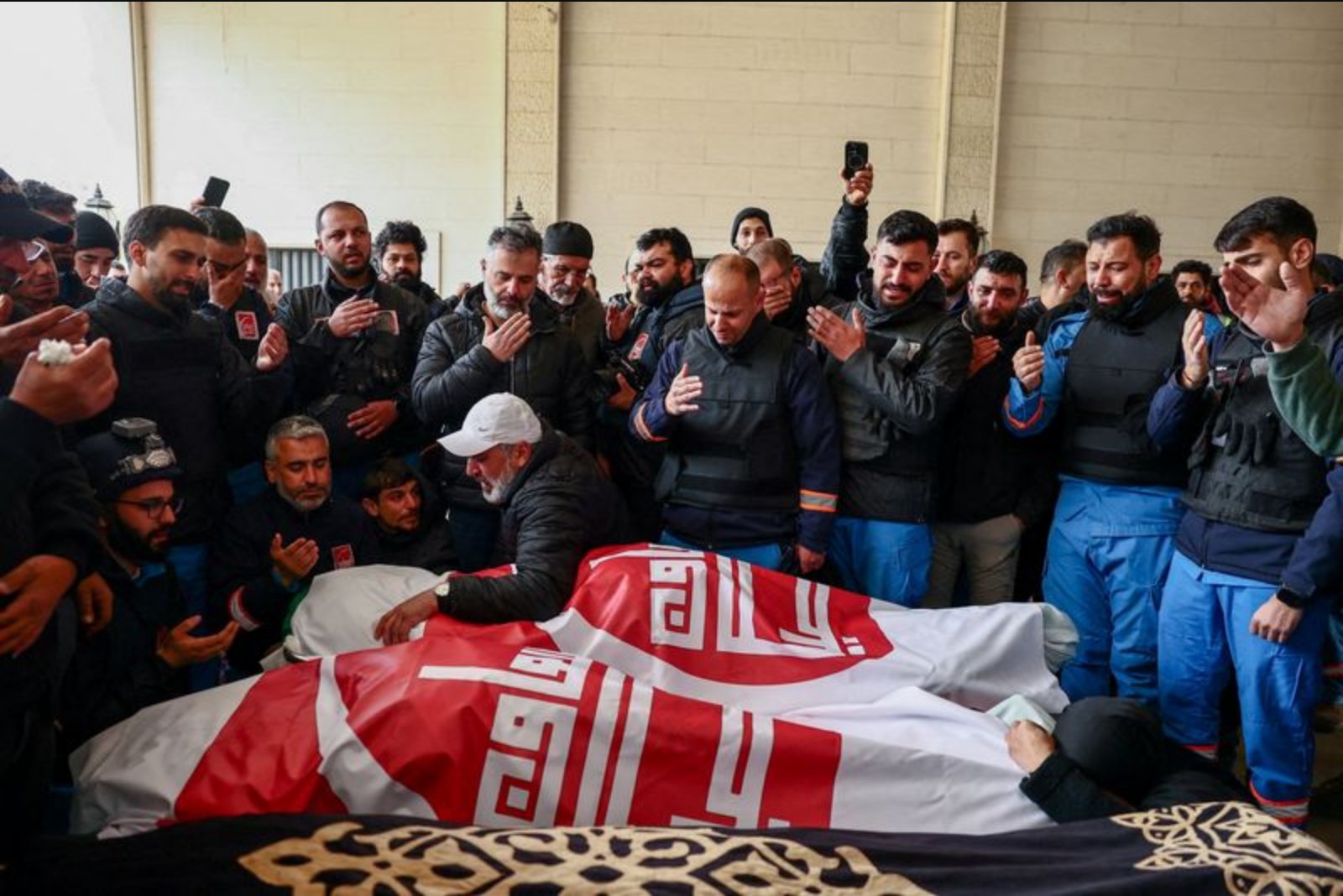
In the southern Lebanese town of Nabatieh, a group of paramedics wearing identical uniforms gathered to bury two of their own, their shoulders heaving with grief as they stood beside two caskets. The men, identified by Lebanon's health ministry as Ali Jaber and Joud Sleiman, were killed on Tuesday while riding a motorcycle to respond to a rescue call, according to official accounts.
Both men were in paramedic uniforms and riding a motorcycle clearly marked as an ambulance with flashing lights when they were struck, the health ministry said. Family members and colleagues attending the funeral spoke out, describing the deaths as part of a pattern of attacks affecting rescuers.
"A paramedic who doesn’t even have a knife, going to save someone else - they strike him and kill him. This has happened in more than one strike, more than one place," said Hassan Jaber, Ali's father and a local official.
The health ministry reports that at least 42 paramedics have been killed by Israeli strikes on Lebanon since March 2, the date on which fighting widened after Hezbollah fired on Israel. Those strikes, together with large-scale evacuation orders in southern Lebanon, have left once-busy towns like Nabatieh largely emptied of residents.
After the funeral ceremony, the remaining paramedics in Nabatieh gathered in the town square to hand out aid to the small number of residents who remain. Despite their grief, the rescuers then returned immediately to their duties.
Among those mourning was Mohammed Sleiman, Nabatieh’s chief paramedic and the father of Joud Sleiman. He accused Israel of deliberately targeting his son and other rescuers, saying that Israel "insists on damaging, on killing, on oppressing, on terrorising - and we insist on staying."
International humanitarian law provides protections for civilians, including medical personnel and journalists. Yet rescuers in Nabatieh said they have seen little practical protection on the ground.
"Unfortunately, we see that in Lebanon, that’s just ink on paper, it’s not being applied at all," said Hassan Jaber, a 43-year-old paramedic who shares the same name as Ali’s father.
The human cost of the strikes across Lebanon has been significant, according to figures cited by health authorities and international agencies. Israeli strikes have wounded more than 3,000 people and killed nearly 1,100, including over 120 children and 80 women. The World Health Organization reports 64 attacks on healthcare facilities since March 2 and says five hospitals are currently out of service.
Separately, exchanges of fire have resulted in casualties on the Israeli side as well: two Israeli troops in Lebanon and one woman in northern Israel have been killed by Hezbollah attacks.
The Israeli military did not immediately respond to requests for comment about the deaths of medics and the damage to health infrastructure cited by Lebanese officials and the WHO.
Rescue workers described adapting their practices to reduce risk. Khodr Ghandour, a civil defense worker in Nabatieh, told Reuters that teams now send only two rescuers at a time to limit the number exposed to potential strikes. He added that in multiple instances, follow-up strikes have prevented responders from reaching the victims of an initial attack.
Mehdi Sadeq, a founding member of Nabatieh’s paramedic unit, said the danger of being hit by a secondary strike - so-called double-tap attacks - has forced rescuers to delay operations, prolonging the time victims wait for aid.
United Nations humanitarian coordinator in Lebanon Imran Reza urged all parties to respect international law and avoid targeting those assisting civilians, saying that "it’s doubly damaging to have health workers targeted and killed in this conflict." His comments underscored concerns about the widening toll on healthcare and emergency services.
As Nabatieh’s paramedic teams grieved, they also resumed work amid damaged infrastructure, limited personnel, and ongoing threats. The losses among medics and the strain on hospitals and emergency responders in Lebanon raise immediate questions about the capacity to deliver care to injured civilians and to sustain relief operations in affected areas.