
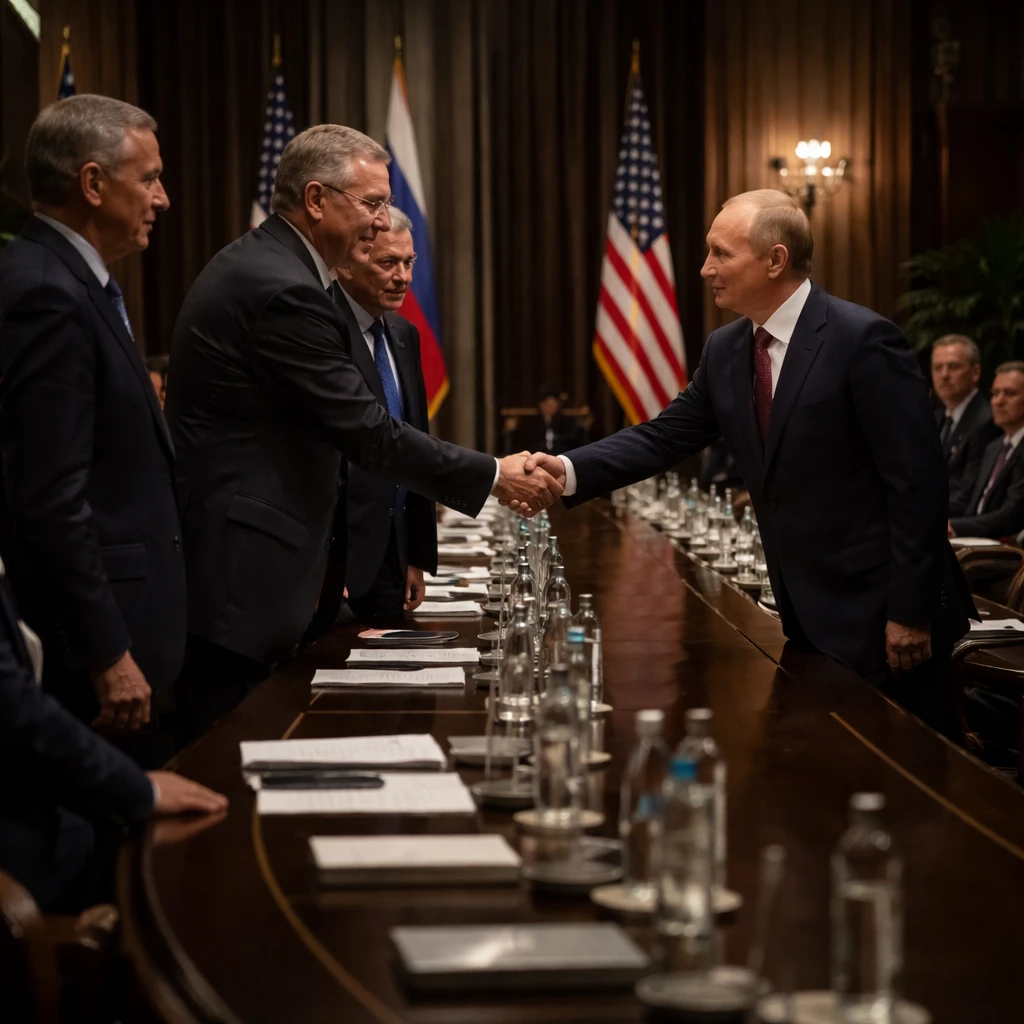
In a significant diplomatic engagement late Thursday, Russian President Vladimir Putin met with a delegation of three United States envoys in Moscow to deliberate on a plan designed to conclude the war in Ukraine, according to statements from the Kremlin.
The American delegation included Steve Witkoff and Jared Kushner, accompanied by Josh Gruenbaum, recently appointed as a senior adviser to the "Board of Peace," an organization tasked with resolving international conflicts, under President Donald Trump's administration.
Putin welcomed the U.S. team shortly before midnight, following President Trump's remarks that a deal to end the hostilities was "reasonably close." Witkoff later conveyed that negotiations had been narrowed down to a single unresolved matter.
Consistent with previous discussions, Putin was supported by his foreign policy aide Yuri Ushakov and special envoy Kirill Dmitriev during the meeting. A brief video shared by the Kremlin depicted Putin shaking hands with the three American representatives before inviting them to their seats at a large oval table.
One of the central issues complicating the negotiations involves territorial control, particularly the fate of the eastern Ukrainian region of Donetsk. Russia demands that Ukraine relinquish the roughly 20% of this region currently under Ukrainian control, a stance unequivocally opposed by Ukrainian President Volodymyr Zelenskiy, who has emphasized Ukraine's determination to retain the territory, citing the heavy toll endured amid years of conflict.
Further complicating the peace talks, Russia insists that Ukraine abandon its aspirations to join the North Atlantic Treaty Organization (NATO) and opposes any NATO military presence within Ukrainian borders post-agreement.
The U.S. envoys arrived in Moscow after attending meetings with Ukrainian officials in Davos, Switzerland. Concurrently, President Trump held talks with Zelenskiy, who affirmed that security guarantees for Ukraine had been finalized, though the territorial dispute remains outstanding.
Meanwhile, Ukraine is enduring a particularly harsh winter season, intensified by heavy Russian missile and drone strikes targeting the nation's energy infrastructure. These assaults have resulted in prolonged power outages and lack of heating for hundreds of thousands of residents across Kyiv and other major cities amid subfreezing temperatures.
In a development described as encouraging by Zelenskiy, representatives from Russia, Ukraine, and the United States are scheduled to hold their first trilateral meetings in Abu Dhabi over the forthcoming Friday and Saturday sessions.
Zelenskiy also mentioned that discussions on economic recovery measures post-conflict are near completion, forming a cornerstone of Ukrainian-backed proposals that seek to balance and potentially counter previous U.S. peace plans perceived as favoring Russia.
When questioned about his message to President Putin, Trump succinctly stated, "The war has to end," underscoring the imperative for resolution.
Key Points:
- High-level talks between Russia and U.S. envoys signal progress toward resolving Ukraine conflict, though major issues persist.
- The territorial dispute over Ukraine's eastern region of Donetsk and Ukraine's NATO membership remain primary obstacles in negotiations.
- The ongoing war severely impacts Ukraine's energy infrastructure amid harsh winter conditions, exacerbating humanitarian challenges.
Risks and Uncertainties:
- Potential failure to resolve the territorial dispute could prolong conflict, affecting geopolitical stability.
- Disagreements over NATO presence and Ukraine's security guarantees create uncertainty in the peace process.
- Continued attacks on critical infrastructure endanger civilian populations and economic recovery efforts.