
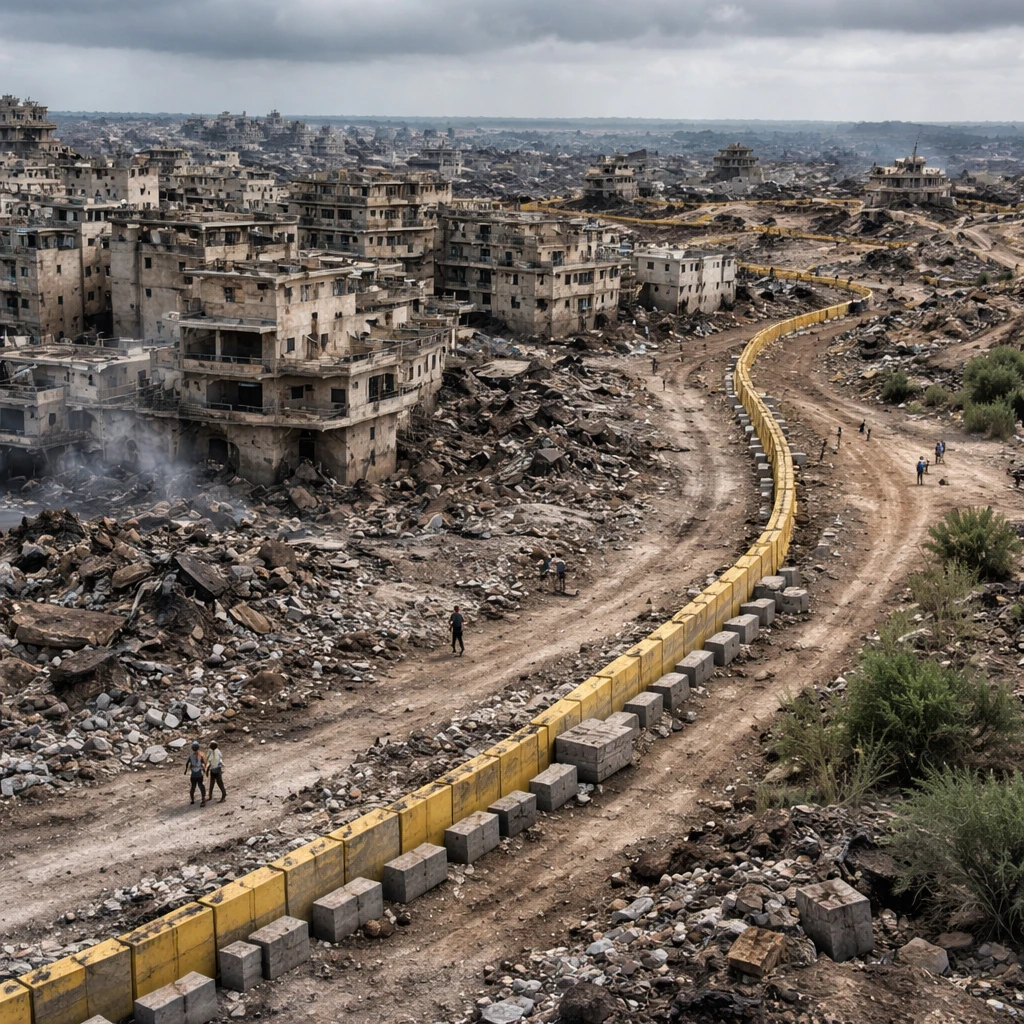
Recent developments in Gaza indicate significant shifts in territorial control following Israel’s repositioning of concrete blocks delineating its armistice boundary with Hamas. Satellite images analyzed alongside testimonies from local inhabitants expose that in December, Israel moved these markers, intended to represent the so-called 'Yellow Line,' deeper into neighborhoods under Hamas jurisdiction. This shift involved the destruction of multiple buildings and forced displacement of Palestinian residents, contravening a U.S.-brokered ceasefire agreement designed to stabilize the region.
Across various sectors of Gaza, these concrete blocks have been observed intruding dozens, occasionally hundreds, of meters beyond the official boundary demarcations held on military documents. Notably, at least six fortified military positions have been established within Israeli-controlled zones near this contested line, as evident from the examined satellite data.
This territorial expansion by Israel represents a unilateral recalibration of the control line in Gaza. It restricts habitable land for Palestinians, occurring despite ongoing efforts by President Donald Trump and international stakeholders to enforce a ceasefire entailing Israeli troop withdrawals. The neighborhood of Al-Tuffah starkly exemplifies this trend. Previously a historic district within Gaza City, Al-Tuffah has transformed into a wasteland marked by destroyed infrastructure and twisted metal remnants after successive Israeli bombardments over two years.
Post-ceasefire in October, approximately thousands of Palestinians sought refuge in Al-Tuffah, anticipating stability through the ceasefire provision that required Israeli forces to retreat towards a marked 'Yellow Line' hugging Al-Tuffah’s eastern boundary. Nevertheless, satellite images dated December 2 and 13 reveal Israel’s initial placement of boundary blocks inside territory under Hamas control, which were then pushed roughly 200 meters farther inward. This adjustment precipitated the razing of at least 40 buildings within the newly claimed zone, leaving scant structures between the new block positioning and the previous demarcation.
The methods employed in the demolition have not been explicitly identified, but historical precedents suggest a combination of airstrikes, controlled detonations, and the use of heavy machinery such as bulldozers. The Israeli military, when queried, rejected allegations of deliberately shifting the Yellow Line and declined to confirm details regarding building demolitions in Al-Tuffah. Official statements emphasized the necessity of situating the Yellow Line markings according to terrain conditions and operational requirements, without releasing supporting evidence for these claims.
A military insider indicated that precise markings along the Yellow Line are impeded by existing urban obstructions, describing the officially published depictions by Israel and the Trump administration as schematic rather than exact representations. Meanwhile, the ceasefire framework, encapsulated in a 20-point plan crafted by the U.S. and other actors, unequivocally demanded an immediate halt to hostilities and a freeze on battle lines pending conditions favorable to a comprehensive staged troop withdrawal.
Amid this evolving landscape, residents such as Manal Abu Al-Kas recount their forced exodus from eastern Al-Tuffah following the repositioning of boundary blocks. Abu Al-Kas and her family, despite having suffered profound losses including the deaths of two sons, endured in their residence until mid-December when the Israeli military's adjustments compelled them to flee the area in January. She reminisced about their once peaceful coexistence, disrupted by the placement of 'yellow stones' which physically and symbolically displaced her family. Facing active shelling, movement became mandatory to preserve safety.
Broader satellite analysis indicates similar boundary encroachments in other parts of Gaza, notably Khan Younis in the south. December imagery shows Israeli military blocks extending approximately 390 and 220 meters beyond the established line, with concurrent destruction of buildings and the dismantling of tented camps intended for displaced populations. Furthermore, the military has erected at least six large fortifications chiefly composed of earth and mud on the Israeli side, some situated within 264 meters of Gaza’s northern boundary in areas like Beit Hanoun. Military comments characterize these fortifications as provisional, aimed at shielding personnel from hostile attacks, although specific inquiries about their construction and strategic purpose remained unanswered.
In response to the encroachment and expanded military presence, Hamas spokesperson Hazem Qassem highlighted the dire humanitarian consequence of these developments. He underscored a forced demographic compression, noting that thousands have fled westward, with Gaza’s residents confined to a narrow western strip comprising less than 30% of the entire territory. This alarming reduction severely limits living and mobility spaces for approximately two million Palestinians, many residing in makeshift shelters or damaged dwellings.
The terms of the ceasefire effectively preserve Israeli control over more than half of Gaza's landmass, with the stipulation that further Israeli withdrawals depend on Hamas disarmament. This intricate arrangement has invited criticism and apprehension concerning the possible de facto partition of Gaza. Reconstruction efforts appear confined to Israeli-controlled zones, restricting broader recovery.
Since implementing the ceasefire in October, documented hostilities have persisted. Israeli forces have continued targeting individuals near the Yellow Line, often citing attempted militant incursions. Verified video footage from early January shows Israeli drones conducting patrols approximately 500 meters inside the Yellow Line within Al-Tuffah, indicating an active military presence beyond the previously agreed boundary. Israeli military spokespersons provided no commentary regarding drone operations in this area.
Casualty figures highlight the toll of sustained conflict post-ceasefire, with Gazan medical authorities reporting over 460 Palestinian deaths, a significant proportion being children, and militants having killed three Israeli soldiers. These counts underscore ongoing ceasefire violations mutually attributed by both sides. The initial Israeli offensive followed a Hamas-led cross-border attack on October 7, 2023, which resulted in 1,200 Israeli fatalities according to Israeli figures. Gaza’s health officials report that Israeli military operations have claimed around 71,000 Palestinian lives since the onset of hostilities.