
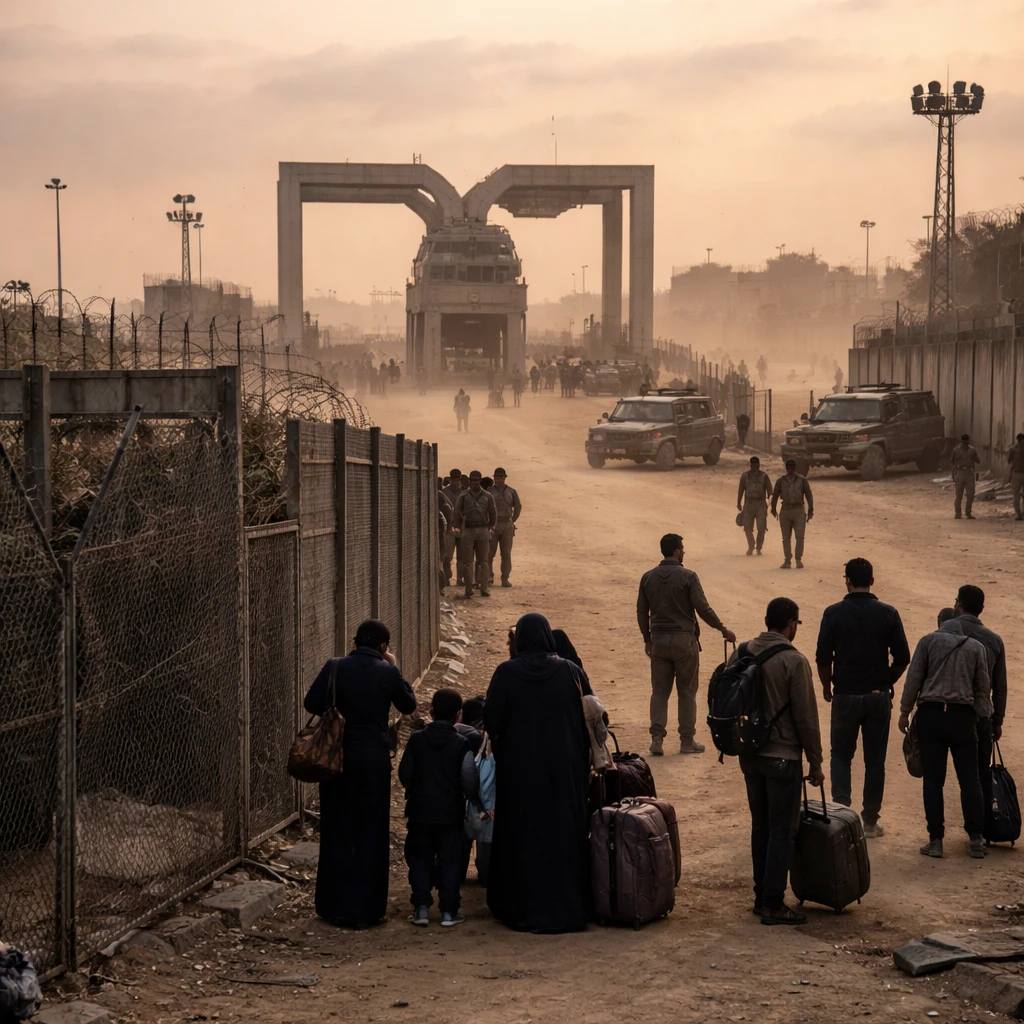
Israeli officials are preparing to reopen the Rafah border crossing between Gaza and Egypt, but with plans to restrict the number of Palestinians allowed to enter Gaza. According to three sources familiar with the issue, Israel's objective is to permit a greater number of Palestinians to exit Gaza than to re-enter once the border reopens next week. The Rafah crossing represents the primary entry and exit point for the more than two million residents of Gaza, making its operation crucial to the movement in and out of the territory.
Ali Shaath, head of a transitional Palestinian committee supported by the United States to temporarily govern Gaza, announced on Thursday that the Rafah border crossing would reopen next week. This development comes amid the second phase of an overarching peace initiative originally proposed by U.S. President Donald Trump. The initial phase, marked by a ceasefire between Israel and Hamas in October, included plans to open Rafah, though it was delayed.
Earlier this month, U.S. officials declared that the peace plan had entered its subsequent phase, which involves further Israeli troop withdrawals from Gaza and the transfer of administrative control from Hamas to a United States-supported Palestinian transition committee. Control of the Gaza side of the Rafah crossing has been under Israeli military oversight since 2024, emphasizing Israel's continued security concerns.
The sources who provided insights on border management requested anonymity given the topic's sensitivity. They noted that details remain indefinite regarding how Israel will implement limitations on Palestinian ingress through the Egyptian border or the specific ratios of allowed exits versus entries. Such limits form part of Israel's broader objective to manage population movement selectively.
In previous discourse, some Israeli authorities have expressed a preference for encouraging Palestinians to emigrate voluntarily from Gaza. However, Israel denies any intentions of forcibly transferring the population. Palestinian communities remain highly apprehensive about the possibility of displacement or temporary leave ending in a failure to return.
Operationally, the Rafah crossing is anticipated to be run by personnel affiliated with the Ramallah-based Palestinian Authority and monitored by officials from the European Union, reflecting arrangements used during a ceasefire period early in the previous year. Efforts to secure the crossing reflect an intent to balance access with stringent security measures, amid longstanding regional tensions.
Requests for comment regarding this plan were directed to Israel’s Prime Minister's Office, which did not respond immediately. Similarly, the Israeli military deferred questions to government authorities and declined to offer public statements on the matter.
The same sources revealed that Israel plans to establish a military checkpoint inside Gaza near its border with Egypt. Through this checkpoint, all Palestinians traveling either into or out of Gaza will undergo security screenings conducted by Israeli forces. Two additional sources corroborated the insistence of Israeli officials on maintaining this screening measure as a condition for managing cross-border movement.
The U.S. Embassy in Israel has not provided a statement regarding American support for Israeli restrictions on Palestinian entries or for the proposed military checkpoint at this time.
During the initial phase of the peace plan, the Israeli military withdrew from parts of Gaza but retained control over 53% of the territory, including the entire land border with Egypt. The population of Gaza, largely concentrated in areas under Hamas administration, lives predominantly in fragile housing conditions such as tents or damaged buildings. The sources also noted uncertainty around the fate of travelers impeded by Israeli checkpoints, especially Palestinians attempting to enter Gaza from Egypt.
Israeli governmental opposition to opening the border has resurfaced in recent weeks. Some officials underscore the necessity of Hamas returning the remains of an Israeli police officer prior to any facilitation of regular border crossings; this individual is the last of the bodies to be repatriated under the ceasefire’s initial phase.
Privately, American officials perceive themselves as the primary drivers behind the implementing timeline of the peace plan, rather than Israel, reinforcing the U.S. role in this diplomatic effort. While the reopening of the Rafah crossing is positioned as a key milestone, challenges over control, security, and population movement remain integral to the progression of this fragile peace process.