
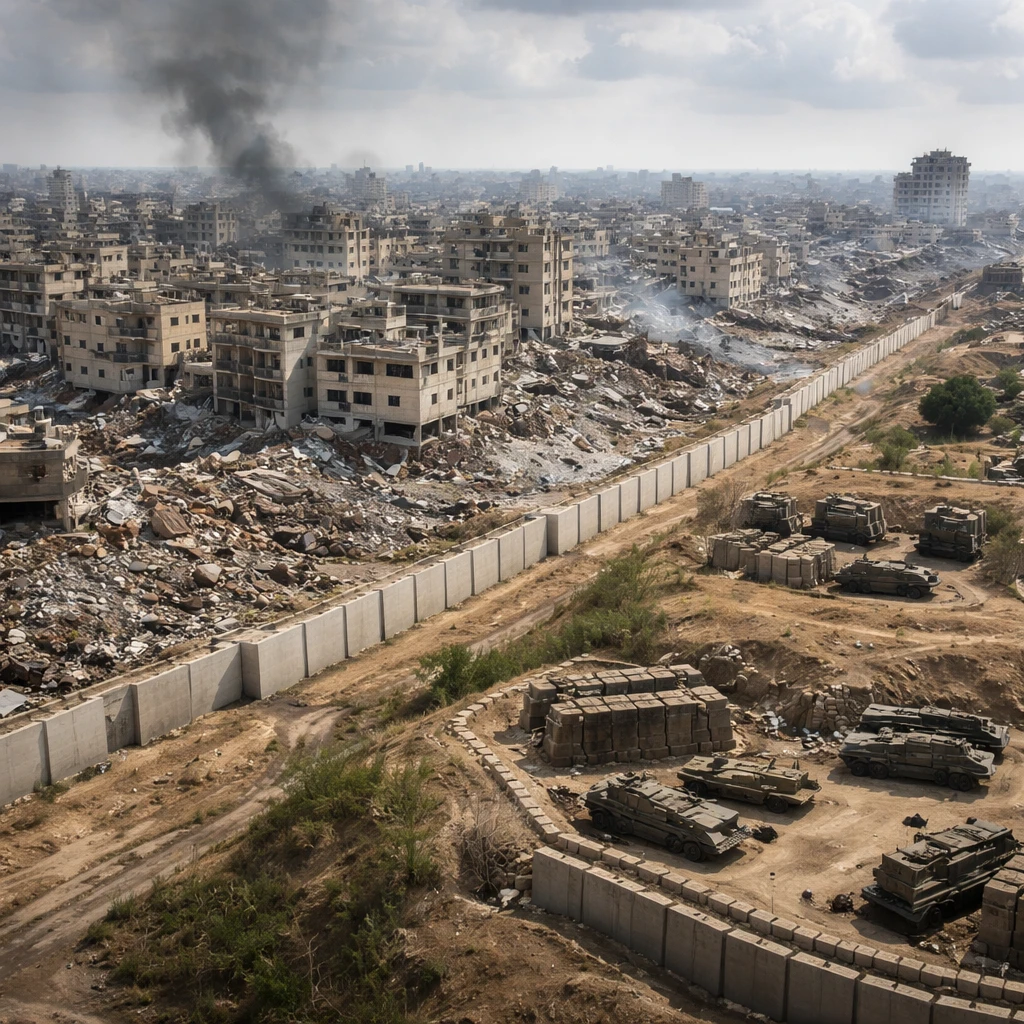
Satellite imagery analyzed alongside witness accounts reveals that in December, Israel shifted its demarcation known as the 'Yellow Line' significantly further into a Gaza City neighborhood controlled by Hamas, destroying dozens of residential buildings and forcing Palestinian inhabitants to flee. This territorial advance contravenes a ceasefire arrangement endorsed by the United States.
The satellite data, combined with firsthand reports, illustrate that in various locations throughout Gaza, Israel has set concrete markers designating the Yellow Line many meters, and in some cases hundreds of meters, inside the zones under Hamas control. Concurrently, the Israeli military erected at least six fortified positions, presumably for troop placement, within proximity to this adjusted line of control.
This shift in terrain control has effectively and unilaterally extended Israel's zone of influence deeper into Gaza. The move stands in contrast to the Trump administration’s ceasefire plan, which envisioned Israeli troop withdrawals to predefined boundaries represented by the Yellow Line.
The alterations are particularly evident in Al-Tuffah, a historically significant district in Gaza City now largely devastated from ongoing Israeli military operations over the past two years. Following the ceasefire in October, Al-Tuffah served as a refuge for thousands of Palestinians, with the expectation that Israeli forces would retreat to the Yellow Line cradling the neighborhood’s eastern border.
However, satellite images from early and mid-December show concrete blocks marking the Yellow Line initially placed inside territory administered by Hamas, then relocated an additional approximately 200 meters further west into Palestinian areas under Hamas control. Subsequent to this repositioning, analysis of the imagery indicates that the Israeli military undertook a demolition campaign that eradicated at least 40 buildings in the area between the original and new block placements. The few buildings remaining stand beyond the most recently positioned markers.
It remains unclear by what methods the demolitions occurred. Historically, Israel has employed a combination of aerial bombing, controlled demolitions, and ground vehicle operations to clear structures. Israeli military officials have acknowledged inquiries regarding the repositioning of the blocks and the destruction but have not provided immediate clarifications. They noted ongoing actions against Hamas post-ceasefire, particularly targeting underground tunnel networks.
An unnamed military source explained the practical challenges in aligning the Yellow Line markers precisely according to maps, citing the presence of civilian homes and other obstacles. The source described public depictions of the Yellow Line by both the Israeli military and U.S. officials as illustrative rather than exact.
The ceasefire agreement, underpinning the 20-point peace plan proposed by President Trump, mandated an immediate cessation of hostilities, including halting aerial and artillery bombardment, with territorial boundaries to remain static pending the staged withdrawal of forces. Despite this, the imagery and resident accounts depict a unilateral alteration of territorial positions by Israeli forces.
Residents such as Manal Abu Al-Kas recounted being compelled to abandon eastern Al-Tuffah after the blocks were moved inside their living zone. Abu Al-Kas and her family had suffered loss and injury during earlier conflicts, with two sons killed and another family member enduring amputation. The family had been living in relative normalcy until the installation of the Yellow Line blocks within their area forced them to evacuate due to the ongoing shelling, which intensified after the block placement shift.
Beyond Al-Tuffah, similar shifts were documented in Khan Younis in the south of Gaza where satellite images displayed concrete markers placed approximately 390 and 220 meters inside Hamas-held territory. Coinciding with this were demolitions of numerous buildings and the dismantling of tent camps intended for displaced people.
The imagery also revealed the construction of six sizable forts by Israeli forces within 700 meters of the line of control on the Israeli side. One notable installation in Beit Hanoun lies roughly 264 meters from the boundary. Officials have conveyed these are temporary earth and mud fortifications designed to shield troops from hostile fire.
Hamas official Hazem Qassem asserted that the encroachment of the Yellow Line has caused significant displacement, compelling thousands to move further west within Gaza. He warned that this trend effectively confines Gaza's population to a narrow coastal strip constituting less than 30 percent of the territory, raising fears of a de facto territorial partition.
The U.S.-brokered ceasefire left predominant Israeli control intact beyond the Yellow Line, with plans for phased troop withdrawals contingent on Hamas disarmament. Gaza’s population of nearly two million people largely remains crowded within a narrow strip controlled by Hamas, living in tents and damaged structures due to widespread destruction.
Concerns persist over the division of Gaza and limitations on reconstruction, which would likely be restricted to areas under Israeli control. Additionally, since the ceasefire, Israel has frequently opened fire in zones near the Yellow Line, citing security threats from Hamas militants attempting incursions.
Documented footage from early January shows Israeli military drones patrolling approximately 500 meters inside the Yellow Line within Al-Tuffah, further evidencing active Israeli presence beyond the agreed boundary. The military declined to comment on drone utilization.
Since the implementation of the ceasefire, Palestinian health sources report that Israeli actions have resulted in over 460 Palestinian fatalities, including many children, whereas militant attacks have killed three Israeli soldiers. Both Israel and Hamas have accused each other of violating the ceasefire.
The ongoing conflict originated following a Hamas-led attack on October 7, 2023, which Israel cites as justification for its military actions resulting in widespread Palestinian casualties and devastation observed in the territory.