
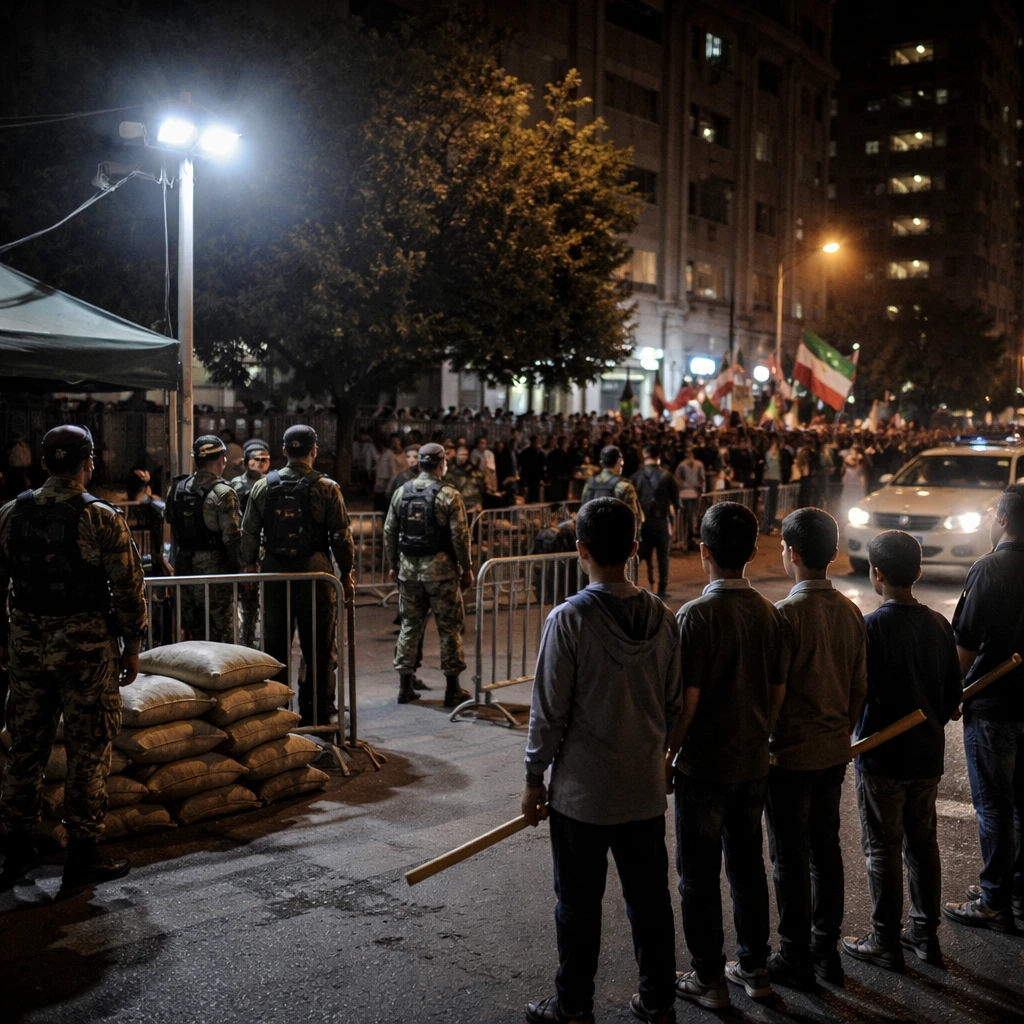
March 30 - As the conflict with the United States and Israel enters its fourth week, Iran has moved to deter potential domestic unrest through a wide-ranging internal security push that includes arrests, executions and large-scale street deployments of security personnel and government-aligned supporters.
Authorities have also expanded the use of community militia forces and mobilised civilians to occupy public spaces most nights with pro-government demonstrations and ceremonies meant to memorialise officials killed in airstrikes. Activists and rights groups say that even children have been recruited to help staff checkpoints and patrols at city entrances, part of an effort to make large areas of public space unusable for potential protesters.
Despite draconian warnings that have discouraged overt public defiance so far, Iranian officials are reported to be deeply concerned about the longer-term fallout of the conflict. Those concerns center on the potential for substantial damage to an already weakened economy and on the possibility that post-war economic stress could ignite broader opposition to the ruling system.
At the center of the domestic control effort is the Basij militia - described by sources as a voluntary paramilitary organisation run by the Revolutionary Guards. The Basij have established checkpoints inside and at the approaches to major cities, activists say; although some of those positions have been targeted in Israeli strikes, they remain in place.
Signs of strain within the Basij have emerged. A senior Revolutionary Guards official, Rahim Nadali, announced on state television last week that the minimum age for volunteers staffing checkpoints and patrols had been lowered to 12, an indication by some sources that manpower shortfalls are pressing.
One senior source in Iran told contacts outside the country that officials are currently prioritising the maintenance of supply chains for the duration of the conflict, but that they are also increasingly anxious about the challenges the economy will face once active fighting ends. A second senior source said that fear of unrest after the conflict is the principal driver of the present crackdown.
Economic pressures may become more visible as businesses reopen after the long Iranian holiday, a third source said. Worries about the state's prospects are already acute. "The Iranian regime was already in deep trouble before the war and it’s now taking a big hit," said Ali Ansari, a professor of modern history at the University of St Andrews. He added that pre-existing political and economic crises are likely to resurface in worse shape when peacetime returns, and that the regime's attempts to stamp out unrest pre-emptively could have the opposite effect, increasing popular opposition.
Reporting from inside Iran remains difficult. Frequent internet shutdowns and a lack of official, reliable statistics since the conflict began make it hard to form a complete picture of the economic damage. Nevertheless, there are reports of widespread harm to infrastructure, including energy facilities that are crucial for state revenue. Observers note that prospects for sanctions relief appear slim, and that Tehran's attacks on neighbouring states have strained economic ties with trading partners.
A senior Iranian source said these factors make sustaining the economy during and after the conflict extremely challenging and increase the risk of renewed unrest.
Mohammad, 38, a Tehran resident who works for a trading company, said his employer has warned staff that job cuts may be necessary. "Our main business is with countries in the region - and obviously it’s not clear whether that can continue after the war," he said, asking to remain anonymous due to fear of reprisal.
The regime's vulnerability predates the current conflict. In January, Iran's ruling clerics and the Revolutionary Guards used lethal force to suppress nationwide street protests driven by frustration with the weak economy, killing thousands according to previously reported accounts. Since the current conflict began, the only publicly confirmed sign of unrest was cheering in Tehran when state media declared Supreme Leader Ayatollah Ali Khamenei dead; authorities subsequently tightened security measures.
Human rights organisations and activists report intensified repression. "Iranian authorities continue to carry out waves of arrests targeting real and perceived dissidents, members of Iran’s ethnic and religious minorities including Baha’is, and people who share reports or footage of strikes," said Louis Charbonneau of Human Rights Watch.
Three rights activists inside Iran said the pressure has been particularly acute in regions with large Kurdish, Arab or Baluchi populations, areas where unrest has frequently concentrated in past episodes. Security forces have, according to activists, warned parents of suspected agitators that their children could face imprisonment or execution, with relatives potentially punished as well.
The prosecutor general's office has told Iranians living abroad that property in Iran could be seized if they express support for the United States or Israel, a warning that extends the campaign of deterrence to the diaspora.
Separately, the authorities have been mobilising supporters to fill public spaces on most nights with pro-government rallies and mourning ceremonies for those killed in airstrikes. Analysts and rights advocates say the likely purpose is to occupy squares and streets so they are unavailable to anti-government demonstrations. Hadi Ghaemi, head of the Center for Human Rights in Iran, described tactics that include cruising residential neighbourhoods in vehicles to intimidate residents with chanting and gunfire aimed at keeping people at home.
A Tehran resident who requested anonymity said people are afraid to go out at night. The resident voiced a fear that if the ruling authorities survive the conflict, an even more severe crackdown could follow.
At the strategic level, Iran's leadership appears to believe it can endure external military pressure by leveraging its ability to disrupt energy flows in the region. Officials have signaled a willingness to close the Strait of Hormuz and to strike Gulf Arab producers with the goal of producing a global oil and gas shock, a strategy they appear to calculate will help them weather the attacks.
Whether that strategy succeeds in preserving the regime's domestic standing depends in part on what Iranians see and feel when the conflict winds down - notably the condition of the economy and the availability of jobs, trade and public services. Iran's future stability, according to multiple sources and rights groups, may rest on the interplay between wartime damage to vital infrastructure and the state's capacity to prevent the emergence of organized domestic opposition once active hostilities subside.
Summary
Iran has intensified internal security measures - including arrests, executions, mass street mobilisations and the use of Basij militia checkpoints - as it confronts sustained attacks by the United States and Israel. Authorities are recruiting civilians, including minors, for checkpoint duty amid manpower strains. Officials and outside observers warn that damage to energy infrastructure, sanctions and fractured regional ties could deepen economic distress and spark renewed unrest after the conflict ends.