
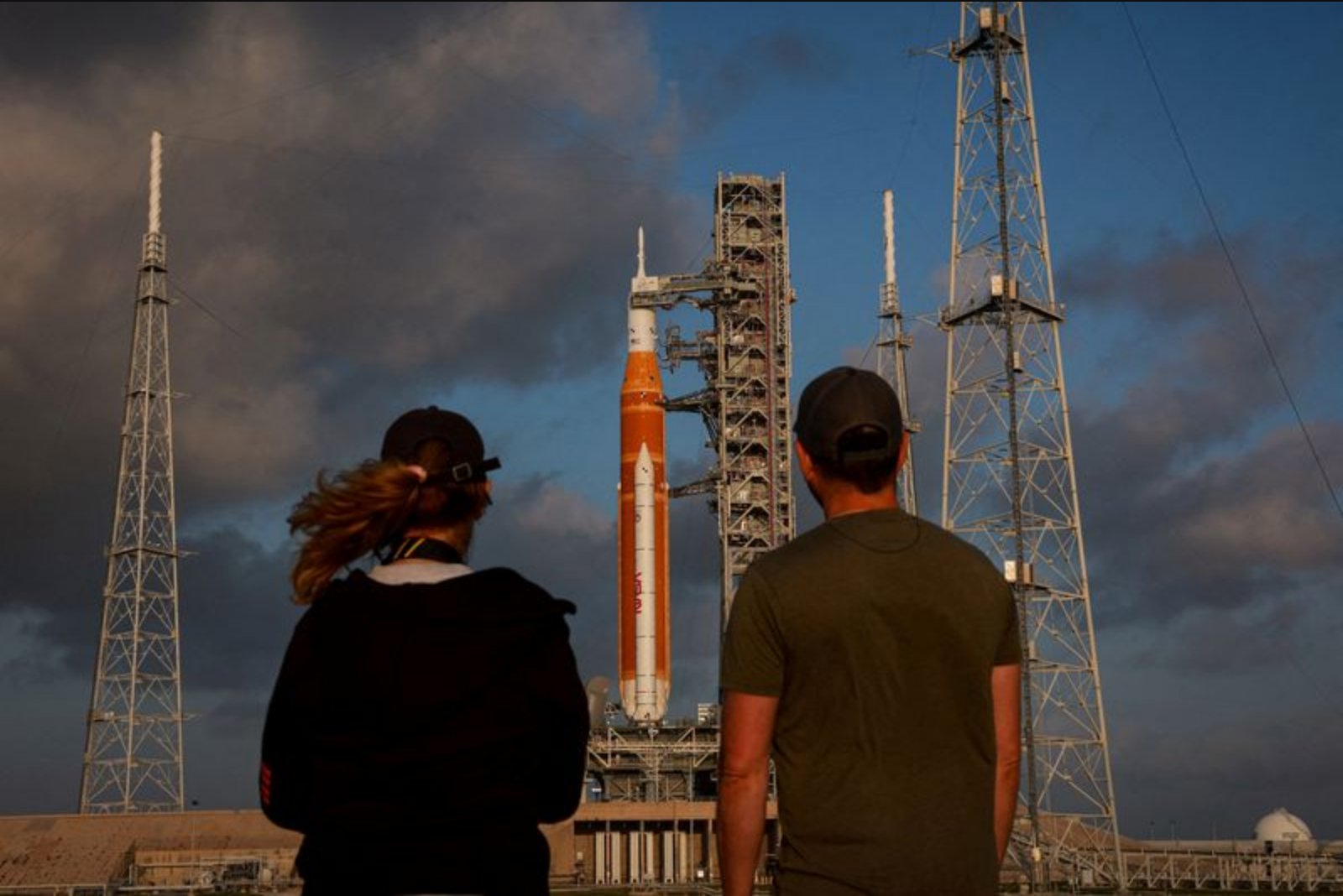
April 1 - NASA’s Artemis II mission, which lifted off on Wednesday, is planned to run for about 10 days and will carry four astronauts on a rapid circuit from Earth around the Moon and back. The mission represents the first crewed lunar flight since the Apollo era and is intended to validate the Orion spacecraft and related systems ahead of planned missions to return humans to the lunar surface later this decade.
Launch day
The mission began with liftoff from NASA’s Kennedy Space Center in Florida aboard the Space Launch System, the agency’s most powerful rocket to date. Following ascent, the Orion crew capsule separates from the rocket’s upper stage and transitions into a highly elliptical orbit around Earth to begin the mission’s staged checkout and preparation sequence.
Days 1-2: Earth-orbit checkouts
During the first one to two days, while in high Earth orbit, the crew conducts extensive systems checks aimed at confirming Orion’s readiness for deep space operations. These on-orbit evaluations focus on life-support systems, the spacecraft propulsion architecture, navigation capabilities and communications links. The objective of these checks is to ensure all critical systems perform nominally before committing to the translunar leg.
Translunar injection
Once the crew and mission control are satisfied with the initial checkout results, Orion’s propulsion system executes a critical engine burn known as translunar injection. That burn propels the spacecraft out of Earth orbit and places it on a trajectory toward the Moon.
Days 3-4: Coast to the Moon
Over the subsequent several days, the crew monitors the spacecraft as it travels away from Earth and toward lunar distance. Throughout this transit, Orion will operate at a greater range from Earth than any previous human spaceflight, and mission controllers will track communications and navigation performance as the vehicle journeys into deep space.
Moon flyby - free-return trajectory
Orion will pass behind the Moon on what is described as a "free-return" trajectory. That flight path is designed to swing the spacecraft back toward Earth without requiring additional propulsion inputs. During this phase the vehicle attains its maximum distance from Earth for the mission.
Days 5-8: Return transit and additional testing
Following the lunar flyby, the crew spends several days heading home. During the return transit they will carry out additional deep-space evaluations, including tests of power systems, thermal-control hardware and procedures for crew operations at distances far beyond low Earth orbit.
Re-entry and splashdown
As Orion nears Earth, the spacecraft separates certain components before entering the atmosphere at approximately 25,000 miles per hour (40,233 kph). One of the mission’s primary objectives is to test the capsule’s heat shield under this high-energy re-entry condition. The mission is expected to end with a splashdown in the Pacific Ocean, where recovery teams will retrieve the crew and vehicle.
This flight is explicitly framed as a systems and operations validation for later missions that aim to return humans to the lunar surface within the decade. The itinerary emphasizes staged checkouts, a translunar injection burn, a free-return lunar pass, and end-to-end testing of re-entry and recovery procedures.