
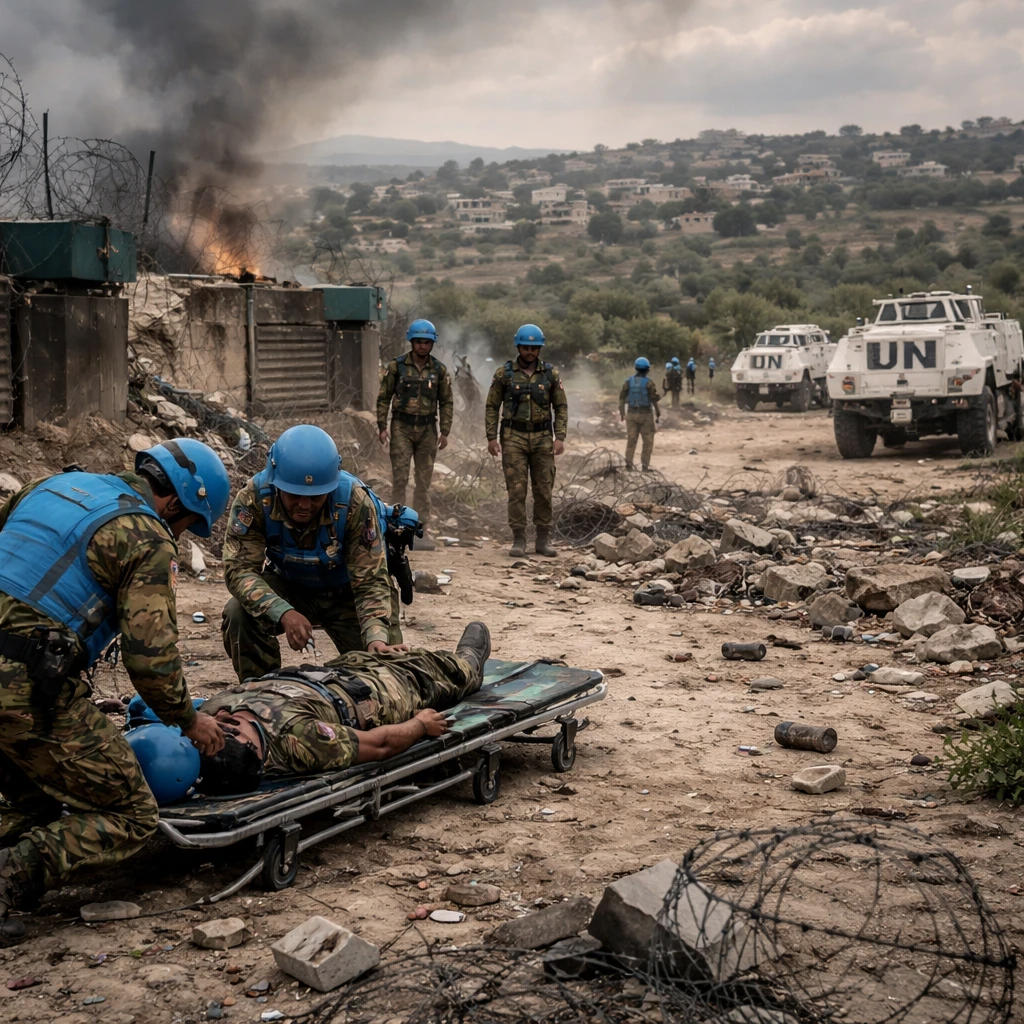
The United Nations peacekeeping force in Lebanon reported that a projectile exploded at one of its positions near the southern village of Adchit al-Qusayr on Sunday, killing a peacekeeper and critically wounding another.
In an early Monday statement, UNIFIL said the source of the strike was unknown and that it had opened an inquiry to establish the full circumstances surrounding the explosion. "We do not know the origin of the projectile. We have launched an investigation to determine all of the circumstances," the mission said.
Indonesia's foreign ministry confirmed on Monday that the deceased peacekeeper was an Indonesian national. The ministry also said three other personnel were injured by indirect artillery fire in the vicinity of the Indonesian contingent's position near Adchit al-Qusayr.
UNIFIL, which is deployed in southern Lebanon to monitor hostilities along the demarcation line with Israel, emphasized the recurring hazards that peacekeepers face in that area. The mission's area of operations lies at the center of ongoing clashes between Israeli forces and Iran-backed Hezbollah fighters.
The statement noted that UNIFIL has been intermittently exposed to danger from both sides over recent years and reminded all parties of their obligations under international law to protect UN personnel and property. "Once again, we call on all actors to uphold their obligations under international law and to ensure the safety and security of UN personnel and property at all times, including by refraining from actions that may put peacekeepers in danger," UNIFIL said.
The incident follows other episodes in which UN positions and personnel have been affected by combat in southern Lebanon. On March 6, Ghana's armed forces reported that the headquarters of its U.N. peacekeeping battalion in Lebanon was struck by missile attacks, leaving two soldiers critically wounded.
Israel's military later acknowledged that tank fire had hit a U.N. position on that date and said the impact had wounded the Ghanaian peacekeepers. According to the Israeli military, its troops had been responding to anti-tank missile fire from Hezbollah, which had moderately wounded two Israeli soldiers.
Indonesia condemned the latest incident, describing any harm to peacekeepers as unacceptable. The Indonesian statement reiterated the country's condemnation "of Israel's attacks in Southern Lebanon."
The wider conflict that has drawn Lebanon into the recent regional confrontation began after Hezbollah fired rockets at Israel on March 2 in a show of solidarity with Tehran, two days after Iran itself was attacked by Israel and the United States. Hezbollah's launch of rockets prompted a renewed Israeli offensive against the group.
With UNIFIL's mandate scheduled to conclude at the end of 2026, the mission continues to operate in a contested and volatile environment where its positions have occasionally been caught in the crossfire between Israeli forces and Hezbollah fighters.
Summary
A projectile struck a UN position near Adchit al-Qusayr, killing one peacekeeper and critically injuring another. Indonesia confirmed the fatality was one of its nationals and reported three additional injuries near its contingent. UNIFIL has launched an investigation and urged all parties to protect UN personnel.
Key points
- UNIFIL reported a deadly explosion at one of its positions near Adchit al-Qusayr; the mission is investigating the projectile's origin.
- Indonesia confirmed the killed peacekeeper was an Indonesian citizen and said three others were injured by indirect artillery fire near the Indonesian contingent.
- The area monitored by UNIFIL is a focal point of clashes between Israeli troops and Iran-backed Hezbollah fighters; past incidents have also impacted UN positions and personnel.
Risks and uncertainties
- Uncertainty over the origin of the projectile leaves open the risk of misattribution and further incidents affecting peacekeepers - this directly impacts international peacekeeping operations and defense-sector stakeholders tasked with force protection.
- Ongoing clashes between Israeli forces and Hezbollah increase the likelihood of additional harm to UN personnel and property, posing operational risks for humanitarian and international organizations operating in southern Lebanon.
Note: This article reflects only the information reported by the parties in their statements and does not add details beyond those statements.