
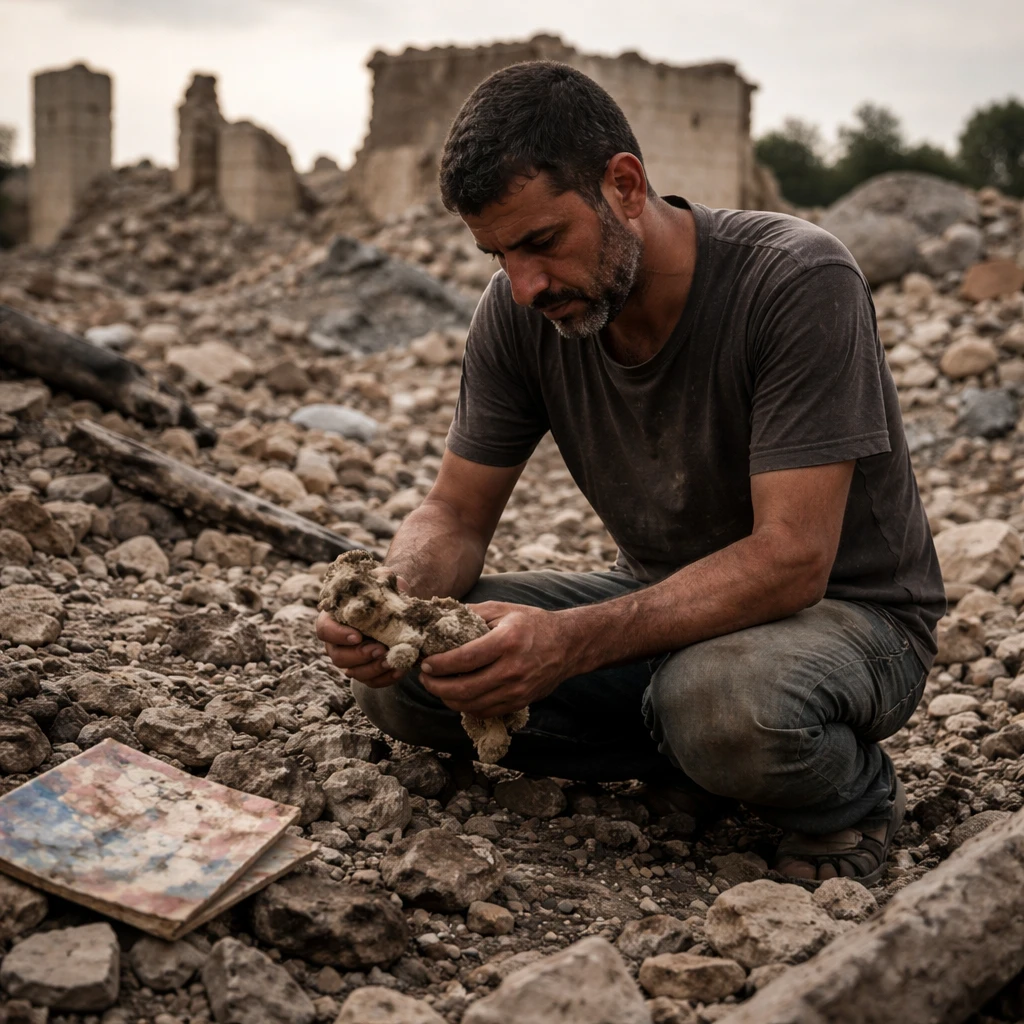
TYRE, Lebanon - Almost daily since the attack that destroyed his home, 34-year-old Hussein Saleh has returned to the plot of land in Tyre where his family once lived. He walks over the shattered ground and sifts through rubble searching for items that might connect him to the relatives he lost - his wife, his 5-year-old daughter Sarrah and six other family members who were killed when an Israeli missile struck the house on March 6.
"Every day or two I come here, I check on things, I look around to find memories, to find a phone, to find anything that can soothe my heart and make things lighter," Saleh said. What remains at the site is sparse: stones that once formed the walls of his home, fragments of metal from the missile, and a tattered book that belonged to one of his daughter's cousins.
Saleh described the home as modest and once full of life - where his daughter played with older cousins and helped tend a pair of young goats owned by his wife's aunt. On the day of the strike he was out buying groceries when he heard the explosions. "I heard two strikes and my heart sunk. My heart ... my heart felt they were gone," he said.
The attack inflicted catastrophic physical damage. Saleh said the bodies were torn apart and so badly mangled that he had to bury different body parts together because they could not be properly identified or sorted. He described the strike as "full of hate" and said he did not understand why his relatives were targeted. He and his relatives were civilians, he said, and there was no military equipment inside the home.
Since March 2, Israeli strikes and military operations in Lebanon have resulted in more than 1,500 deaths, according to Lebanon's health ministry figures cited in reports. The tally includes 130 children and 101 women. The escalation followed renewed hostilities between Israel and the Lebanese armed group Hezbollah.
On Wednesday, a two-week ceasefire between the United States and Iran was announced. Lebanese sources close to Hezbollah told Reuters that the group had paused its attacks in line with the truce. At the same time, Israeli strikes have continued, and Israel's prime minister Benjamin Netanyahu said Lebanon was not included in the ceasefire.
Large portions of Lebanon have been subject to evacuation warnings from Israel since March 2. Those notices have covered about 15% of the country and included areas such as Tyre. International law experts, cited in reporting, have said evacuation orders should be tied to imminent attacks and that follow-on strikes must still take precautions to avoid civilian harm.
Saleh recounted his daughter's recent health struggles and the family hope for recovery. Sarrah had been undergoing physical therapy intended to help her walk again after a condition left her partly paralyzed. "We hoped that in two months she would be able to walk again and play like the other kids ... I don't know how to describe this loss," he said.
The personal consequences extend beyond physical loss. Saleh said he can no longer be alone because the loneliness is overwhelming. "The loss, being apart from them, is so hard. My whole life has changed," he said, breaking down several times while speaking about the decimated home and the family members he buried.
Contextual notes
This account focuses on the human toll at a single site in Tyre and situates that loss within the broader casualty figures reported for Lebanon since the resumption of intense hostilities in early March. The reporting includes statements about a new two-week ceasefire between the United States and Iran and describes how Hezbollah's operations and Israeli strikes have behaved in relation to that truce, as reported by Lebanese sources and statements attributed to Israeli leadership.
Details in this article are based on the first-hand account of Saleh and official casualty figures cited from Lebanon's health ministry in the course of reporting. The article does not provide independent forensic or legal determinations of the target or intent behind the strike that destroyed Saleh's home.