
World February 5, 2026

French Navy Seizes Nearly 678 kg of Cocaine in Caribbean, Hands Vessel to Barbados

Interception underscores Paris's intensified efforts against trafficking from Latin America and the Caribbean

By Leila Farooq
French Navy Seizes Nearly 678 kg of Cocaine in Caribbean, Hands Vessel to Barbados

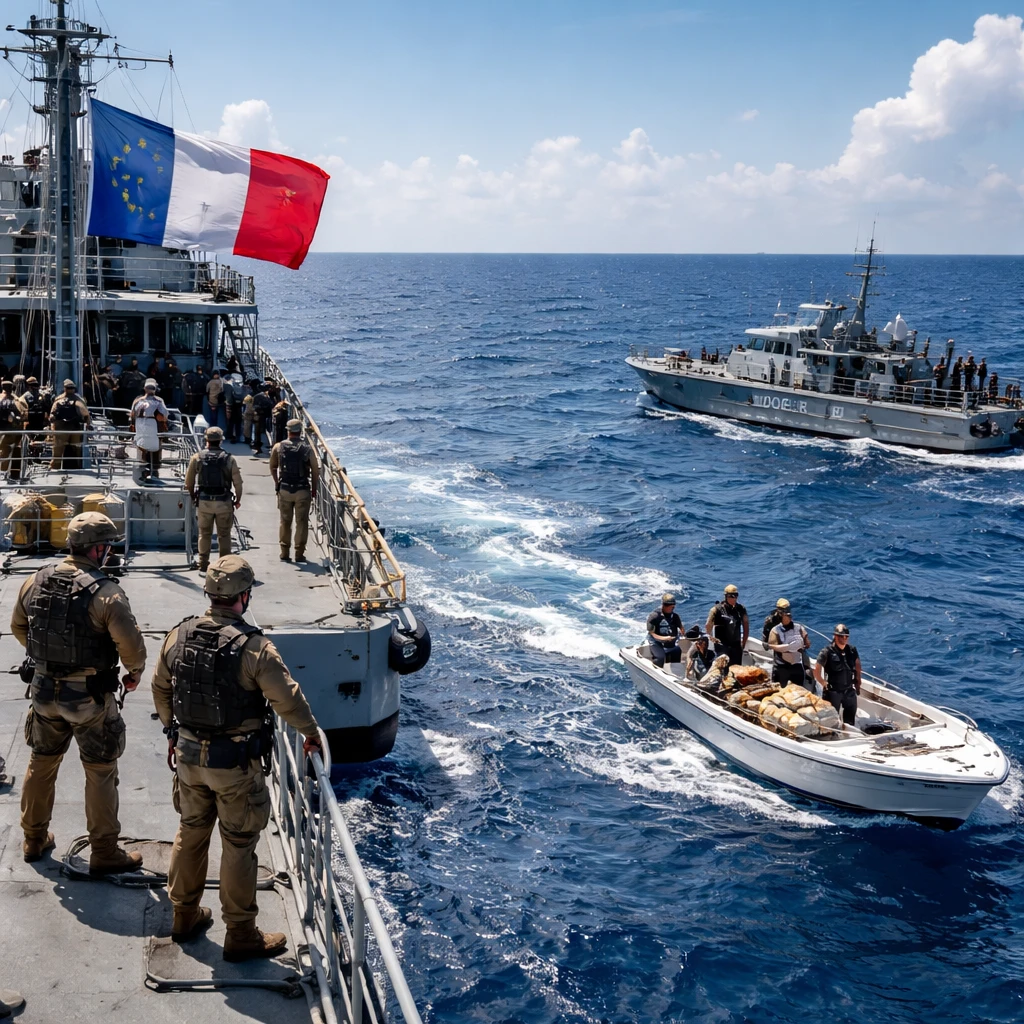
The French Navy intercepted a vessel in the Caribbean carrying roughly 678 kilogrammes of cocaine and transferred custody to Barbadian authorities, France's Armed Forces Minister said. The seizure comes as France intensifies actions against drug trafficking linked to rising gang-related crime at home and an observed increase in cocaine use, prompting Paris to push for coordinated measures at the European level.

Key Points

  • French Navy intercepted a boat in the Caribbean carrying about 678 kilogrammes of cocaine and transferred it to Barbadian authorities; this was confirmed by Armed Forces Minister Catherine Vautrin on X.
  • France has been intensifying enforcement and policy responses to drug trafficking in the Caribbean and Latin America, reflecting concerns about rising gang-related drug crime and a December report showing cocaine surpassing cannabis as the top illegal drug in France.
  • Paris is pursuing diplomatic and regulatory initiatives, including a multi-pronged plan announced by the foreign minister during a visit to Colombia and advocacy for an EU sanctions regime to address trafficking; sectors impacted include maritime security, law enforcement, and regional policy coordination.

The French Navy intercepted a boat in Caribbean waters that was transporting cocaine and handed the vessel and its cargo to Barbadian authorities, France's Armed Forces Minister said on Thursday. Minister Catherine Vautrin posted on X that approximately 678 kilogrammes of cocaine were seized during the operation.

The move takes place amid broader international efforts by the United States and other countries to step up enforcement against drug trafficking. France, which maintains overseas territories in the Caribbean and parts of Latin America, has adopted a more assertive posture in recent months in response to the flow of illegal narcotics across the region.

A report published in December by the French Monitoring Center for Drugs and Drug Addiction indicated that cocaine has overtaken cannabis as the most prevalent illegal drug in France. Authorities have also reported a rise in gang-related drug crime domestically, concerns that have informed French policy actions.

In a related diplomatic effort, France's Foreign Minister Jean-Noel Barrot launched a multi-pronged plan during a visit to Colombia, noted as the world's largest producer of cocaine, aimed at addressing a rapid escalation in drug trafficking across Latin America, the Caribbean and, increasingly, Europe. Paris has been advocating for the establishment of a European Union sanctions framework to confront the problem.

The interception and handover to Barbadian authorities highlight France's operational role in regional maritime security and its reliance on international cooperation to disrupt shipments of illegal drugs. Official comments stressed the quantity seized and the collaborative nature of the response, while broader policy steps continue to be promoted by Paris at the European level.


Context and next steps

French officials have signaled a shift toward more aggressive enforcement and diplomatic measures to curb trafficking flows originating in Latin America and the Caribbean. The December monitoring report and increasing gang-related incidents in France have contributed to that policy direction. How these operational seizures and proposed sanctions will affect longer term trafficking trends and regional dynamics remains a focus for French authorities.

Risks

  • An increase in gang-related drug crime in France raises uncertainty about domestic security and enforcement burdens, which could affect public safety and law enforcement resource allocation - impacts law enforcement and public safety sectors.
  • The growing presence of cocaine in France and expanding trafficking into Europe create uncertain outcomes for regional policy effectiveness, leaving open how quickly proposed measures such as an EU sanctions regime might reduce flows - impacts regulatory and international policy sectors.
  • Coordinated international action is required to intercept shipments at sea and address production and distribution networks; the need for sustained multinational cooperation introduces uncertainty over enforcement consistency and diplomatic alignment - impacts maritime operations and international security collaboration.

More from World

Pakistan Declares End to Balochistan Operation After 216 Militants Killed Feb 5, 2026 A Walk to Belonging: Muslim Students from Sandzak Find Solidarity in Serbia’s Protests Feb 5, 2026 U.S. Drone Makers Pivot to Asia as Regional Tensions Rise Feb 5, 2026 French envoy says Taiwan Strait naval transits uphold international law, not provocation Feb 5, 2026 ’Today’ Co-Host Urges Contact After Her 84-Year-Old Mother Disappears Near Tucson Feb 4, 2026