
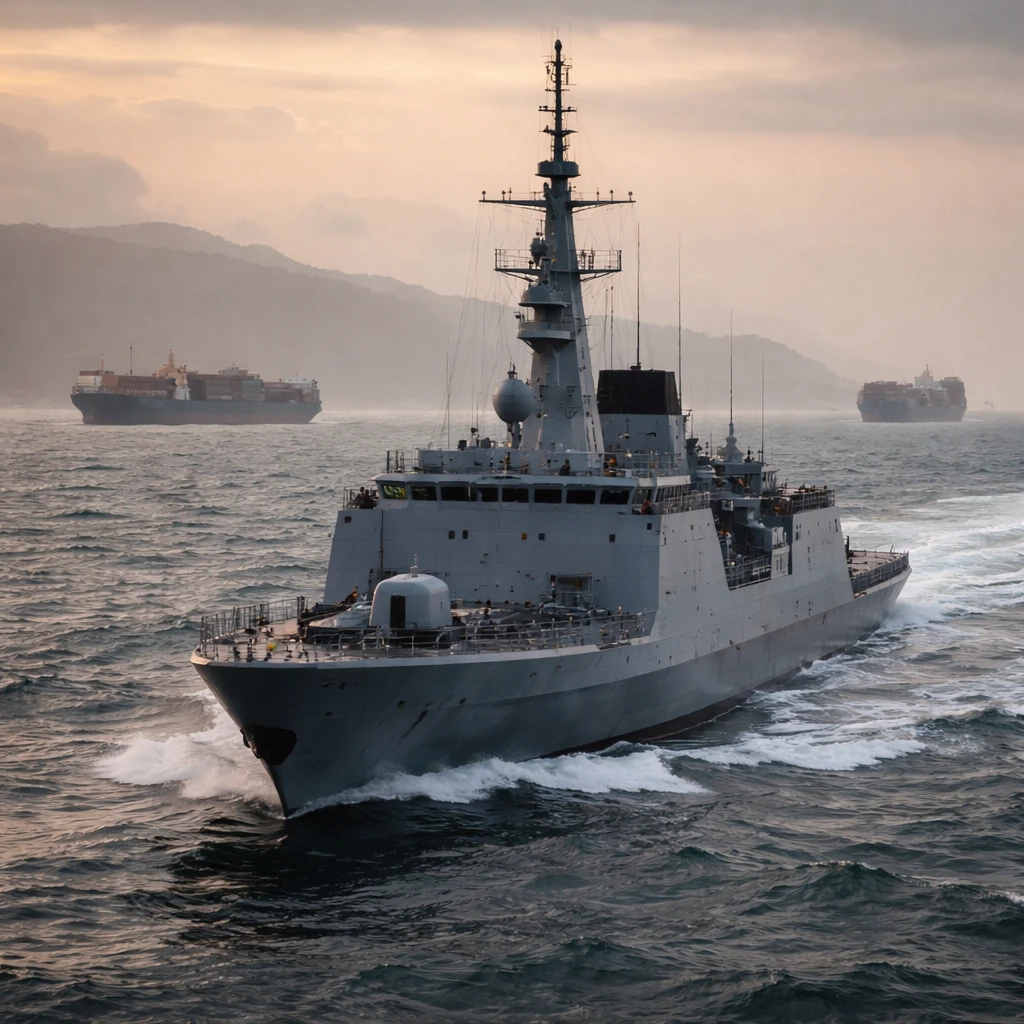
TAIPEI, Feb 5 - Naval operations by foreign countries through the Taiwan Strait are carried out to reinforce international maritime law rather than to provoke Beijing, France's de facto ambassador in Taipei said on Thursday.
Franck Paris, director of the French Office in Taipei, emphasized that French naval assets are dispatched into international waters with care and without intent to incite. "We are careful to send these naval assets into international waters without any provocation," he told reporters, describing the purpose of such voyages as sending a clear message about the primacy of international law in those waters.
Paris noted that France will chair the Group of Seven nations for the coming year and that it has become routine for G7 statements to include language defending the status quo across the strait and opposing the use of force or coercion. He said there is "a good choreography between a number of G7 partners to send this message," pointing to past naval transits by countries including Canada and the Netherlands as examples of that coordination.
U.S. warships pass through the strait every few months, a practice that has at times enraged Beijing. Other U.S. allies, such as France, Australia, Britain and Canada, have also made occasional transits. The last publicly confirmed sailing by a French navy ship in the strait was in 2024, Paris said.
The Taiwan Strait is a narrow and strategically significant channel through which trade worth billions of dollars a year flows. The government of Taiwan, which rejects Beijing's claims of sovereignty over the island, welcomes allied naval transits as demonstrations of support for freedom of navigation. At the same time, Taipei says China's military routinely operates in the waterway as part of what it sees as a pressure campaign.
France maintains no formal diplomatic ties with Taiwan, like most countries, yet Taipei regards Paris as an important partner and fellow democracy. Paris recalled that three decades ago France sold Mirage fighter jets and frigates to Taiwan, while noting that the United States remains the island's most important international source of arms.
He added that "these assets are still used by the Taiwanese defence," and that French companies have supported their upkeep by supplying necessary equipment. "This is the framework that we are committed to and this framework has not been questioned for years," Paris said, underlining continuity in France's approach to defense-related cooperation.
The debate over naval transits intersects with concerns about regional stability, commercial shipping and defense supply chains because the strait serves as a major artery for global trade. While officials like Paris frame allied sailings as legal affirmations, Beijing's periodic aggressive responses to foreign warships in the area highlight the potential for tension.
In addition to these security-focused remarks, the broader public messaging around the strait has entered commercial and investment conversations. One promotional note asks: "What are the best investment opportunities in 2026?" and argues that better data should guide investment choices rather than instinct alone. It describes an investment product that combines institutional-grade data with AI-powered insights to help identify opportunities more often, noting that it will not guarantee winners but may assist investors in finding more of them.
Paris' comments reflect a continuing diplomatic effort by G7 partners to present a coordinated stance on the Taiwan Strait, framing naval transits as legal demonstrations meant to uphold established norms in a waterway of high strategic and economic importance.