
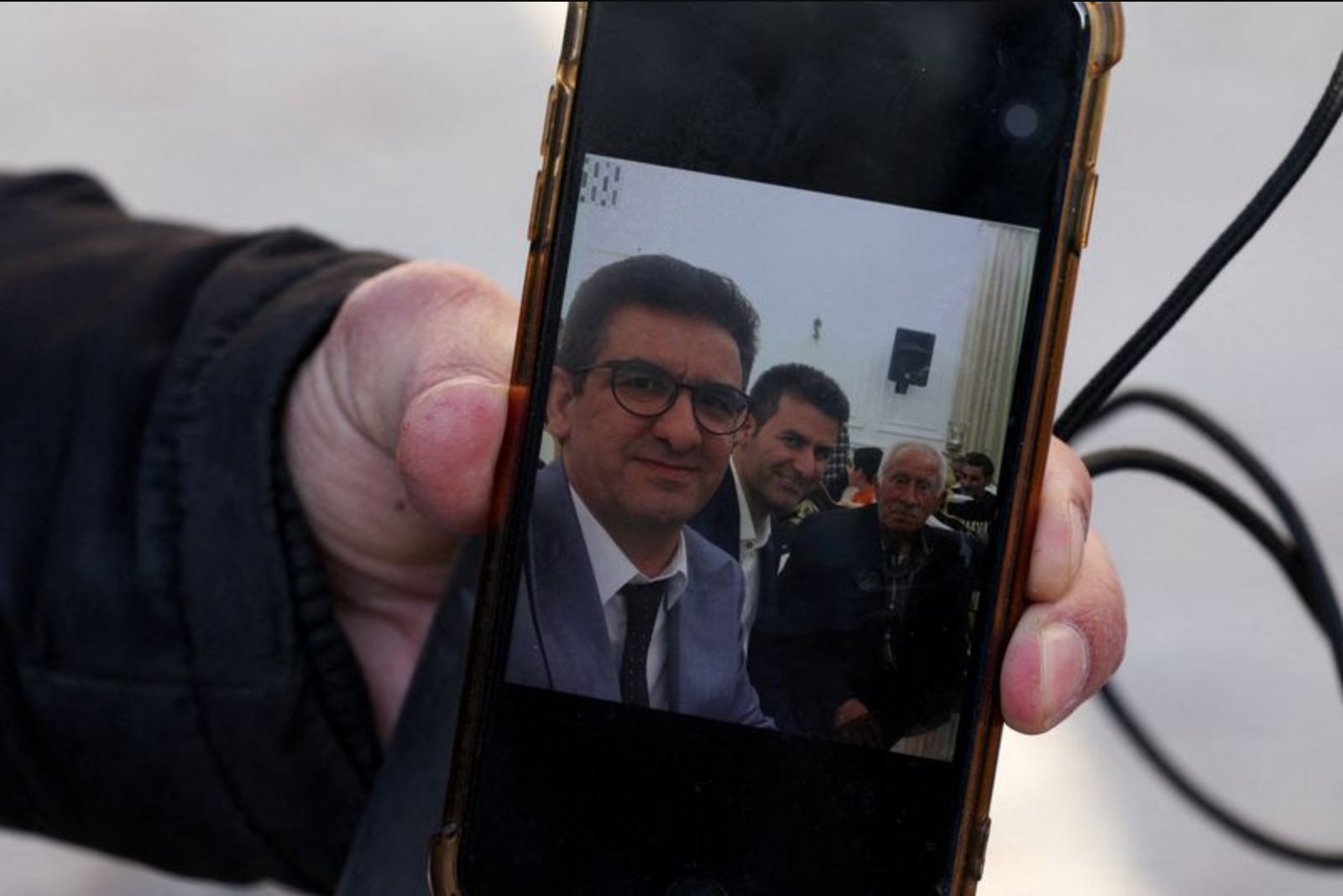
For two decades Mahdi Mirzahosseini worked as an assistant in butchery. Around a year ago, he launched his own shop - a venture his family said he was determined to operate in time for the Persian new year. That shop, located on the ground floor of a mixed-use complex containing homes, retail units and a laundry, was destroyed in an attack on Monday. Neighbors described the incident as a double strike.
Now 41, Mirzahosseini has not been seen since the blasts. Each day since the attack two of his older brothers have returned to the site to search. They said on Saturday that, despite continuous searches by a tractor and recovery teams, they have only found his car key and jacket. The family said he is the only person still missing from the site.
Rescue personnel working at the scene reported that six bodies were recovered from the rubble and that 18 people survived the strike. A neighbor and a rescue worker both said the complex had no links to any military activity and that it was struck twice in quick succession a short time after noon.
Pir-Hossein Kolivand, president of the Iranian Red Crescent Society, placed the strike against this commercial complex in a broader context, saying it was one of more than 80,000 civilian structures damaged in U.S. and Israeli strikes on Iran during the three-week-old war. He said the strikes had also inflicted damage on nearly 500 schools and 266 medical facilities, including hospitals, clinics and pharmacies. Reuters could not independently verify his tally or the specific circumstances of the attack on the complex.
Kolivand warned that "The number of attacks on residential and civilian areas is increasing." The statement came alongside noting that Israel and the United States say they do not target civilians.
Six days after the explosion, where the complex once stood there remained a wide crater ringed by mountains of rubble. Shreds of blackened clothing dangled from a nearby leafless tree.
Amir Saeed-Jamshidi, a Red Crescent first responder, described his team's arrival at the scene minutes after the explosions. He said they found a mass of debris and active fires, and that residents told them people trapped beneath the wreckage were phoning for help. His team dug two tunnels in their efforts to reach survivors, including some people located deep in an underground garage.
The blast's shockwave damaged surrounding structures; one nearby building had all its windows blown out, according to rescue workers on site.
Mirzahosseini is the youngest of seven siblings. His brother Hamid said the shop was closed for the first two weeks of the war, but customers began calling to inquire about buying meat and chicken for the holidays. Hamid recounted that their mother urged Mahdi to remain at home, but the younger man insisted on returning. When urged, he replied, "Customers are calling. I have to go do my work," Hamid said.
Despite the limited physical evidence recovered so far, the family has not given up hope. Another brother, Khalil, holding his infant near the ruin where the butcher shop once stood, said, "God willing we will find him safe." He added, "There is no trace of him."
Context and ongoing efforts
Search and recovery operations have continued at the site with specialized teams and heavy equipment. Workers reported having to tunnel through unstable rubble to reach pockets where survivors might be trapped, highlighting the difficulty and danger of the ongoing rescue mission.
Authorities and aid organizations have provided counts of damaged civilian infrastructure and institutions, though those figures have not been independently confirmed. Local accounts and rescue-worker testimony at the scene describe intense destruction and human distress following the strikes.