
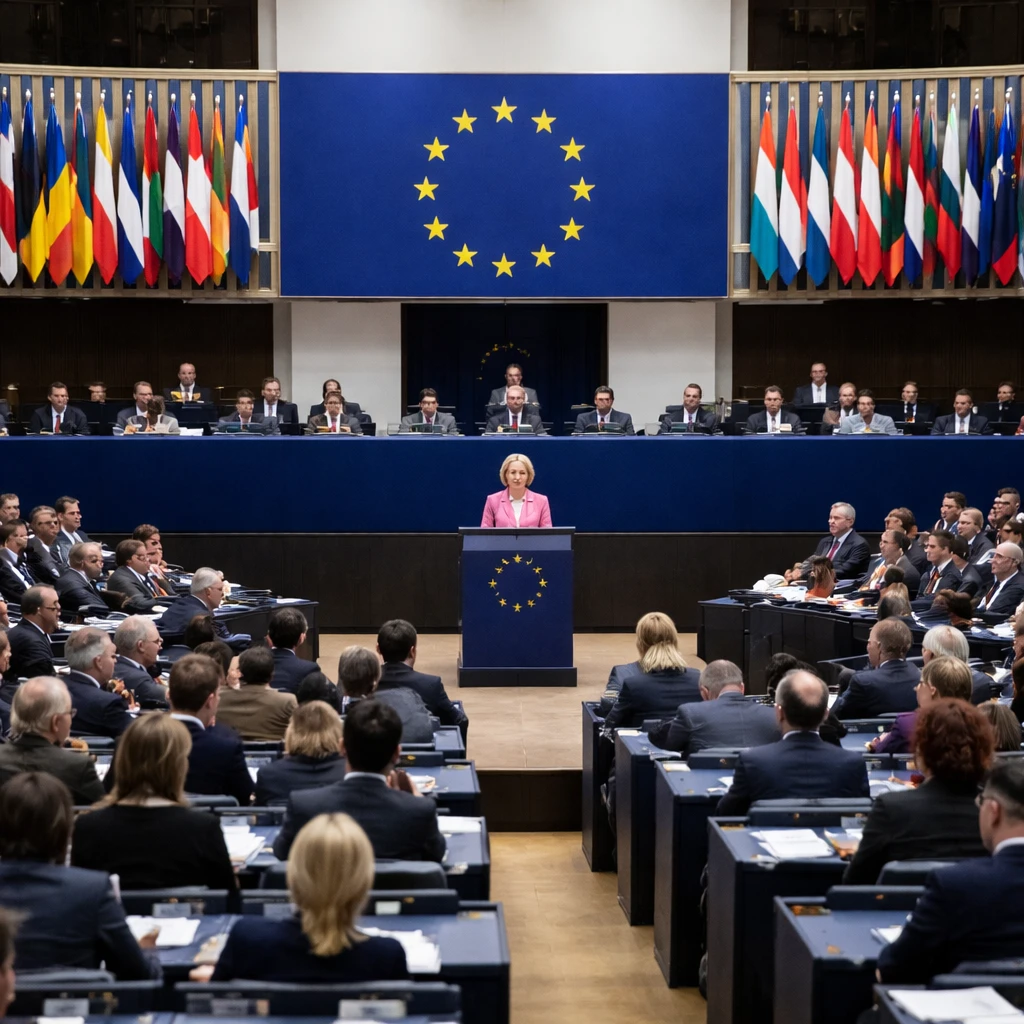
European Commission President Ursula von der Leyen successfully overcame a no-confidence vote in the European Parliament linked to the Mercosur trade agreement with South American nations. The motion, prompted by far-right lawmakers, did not secure enough support, despite ongoing parliamentary scrutiny of the trade deal’s negotiation process and regulatory compliance. Concurrently, the Parliament has sought a legal evaluation of the agreement, potentially delaying its enactment.
Key Points
- European Commission President Ursula von der Leyen withstood a no-confidence vote by the European Parliament, with only 165 out of 720 members opposing her.
- The no-confidence motion was triggered by far-right parliamentarians focusing on concerns related to the Mercosur trade deal with South American countries.
- The European Parliament is seeking a legal opinion from the EU Court of Justice on the Commission's procedure in finalizing the Mercosur agreement, potentially postponing the trade deal's implementation.
In Strasbourg on Thursday, European Commission President Ursula von der Leyen faced a no-confidence vote initiated within the European Parliament, centered on the recently negotiated trade deal between the EU and Mercosur countries in South America. The motion, championed by members of the far-right political spectrum, concluded with only 165 out of 720 Members of the European Parliament (MEPs) voting against von der Leyen’s leadership, enabling her to maintain her position. This event constitutes the fourth unsuccessful attempt to censure von der Leyen over the previous six months.
Notably, President von der Leyen was absent during the vote as she was engaged in preparations for an urgent EU leaders' summit scheduled in Brussels. This summit addresses the increasingly complex and strained relations between the European Union and the United States.
European Parliament rules permit as few as 72 MEPs to initiate a censure motion, a threshold that has allowed minor factions across the political spectrum to challenge the Commission President’s tenure repeatedly. Despite the failure of the no-confidence motion on Thursday, the Parliament proceeded earlier on Wednesday to forward the Mercosur trade deal to the EU Court of Justice. This referral requests a formal legal opinion on the procedural conduct of the Commission in concluding the agreement.
The outcome of this judicial review holds significance, as it bears the potential to delay or hinder the implementation of the free-trade agreement between the European Union and its South American partners. This legal uncertainty may affect trade relations and regulatory expectations surrounding the pact.
This procedural and political backdrop reflects ongoing scrutiny within key EU institutions regarding international trade agreements, underlining the complexities inherent in balancing regulatory processes, political consensus, and external diplomatic relationships.
Risks
- The ongoing parliamentary scrutiny and legal review of the Mercosur trade deal could delay its enactment, creating uncertainty for businesses and policymakers involved in related sectors.
- Repeated no-confidence motions against the Commission President indicate political instability or discontent within parts of the EU legislative body, possibly impacting governance continuity.
- EU's strained relationship with the United States, as highlighted by the emergency leaders’ summit, could complicate broader international trade and diplomatic engagements, affecting markets tied to transatlantic cooperation.