
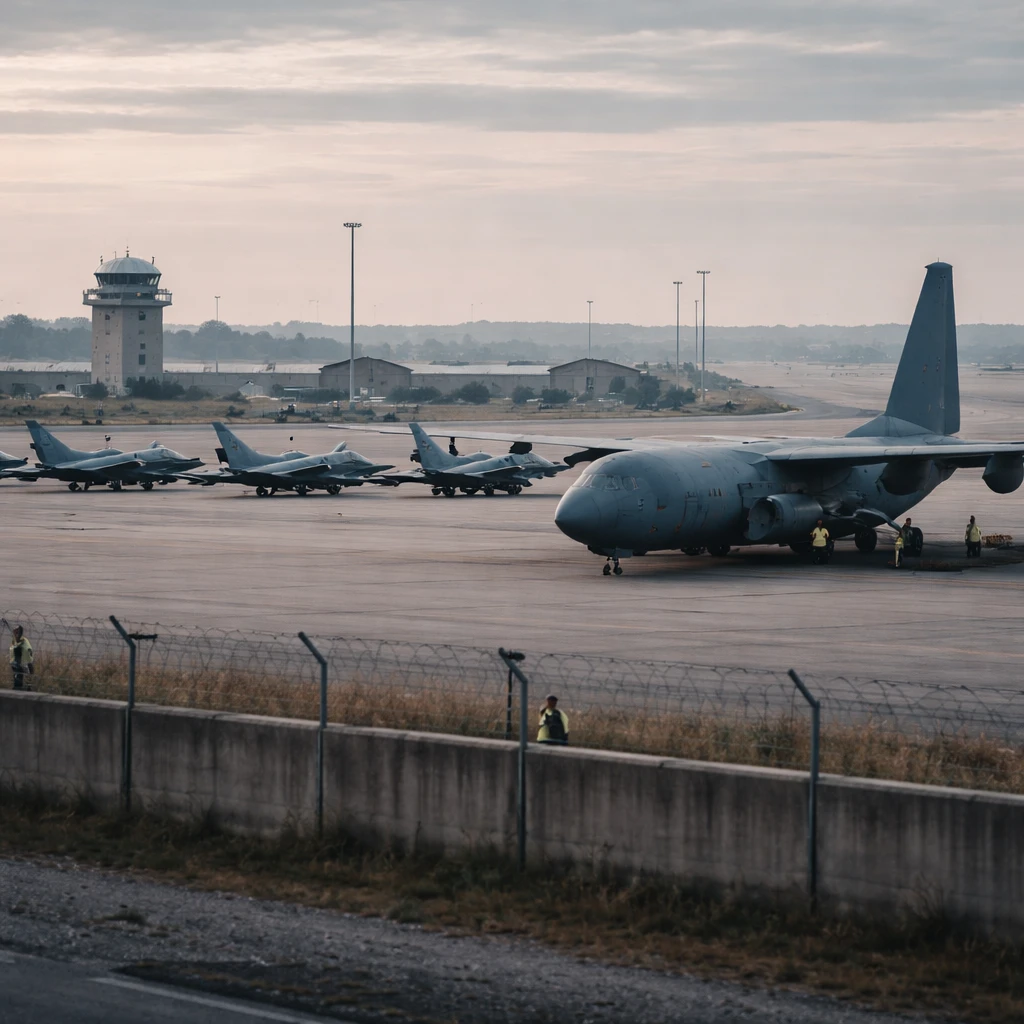
France, Italy and Spain have moved to deny or restrict support for U.S.-Israeli military activity connected to strikes on Iran, according to diplomatic sources and published reports. The actions underscore growing friction between Washington and several of its closest NATO allies over the handling of the conflict.
U.S. President Donald Trump targeted some European NATO members in public posts, singling them out as unhelpful amid the month-long war. Earlier in the month he had labelled long-standing NATO allies "cowards" for not backing efforts against Iran. On Tuesday he specifically criticised countries that did not assist with the U.S.-Israeli strikes on Iran, including France, posting on Truth Social: "The Country of France wouldn’t let planes headed to Israel, loaded up with military supplies, fly over French territory. France has been VERY UNHELPFUL with respect to the ’Butcher of Iran,’ who has been successfully eliminated! The U.S.A. will REMEMBER!!! President DJT."
France refused airspace for Israeli transport of U.S. weapons
Western diplomatic sources and two people familiar with the events told Reuters that France did not authorise Israeli aircraft to transit French airspace while carrying American weapons intended for use against Iran. One of the sources noted that Israeli planes were the ones requesting the overflight because they were transporting the weaponry.
The sources said the refusal took place over a recent weekend and represented the first occasion France had denied such a request since the conflict began on February 28. Neither the French presidency nor the foreign ministry was immediately available to comment on the matter.
Italy blocks landings at Sigonella air base
Italian officials, cited by sources on Tuesday, said Rome had refused permission last week for U.S. military aircraft to land at the Sigonella air base in eastern Sicily prior to deployments to the Middle East. The Corriere della Sera first reported that "some U.S. bombers" were scheduled to touch down at the base before continuing to the region.
The report did not state when the aircraft were due to land. It said permission was withheld because the United States had not requested clearance and because Italy's military leadership had not been consulted in accordance with the treaties that govern use of U.S. military facilities on Italian soil.
Spain keeps airspace closed and conditions use of bases
Spain confirmed on Monday that it had closed its airspace to U.S. planes involved in attacks on Iran. Spanish Prime Minister Pedro Sanchez has been among the most vocal critics of the U.S. and Israeli strikes.
Spanish Defence Minister Margarita Robles said on Tuesday that Spain would only permit use of its bases if operations were for the "collective defence" of NATO allies, clarifying that the denial of use of Spanish airspace for U.S. aircraft connected to the conflict with Iran had been in effect since the conflict began on February 28.
Spain's foreign minister, Jose Manuel Albares, told state broadcaster TVE that Madrid was not worried about any reprisals, saying: "We fear absolutely nothing. How could a country possibly fear anything for upholding international law, world peace and the United Nations Charter? What kind of world would we live in if those who should be afraid were those who respect the law?"
President renews public criticism and cites Britain
On Tuesday, Mr. Trump also criticised Britain in a Truth Social post while Buckingham Palace confirmed that King Charles and Queen Camilla will undertake a state visit to the United States in late April. In his post he wrote: "All of those countries that can’t get jet fuel because of the Strait of Hormuz, like the United Kingdom, which refused to get involved in the decapitation of Iran, I have a suggestion for you: Number 1, buy from the U.S., we have plenty, and Number 2, build up some delayed courage, go to the Strait, and just TAKE IT."
France, Italy, Spain, Britain and the United States are all members of NATO.
Contextual notes
This reporting describes a series of denials and restrictions by European governments regarding the use of their airspace and bases for operations tied to U.S. and Israeli strikes on Iran, the public criticism by the U.S. president, and the diplomatic sensitivity among NATO allies. Where details were cited from Italian media or diplomatic sources, the timing of specific aircraft movements was described as not specified.