
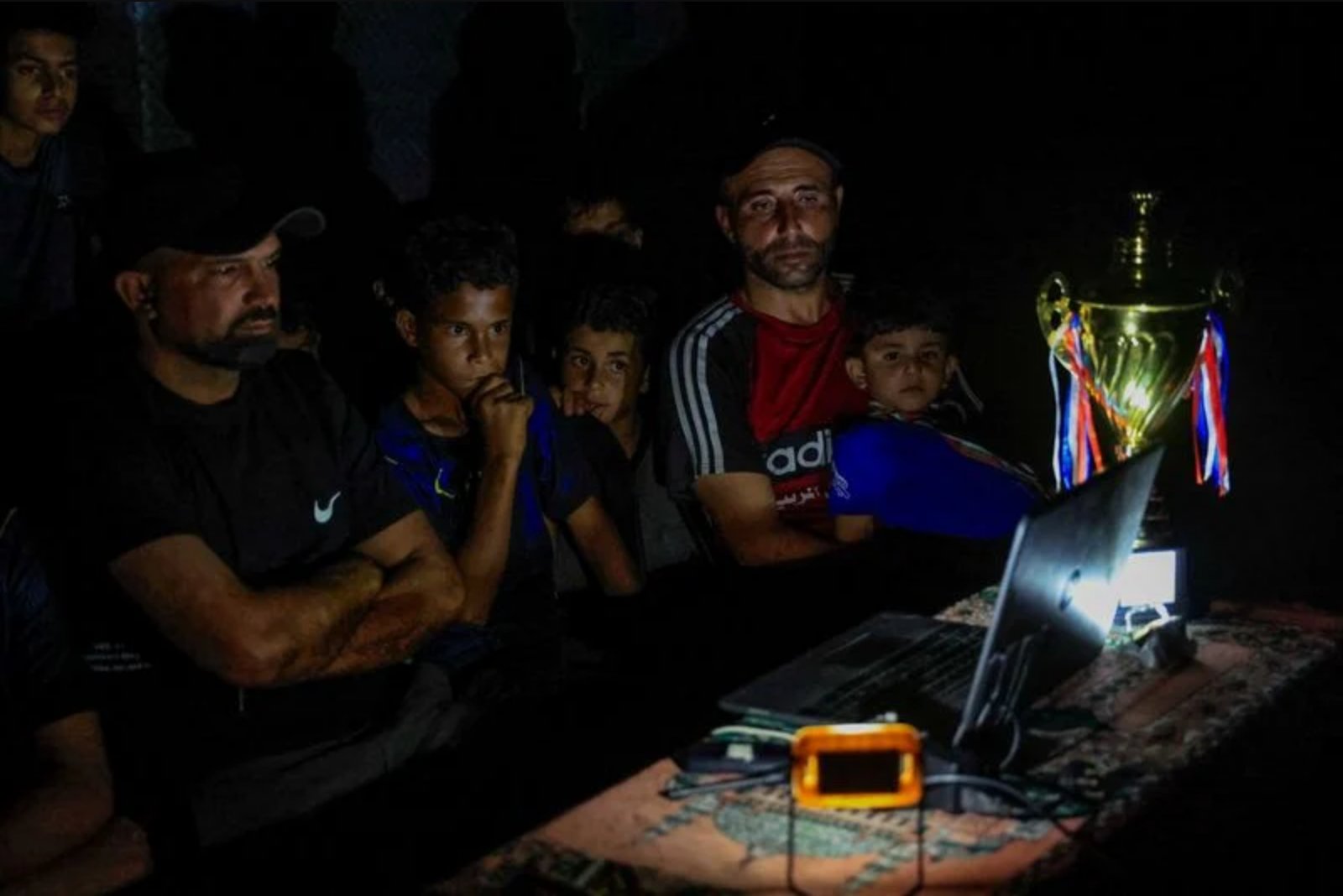
Fadi Al-Arawi, once a player in the Gaza Strip Premier League, has not set foot on a football pitch since professional sports in the territory were suspended at the outbreak of war more than two years ago. Like many of his fellow Gazans, he no longer has a permanent home from which to watch global sporting events on television.
As the Saturday match between Qatar and Switzerland was about to begin, Al-Arawi donned his old Gaza Sports Club uniform and the medals he won while competing internationally. He and a small group of friends gathered in a room of a school that has been repurposed as a shelter for people displaced by Israel's military campaign. In the dim light they hovered around a laptop that flickered as they hunted for an internet signal.
"See, this is the internet, it’s starting to cut out and the match hasn’t even started yet," Al-Arawi, 38, said in Khan Younis as Israeli drones hummed overhead.
He added, referring to the noise above, that "We might live or die, we might be bombed." The scene illustrates how basic services - from reliable power to steady internet connectivity - have been disrupted across the territory.
Much of Gaza has been left in ruins and its civil infrastructure severely damaged during a two-year military assault launched after the October 2023 Hamas attacks. An October 2025 truce did not end the security incidents: Israel has continued to carry out attacks in Gaza, and Hamas has so far rebuffed calls to lay down its arms in exchange for Israel withdrawing its troops.
Nearly the entire population of more than 2 million Palestinians remains crowded into a narrow coastal strip of territory controlled by Hamas, with many living in tents and in partially destroyed buildings.
In Gaza City, Royal Cafe owner Alaa Babli has made specific investments to keep late-night World Cup screenings possible. He installed two alternative power lines and added a backup battery so that matches can still be shown after fuel-powered generators shut down after midnight.
Among those who came to watch under flags of Egypt and Morocco hanging on a cafe wall was Hani Abu Rizq. He described the ever-present fear people feel when away from shelter: "The cafe could be targeted. Something next to me could be targeted and I could lose my life..." He added, "But despite everything we are suffering, we are continuing, and we will watch the matches."
The impact of the war on sport and sporting infrastructure has been substantial. The Palestinian Football Association reports that 1,000 athletes were among the 73,000 Palestinians killed in the conflict since 2023, a toll that includes children and amateurs across various sports, as well as referees and professional players. Around 285 sports facilities have been destroyed to varying degrees - some were bulldozed, others were hit by bombs.
Israeli forces have also converted stadiums into detention camps, according to the account, and some of those facilities gained notoriety for allegations of mistreatment of prisoners held there - allegations that Israel denies.
The enclave’s principal Al-Yarmouk Stadium in Gaza City, where Al-Arawi and other professionals once performed before thousands of spectators, is now occupied as a tent city housing displaced families.
"Since the Israeli war of extermination in 2023, Palestinian sports have been a primary target of the Israeli military machine," Mustafa Siam of the Palestinian Football Association said.
The scenes of fans crowding around unstable internet feeds and makeshift power backups point to broader strains on Gaza’s infrastructure - from energy and telecommunications to public venues. Yet they also underscore a persistent effort by residents to retain fragments of normalcy through shared experiences such as watching World Cup matches, even as security threats and infrastructure collapse complicate daily life.