
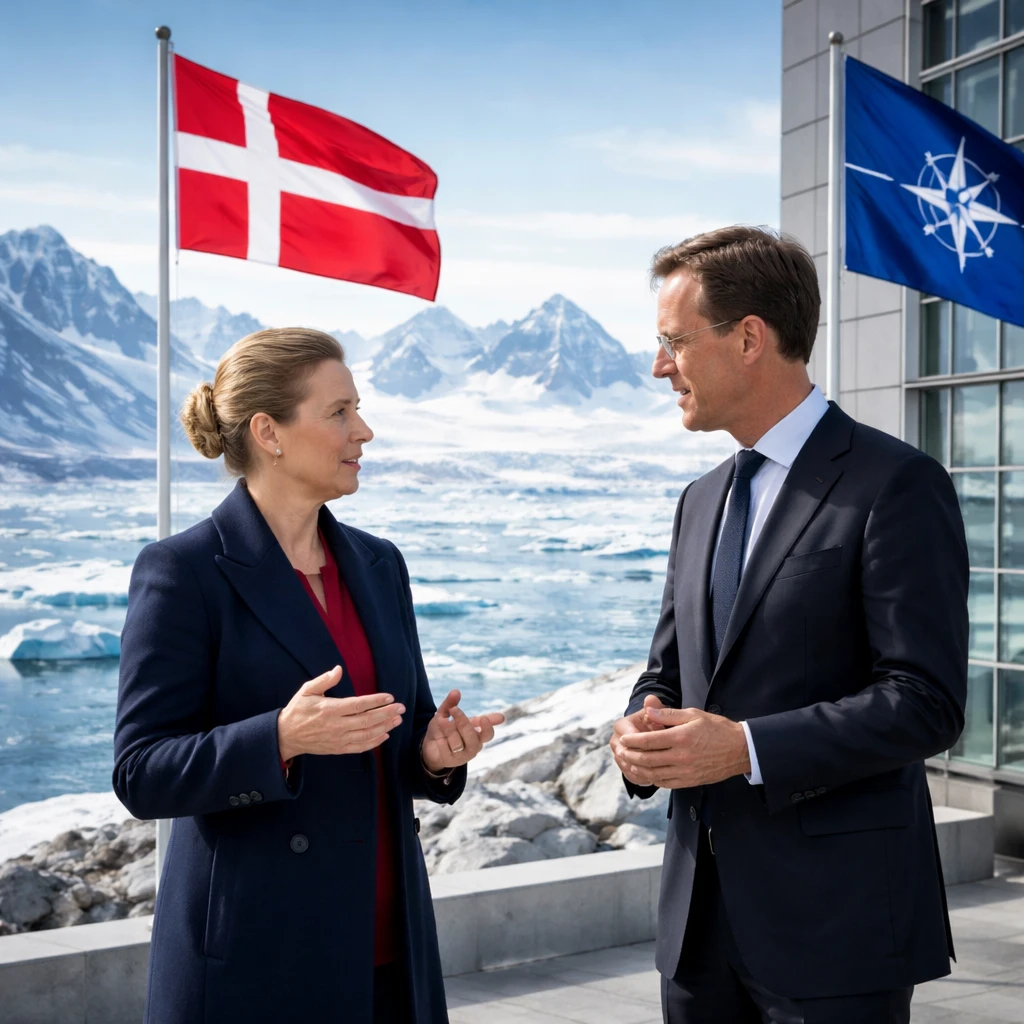
Denmark's Prime Minister, Mette Frederiksen, announced on Friday her consensus with NATO Secretary General Mark Rutte regarding the urgent need for the alliance to enhance security measures throughout the Arctic. This development follows recent upheavals caused by U.S. President Donald Trump's public threat to annex Greenland, an autonomous territory under Danish jurisdiction.
Both Denmark and Greenland's administrations have clearly communicated that Greenland's sovereignty is a settled matter and will not be reconsidered. Nevertheless, they remain open to negotiating various other issues concerning the island's future.
In a statement issued on Thursday, President Trump claimed to have obtained permanent and exclusive U.S. access to Greenland after discussions with Rutte. Echoing the sentiment, NATO's chief underscored the necessity for allied nations to escalate efforts against emerging threats from countries like Russia and China in the strategically significant Arctic region.
Frederiksen emphasized the collective responsibility of NATO members to fortify defense and security in the Arctic, stating, "Defense and security in the Arctic is a matter for the entire alliance." She shared these views on social media alongside a photograph with Rutte taken in Brussels.
Rutte affirmed his collaboration with Frederiksen is focused on advancing deterrence and defense strategies. In line with ongoing diplomatic initiatives, Frederiksen planned a visit to Nuuk, Greenland's capital, on the same day to engage directly with the island's prime minister.
Further diplomatic progress was noted by Denmark’s Foreign Minister, Lars Lokke Rasmussen, who reported that Danish and U.S. diplomats convened in Washington on Thursday to establish a framework for forthcoming talks. Rasmussen urged for discretion regarding the timing of future meetings to mitigate tension and promote a composed negotiation process.
A source familiar with the discussions confirmed that during the Davos summit, Rutte and Trump agreed on pursuing additional consultations among the U.S., Denmark, and Greenland. The focus centers on revising a 1951 agreement that regulates American military presence on Greenland, marking a critical step in updating Arctic defense protocols in light of contemporary geopolitical challenges.