
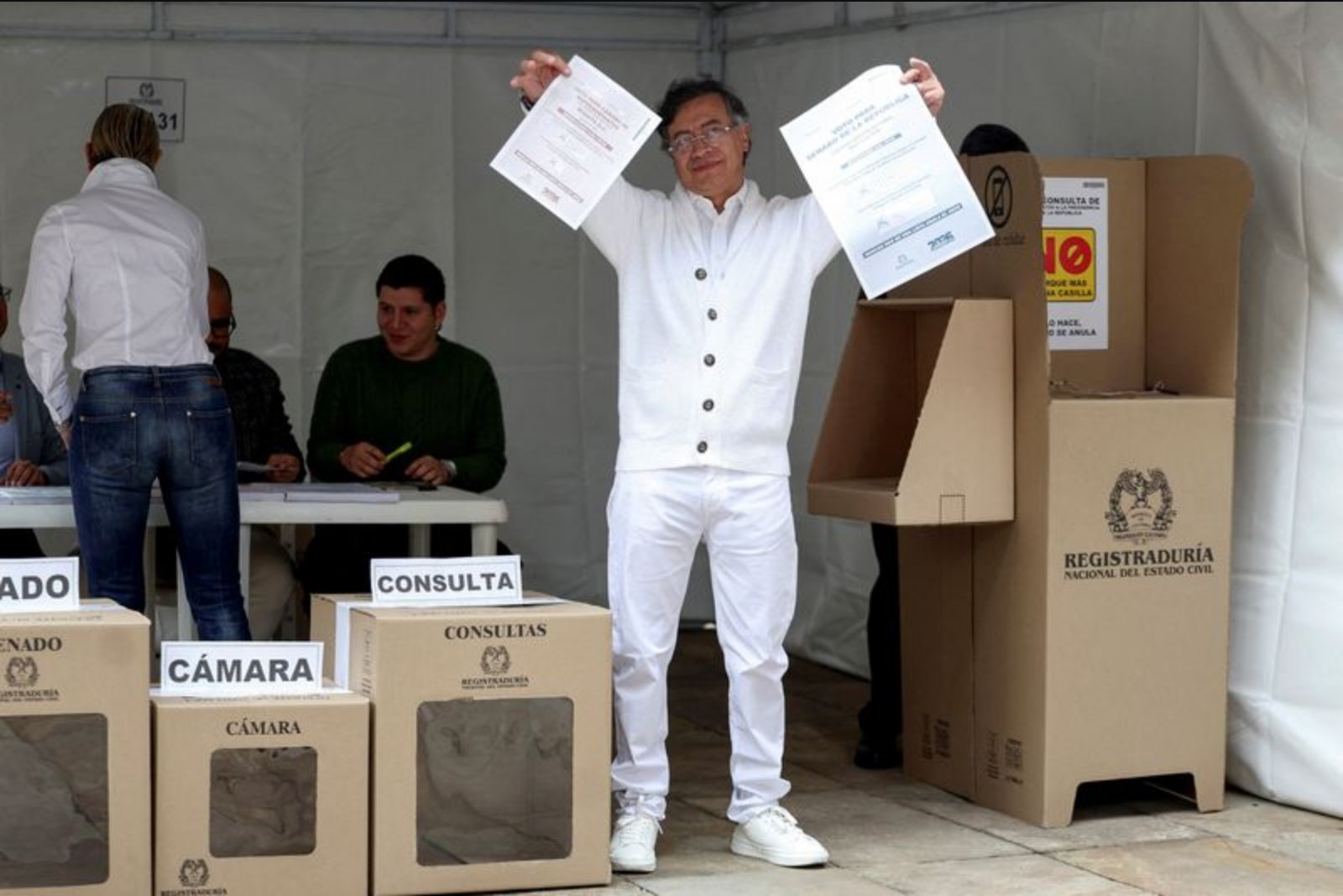
BOGOTA - Colombians cast ballots on Sunday to fill the national legislature and to hold consultations that will determine some presidential candidates for the May elections. The outcome of the vote will play a central role in shaping the legislative environment the next president inherits - affecting that leader's ability to secure backing for policy priorities and legislative proposals.
Voters confronted a long ballot: over 3,000 individuals sought election to Congress, competing for 102 seats in the Senate and 182 seats in the lower House. Analysts following the race expected representation to be split among roughly two dozen parties, a fragmentation that would likely require the incoming president to assemble a coalition to pass significant legislation and execute an agenda.
In parallel to the congressional contests, some 41.2 million eligible voters could also participate in intra-party consultations. These consultations were the mechanism by which a number of right-wing, centrist and left-wing parties would select which candidates would carry their banners into the presidential campaign. Notably, several prominent figures did not take part in Sunday’s consultations, including leftist Ivan Cepeda, right-winger Abelardo De La Espriella and centrist Sergio Fajardo.
At polling stations in Bogota, voters expressed mixed emotions about the day. Federico Rodriguez, a 32-year-old business administrator, emphasized the importance of turnout: "It is very important to come and exercise the right to vote. The most important thing is for Colombia to decide its future and for the results to be respected," he said after voting in the city's north.
"It is a source of pride that we can go out and exercise our right to vote and to democracy, but I also have uncertainty about the results, about knowing what Colombia's future will be in the next four years," said university student Isabella Suarez, 21.
Polling hours were set from 8 a.m. local time (1300 GMT) until 4 p.m. (2100 GMT).
The electoral process unfolded amid technical questions and stepped-up security. President Gustavo Petro, whose term ends in August, raised concerns about the software that would be used to tally the vote, suggesting the possibility of irregularities. In response, National Registrar Hernan Penagos offered assurances of transparency, saying the system's results could be verified by party observers.
Separately, authorities moved to protect the voting process from violent interference. Defense Minister Pedro Sanchez said some 246,000 members of the military forces and the national police had been placed on high alert to deter attacks by illegal armed groups that might try to disrupt the election or exert pressure on voters.
The ballots and consultations conducted on Sunday will influence the composition of the next Congress and the field of presidential contenders who advance toward the May elections. The immediate factual picture includes the number of seats contested, the scale of voter eligibility and the operational and security measures deployed during the vote.